
Miss Tanya, a 10-year-old female child, 1st order child born of a non-consanguineous marriage from Chandigarh, Punjab, presented to the pediatric emergency with rapid, deep, labored breathing (Kussmaul respiration) and drowsiness for 18 hours, recurrent non-bilious vomiting and diffuse abdominal pain for 2 days, preceded by progressive polyuria, polydipsia, nocturia, and unexplained weight loss of 3.5 kg over the past 4 weeks.
- Rapid, deep, sighing respirations (Kussmaul breathing) with sweet, fruity odor of acetone on breath
- Severe progressive dehydration with sunken eyes, dry tongue, and delayed capillary refill
- Diffuse abdominal pain and persistent vomiting mimicking an acute surgical abdomen
- Progressive lethargy, drowsiness, confusion, or coma
- Preceding classical osmotic triad: Polyuria (frequent large-volume urination), Polydipsia (insatiable thirst), and Polyphagia with rapid Weight Loss
HOPI
The history is dated back to 4 weeks ago when the parents noticed that the child had developed excessive thirst and was drinking 4 to 5 liters of water daily.
Always elicit the chronicity of the osmotic symptoms (polyuria, nocturia, secondary enuresis in a previously continent child, polydipsia, weight loss) and identify the precipitating cause (missed insulin, new-onset T1D, systemic infection). Inquire strictly about warning signs of impending Cerebral Edema (the leading cause of DKA mortality): severe headache, sudden decrease in heart rate (bradycardia), elevation of blood pressure, lethargy, or deteriorating sensorium during rehydration.
- Preceding Osmotic Triad (4 Weeks Duration):
- Polyuria & Nocturia: Child began voiding urine 10 to 12 times a day and woke up 3 to 4 times every night to pass large volumes of urine. Developed two episodes of secondary bedwetting (nocturnal enuresis) despite having achieved bladder control 6 years ago.
- Polydipsia: Insatiable thirst; kept water bottles beside her bed, drinking large quantities even during the night.
- Significant Weight Loss despite Polyphagia: Mother noticed child was constantly hungry and eating larger portions, yet lost 3.5 kg over 4 weeks; clothes became visibly loose and cheekbones prominent Points to total absolute insulin deficiency resulting in unchecked lipolysis and muscle proteolysis.
- Acute Deterioration (Past 48 Hours):
- Developed persistent non-bilious vomiting (6 to 7 episodes/day) and diffuse dull aching periumbilical abdominal pain Caused by ketosis, delayed gastric emptying (gastroparesis), and mesenteric hypoperfusion.
- Mother initially suspected food poisoning and administered oral antiemetics, but oral intake ceased completely.
- Labored Breathing & Altered Sensorium (Past 18 Hours):
- Developed rapid, deep, heavy sighing respirations without cough, stridor, or wheezing (Kussmaul breathing) Respiratory compensation for profound metabolic acidosis, blowing off CO2 to restore pH.
- Mother noted a strange, sweet, fruity smell on the child's breath (acetone breath).
- Child became progressively drowsy, confused, weak, and disoriented to time and place, prompting immediate emergency transfer.
- Negative History:
- No history of high fever, productive cough, or burning micturition Rules out obvious precipitating septic focus such as pneumonia or pyelonephritis.
- No history of severe headache, visual blurring, projectile vomiting, or seizures Argues against cerebral edema at presentation.
- No history of prior episodes of ketosis or known diagnosis of diabetes mellitus (First-time presentation of Type 1 Diabetes).
- No history of steroid administration, thiazide diuretics, or atypical antipsychotics.
Past History
- Full-term normal delivery; no history of serious past illnesses or hospital admissions.
- Normal developmental milestones and excellent academic record in school.
Family history
- Born of a non-consanguineous marriage.
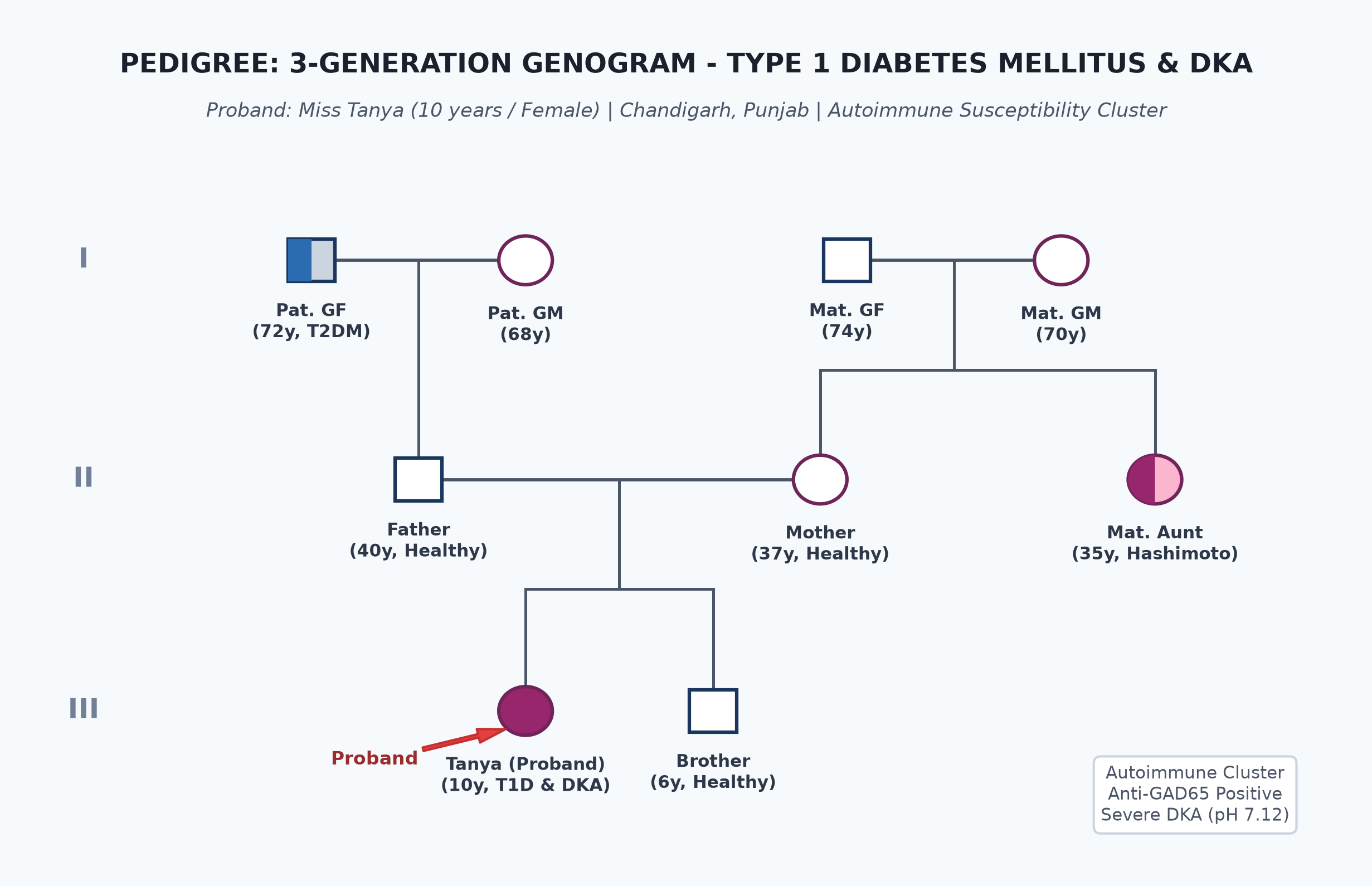
- Father 40 years, school teacher, healthy; Mother 37 years, homemaker, healthy.
- Younger brother (6 years old) is completely healthy.
- Maternal Aunt (35 years old): Has autoimmune Hashimoto's thyroiditis on Levothyroxine.
- Paternal Grandfather (72 years old): Has Type 2 Diabetes Mellitus on oral metformin.
- Demonstrates a family cluster of autoimmune endocrine susceptibility.
Immunization history
- Fully immunized up to age according to the National Immunization Schedule, including MMR and typhoid conjugate vaccine.
Dietary history
- Prior to acute illness, consumed a balanced family diet meeting age-appropriate caloric requirements.
24-Hour Recall Deficit Analysis
$$ \text{Ideal Body Weight (IBW for 10 years, 50th centile WHO)} = 32.0\text{ kg} $$| Nutrient | Expected Intake (ICMR-NIN 2024 for IBW 32 kg) | Observed Intake (Pre-morbid) | Deficit | Inference |
|---|---|---|---|---|
| Energy (kcal) | $32.0\text{ kg} \times 62\text{ kcal/kg} = 1984\text{ kcal}$ | 1920 kcal | 64 kcal | Adequate pre-morbid intake |
| Protein (g) | $32.0\text{ kg} \times 0.95\text{ g/kg} = 30.4\text{ g}$ | 34.0 g | Nil | Adequate protein |
Normal baseline nutrition confirms acute catastrophic catabolism driven by insulinopenia.
Socioeconomic and KAP
- Modified BG Prasad Socioeconomic Class II (Upper Middle Class).
- Urban residence with piped municipal water and sanitation.
- Parents unfamiliar with childhood diabetes; assumed polyuria was caused by high fluid intake due to warm weather.
Summary of History
Miss Tanya, a 10-year-old female child born of non-consanguineous parents, presented with a 4-week history of classic osmotic symptoms (polyuria, polydipsia, nocturia, significant weight loss), complicated over the past 48 hours by persistent vomiting, abdominal pain, Kussmaul respirations, fruity breath, and progressive obtundation.
I would like to think of Type 1 Diabetes Mellitus presenting for the first time as Severe Diabetic Ketoacidosis (DKA) with approximately $10\%$ dehydration and severe metabolic acidosis, without clinical signs of cerebral edema or septic shock.
General head to toe examination
- Behavioral State: Drowsy, obtunded, responds to verbal calls with slurred moans; Glasgow Coma Scale (GCS): 13/15 ($E_3 V_4 M_6$).
- Vitals:
- Pulse / Heart Rate: 134 beats/minute, rapid, low volume, regular, all peripheral pulses palpable.
- Respiratory Rate: 34 breaths/minute, deep, rapid, sighing, prominent thoracic excursion (Kussmaul breathing).
- Blood Pressure: $98/62\text{ mmHg}$ ($50^{\text{th}}$ centile; adequate perfusion maintained).
- Temperature: $36.4^\circ\text{C}$ (afebrile).
- Capillary Refill Time (CRT): 3.0 seconds; extremities are cool.
- Anthropometry:
| Parameter | Observed | Expected (50th WHO) | Z-score / Centile | Inference |
|---|---|---|---|---|
| Current Weight | 28.5 kg | 32.0 kg | $-1\text{ to } -2\text{ SD}$ | Weight loss of 3.5 kg (~11%) |
| Pre-morbid Weight | 32.0 kg | 32.0 kg | $50^{\text{th}}\text{ centile}$ | Normal baseline weight |
| Height | 138.0 cm | 138.5 cm | $50^{\text{th}}\text{ centile}$ | Normal Stature (No stunting) |
| Dehydration Assessment | Severe (~10% Deficit) | — | — | Sunken eyes, parched tongue |
- General Physical Findings:
- Odor of Breath: Pungent, sweet, fruity acetone odor easily detected at bedside.
- Signs of Dehydration:
- Sunken anterior fontanelle / sunken eyeballs with dry conjunctivae and absent tears.
- Oral mucosa, lips, and tongue are parched and dry.
- Skin turgor markedly decreased; abdominal skin pinch retracts slowly ($> 2$ seconds).
- Acanthosis Nigricans: Completely absent over neck and axillae (rules out insulin-resistant Type 2 Diabetes).
- Thyroid Gland: Not enlarged, no goiter, non-tender.
- Pallor, Icterus, Cyanosis, Clubbing, Lymphadenopathy, Edema: Absent.
Systemic Examination
Abdomen
- Inspection: Scaphoid, symmetrical, no visible peristalsis, umbilicus inverted.
- Palpation: Soft, generalized mild non-specific tenderness on deep palpation, maximal in periumbilical region; no localized right iliac fossa tenderness, no guarding, no rebound tenderness, no rigidity Points to ketotic pseudo-peritonitis; classic trap that mimics acute appendicitis.
- Organomegaly: Liver and spleen not palpable.
- Auscultation: Bowel sounds sluggish and hypoactive (1-2/minute, due to ileus).
Central Nervous System (CNS) & Neurological Safety Check
- Drowsy, rousable to name call; oriented to mother but disoriented to hospital ward.
- Cranial Nerves: Pupils equal bilaterally ($3\text{ mm}$), briskly reactive to light; extraocular movements full; facial symmetry maintained.
- Fundoscopy: Bilateral optic discs clear with sharp margins; no papilledema, no retinal hemorrhages (rules out cerebral edema).
- Meningeal Signs: Neck stiffness and Kernig sign negative.
- Motor System: Symmetrical muscle tone, power 4/5 throughout; deep tendon reflexes $2+$ symmetrical; plantars flexor bilaterally.
Respiratory & Cardiovascular Systems
- Respiratory: Deep Kussmaul respirations; chest clear with symmetrical vesicular breath sounds bilaterally; no crackles, no wheezing.
- Cardiovascular: Tachycardia (134 bpm); normal $S_1, S_2$; no heart murmurs, gallops, or friction rubs.
Summary
Miss Tanya, a 10-year-old female child born of non-consanguineous parentage, presents with a 4-week history of polyuria, polydipsia, nocturia, and significant weight loss, acutely decompensating over 48 hours with vomiting, abdominal pain, severe dehydration (~10%), Kussmaul respirations, acetone breath odor, and drowsiness (GCS 13/15). Physical examination confirms severe dehydration, tachycardia, absence of localized peritonitis, and clear optic discs.
Final Clinical Diagnosis: New-Onset Type 1 Diabetes Mellitus presenting in Severe Diabetic Ketoacidosis (DKA) with severe dehydration (~10%), high anion gap metabolic acidosis, without cerebral edema or septic shock.
Differential Diagnosis
| Disorder | Points IN FAVOR | Points AGAINST |
|---|---|---|
| Type 1 Diabetes Mellitus with Severe DKA | Classical osmotic symptoms, weight loss, Kussmaul breathing, acetone odor, hyperglycemia, ketosis, high anion gap | Primary Clinical Diagnosis |
| Type 2 Diabetes with Hyperosmolar Hyperglycemic State (HHS) | Polyuria, severe dehydration, hyperglycemia | Prominent severe ketoacidosis (Kussmaul breathing, ketones), young lean child, absence of obesity or acanthosis nigricans |
| Acute Appendicitis / Peritonitis | Vomiting, diffuse abdominal pain, dehydration | Abdomen is soft without guarding or rebound tenderness; does not explain Kussmaul breathing, sweet breath, or 4-week polyuria |
| Severe Sepsis / Septic Shock with Lactic Acidosis | Tachypnea, tachycardia, delayed CRT, altered sensorium | Child is afebrile; breath smells of acetone; preceding 4-week history of polyuria and polydipsia rules out primary sepsis |
| Salicylate / Aspirin Poisoning | Hyperpnea, vomiting, metabolic acidosis | No history of accidental ingestion; doesn't account for 4-week osmotic triad or weight loss |
Investigation Protocol & Diagnostic Workup
flowchart TD
    A["Child with Dehydration, Kussmaul Breathing & Altered Sensorium"] --> B["Stat Bedside Capillary Blood Glucose & Urine Dipstick"]
    B --> C{"Glucose > 200 mg/dL & Urine Ketones ≥ 2+?"}
    C -->|Yes| D["Stat Venous Blood Gas, Electrolytes, BUN, Creatinine"]
    D --> E{"ISPAD DKA Staging: pH & HCO3-?"}
    E -->|pH < 7.10 OR HCO3- < 5 mEq/L| F["Severe DKA: High-Dependency / PICU Care"]
    E -->|pH 7.10-7.19 OR HCO3- 5-9| G["Moderate DKA"]
    E -->|pH 7.20-7.29 OR HCO3- 10-14| H["Mild DKA"]
    F --> I["Hour 0-1: 0.9% Normal Saline 10-20 mL/kg Resuscitation Bolus"]
    I --> J["Hour 1 onwards: Regular Insulin Infusion 0.05-0.1 U/kg/hour (NO BOLUS)"]
    J --> K["Two-Bag Fluid Replacement Protocol over 48 Hours with Potassium Addition"]
1. Emergency Blood & Gas Panel
- Capillary Blood Glucose (Bedside): $486\text{ mg/dL}$ (Diagnostic $>200\text{ mg/dL}$).
- Venous Blood Gas (VBG):
- pH: $7.12$ (Severe DKA defined by ISPAD as $\text{pH} < 7.10\text{ to } 7.15$).
- Serum Bicarbonate ($HCO_3^-$): $8.4\text{ mEq/L}$ (Severe DKA $< 5-10\text{ mEq/L}$).
- Venous $p\text{CO}_2$: $22\text{ mmHg}$ (Respiratory compensation).
- Serum & Urine Ketones:
- Urine Ketones: $4+$ (strongly positive).
- Serum Beta-Hydroxybutyrate (Point-of-Care): $5.8\text{ mmol/L}$ (Diagnostic $>3.0\text{ mmol/L}$).
- Serum Electrolytes:
- Serum Sodium ($Na^+$): $132\text{ mEq/L}$.
- Corrected Sodium Calculation (ISPAD 2022 Formula): $$ \text{Corrected } Na^+ = \text{Measured } Na^+ + 1.6 \times \left[\frac{\text{Blood Glucose (mg/dL)} - 100}{100}\right] $$ $$ \text{Corrected } Na^+ = 132 + 1.6 \times \left[\frac{486 - 100}{100}\right] = 132 + 1.6 \times 3.86 = 132 + 6.18 = \mathbf{138.2\text{ mEq/L}} $$
- Serum Potassium ($K^+$): $4.8\text{ mEq/L}$ (Normal in serum due to transcellular shift driven by acidosis and insulinopenia, despite massive whole-body potassium depletion).
- Serum Chloride ($Cl^-$): $96\text{ mEq/L}$.
- Serum Anion Gap: $$ \text{Anion Gap} = Na^+ - (Cl^- + HCO_3^-) = 132 - (96 + 8.4) = \mathbf{27.6\text{ mEq/L}} \quad (\text{High Anion Gap } > 12) $$
- Effective Serum Osmolality: $$ \text{Effective Osmolality} = 2 \times Na^+ + \frac{\text{Glucose (mg/dL)}}{18} = 2 \times 132 + \frac{486}{18} = 264 + 27 = \mathbf{291\text{ mOsm/kg}} $$
2. Baseline Renal Function & Glycated Hemoglobin
- Blood Urea Nitrogen (BUN): $24\text{ mg/dL}$ (mild pre-renal azotemia).
- Serum Creatinine: $0.8\text{ mg/dL}$.
- HbA1c: $11.4\%$ (Diagnostic $>6.5\%$; proves chronic hyperglycemia over preceding 8-12 weeks).
3. Autoantibody Profile (Etiological Workup)
- Anti-Glutamic Acid Decarboxylase (Anti-GAD65) Antibodies: Strongly positive ($>2000\text{ IU/mL}$).
- Anti-Islet Antigen 2 (Anti-IA2) & Zinc Transporter 8 (ZnT8) Antibodies: Positive.
- Confirms Autoimmune Type 1A Diabetes Mellitus.
Therapeutic Management Protocol (ISPAD 2022 Guidelines)
1. Emergency Fluid Resuscitation & Deficit Replacement
- Initial Resuscitation (Hour 0 to 1):
- Administer 0.9% Normal Saline (0.9% NaCl) at $10\text{ mL/kg}$ over 60 minutes ($285\text{ mL}$ over 1 hour).
- Golden Rule: Never bolus insulin during the initial fluid resuscitation phase!
- Maintenance + Deficit Replacement (Hours 1 to 48):
- Assume a $10\%$ fluid deficit ($100\text{ mL/kg} = 2850\text{ mL}$).
- Subtract initial $10\text{ mL/kg}$ bolus ($2850 - 285 = 2565\text{ mL}$ remaining deficit).
- Calculate 48-hour maintenance using Holliday-Segar method: $$ \text{Daily Maintenance for 28.5 kg} = 1000 + 500 + (8.5 \times 20) = 1670\text{ mL/day} \times 2\text{ days} = 3340\text{ mL} $$
- Total 48-hour fluids = $\text{Remaining Deficit } (2565\text{ mL}) + \text{48-hr Maintenance } (3340\text{ mL}) = 5905\text{ mL}$ over 48 hours $\approx \mathbf{123\text{ mL/hour}}$.
2. Insulin Therapy Protocol
- Drug & Route: Regular soluble crystalline insulin via continuous IV infusion pump.
- Dose: $0.05\text{ to } 0.1\text{ U/kg/hour}$ ($1.4\text{ to } 2.8\text{ units/hour}$).
- Timing: Start insulin infusion only after the first hour of fluid expansion is complete.
- NEVER administer an IV insulin bolus! (IV boluses precipitously drop osmolarity and dramatically increase the risk of cerebral edema).
3. Potassium Replacement
- Total body potassium is severely depleted due to osmotic diuresis.
- Add potassium ($40\text{ mEq/L}$ of fluid as $20\text{ mEq}$ KCl and $20\text{ mEq}$ potassium phosphate) to IV fluids as soon as urine output is confirmed and serum $K^+ < 5.5\text{ mEq/L}$.
4. Glucose Addition (The "Two-Bag System")
- As blood glucose declines to $250\text{--}300\text{ mg/dL}$, switch IV fluids to 5% Dextrose with 0.45% to 0.9% NaCl to prevent hypoglycemia while continuing insulin infusion to clear ketoacidosis.
- Titrate glucose infusion rate to keep blood glucose between $150\text{ and } 200\text{ mg/dL}$ until acidosis is fully resolved ($\text{pH} > 7.30, HCO_3^- > 15\text{ mEq/L}$, and beta-hydroxybutyrate $< 1.0\text{ mmol/L}$).
5. Cerebral Edema Protocol (Neurological Emergency)
- Monitor GCS, pupillary reflexes, and vitals hourly.
- If headache, bradycardia, hypertension, or falling GCS occurs:
- Immediately elevate head of bed $30^\circ$.
- Administer 3% Hypertonic Saline ($2.7\% - 3.0\% \text{ NaCl}$): $3\text{ to } 5\text{ mL/kg}$ over 10-15 minutes, OR 20% Mannitol: $0.5\text{ to } 1.0\text{ g/kg}$ over 20 minutes.
- Reduce IV fluid rate by one-third. Do not wait for CT head to initiate hyperosmolar therapy!