
Miss Riya, a 13-year-old female adolescent, 1st order child born of a non-consanguineous marriage to healthy parents from Lucknow, Uttar Pradesh, presented to the Pediatric Endocrine & Clinical Genetics Clinic with chief complaints of progressive failure of linear growth with severe short stature noticed since 5 years of age (falling progressively below the 3rd percentile on the WHO and IAP growth charts), absence of secondary sexual characteristics (absence of thelarche and pubarche), and primary amenorrhea, whose physical examination revealed classic Turner dysmorphic stigmata including webbing of the neck (pterygium colli), low posterior hairline, high-arched palate, broad shield-shaped chest with widely spaced hypoplastic nipples, bilateral cubitus valgus, multiple pigmented melanocytic nevi, and radio-femoral delay with upper limb hypertension, confirmed on high-resolution peripheral blood lymphocyte karyotyping to have Classical Monosomy X (45,X Turner Syndrome), with screening investigations revealing a Bicuspid Aortic Valve with Mild Coarctation of the Aorta, Horseshoe Kidney, and Hypergonadotropic Hypogonadism, currently planned for Recombinant Human Growth Hormone (rhGH) and Pubertal Induction with Transdermal $17\beta$-Estradiol.
In a short stature or delayed puberty case, the examiner tests clinical syndromic recognition and endocrine protocols:
- Dysmorphology Recognition: Systematically demonstrate the stigmata from head to toe: facies (micrognathia, epicanthal folds, downward slanting palpebral fissures), mouth (high arched palate), neck (pterygium colli, low hairline), chest (shield chest, wide internipple distance), limbs (cubitus valgus: carry angle $>15^\circ$, short 4th metacarpal: Archibald sign, nail dysplasia), and skin (melanocytic nevi).
- Cytogenetic Heterogeneity: 45,X monosomy (~50%), 45,X/46,XX mosaicism (~20%), 46,X,i(Xq) isochromosome (~15%), and 45,X/46,XY mosaicism (~10%). CRITICAL VIVA TRAP: Any presence of Y chromosome material (SRY positivity) demands prophylactic bilateral gonadectomy due to a $15-30\%$ risk of malignant gonadoblastoma!
- The Cardiovascular Mandate: Turner patients carry a high risk of catastrophic aortic dissection. Measure blood pressure in both arms and lower limbs (rule out Coarctation of Aorta). Emphasize the Aortic Size Index (ASI) on echocardiography/cardiac MRI.
- Pubertal Induction Protocol: Explain why estrogen is initiated at low doses at 11-12 years and why progestins must be strictly withheld for at least 2 years (to prevent tubular breast deformity and premature epiphyseal closure).
Chief Complaints
- Marked short stature compared to classmates and age-matched peers noticed since 5-6 years of age.
- Absence of breast development and lack of pubic or axillary hair at 13 years of age (Delayed Puberty).
- Failure to attain menarche (Primary Amenorrhea).
HOPI
Miss Riya was born at full term with an uneventful perinatal period, although the mother recalls the baby had noticeable puffiness over the dorsum of both hands and feet during the neonatal period (congenital lymphedema, which resolved by 6 months of age).
- Growth Deceleration Pattern:
- The patient had normal milestones and height progression during infancy.
- From 5 years of age, parents noticed her height was lagging significantly behind peers. Over the past 3 years, her linear growth has virtually plateaued, growing at a sluggish velocity of only $2.5\text{ cm/year}$ (normal pubertal growth velocity is $6-9\text{ cm/year}$).
- Current height is $124.0\text{ cm}$ ($Z$-score $-4.2\text{ SD}$ below the mean on IAP 2015 growth charts; far below her Mid-Parental Target Height of $156.5\text{ cm} \pm 5\text{ cm}$).
- Absence of Secondary Sexual Characteristics:
- At 13 years of age, she has had zero breast development (Tanner Stage B1 - prepubertal).
- No growth of pubic hair (Tanner Stage P1) or axillary hair.
- Has not attained menarche.
- Cardiovascular & Systemic Review:
- Mother noted occasional fatigue and leg cramps during physical exercise in school.
- No history of exertional chest pain, syncope, palpitation, or shortness of breath.
- History of recurrent bilateral acute otitis media (4 episodes between ages 3 and 7 years), managed conservatively.
- School performance is good in languages, reading, and writing, but she experiences difficulties in mathematics, spatial concepts, and non-verbal problem solving (characteristic Turner cognitive profile).
- Negative Inquiries:
- No history of chronic diarrhea, foul-smelling greasy stools, or abdominal distension (excludes Celiac disease).
- No history of cold intolerance, constipation, dry coarse skin, or lethargy (excludes severe hypothyroidism, although screened for Hashimoto's).
- No history of chronic cough, jaundice, vomiting, or polyuria/polydipsia.
Past History
- History of recurrent ear infections in childhood. No history of fractures, chronic corticosteroid use, or prior surgery.
Antenatal, Natal, and Developmental History
- Antenatal: Primigravida mother, uneventful pregnancy, no gestational diabetes or hypertension; routine scans reported normal.
- Natal: Full-term normal vaginal delivery; birth weight $2600\text{ grams}$ (mild LBW); transient puffy hands and feet noticed at birth.
- Developmental: Normal motor and language milestones: walked without support at 13 months, spoke sentences by 2.5 years. Currently studying in 8th grade.
Family History
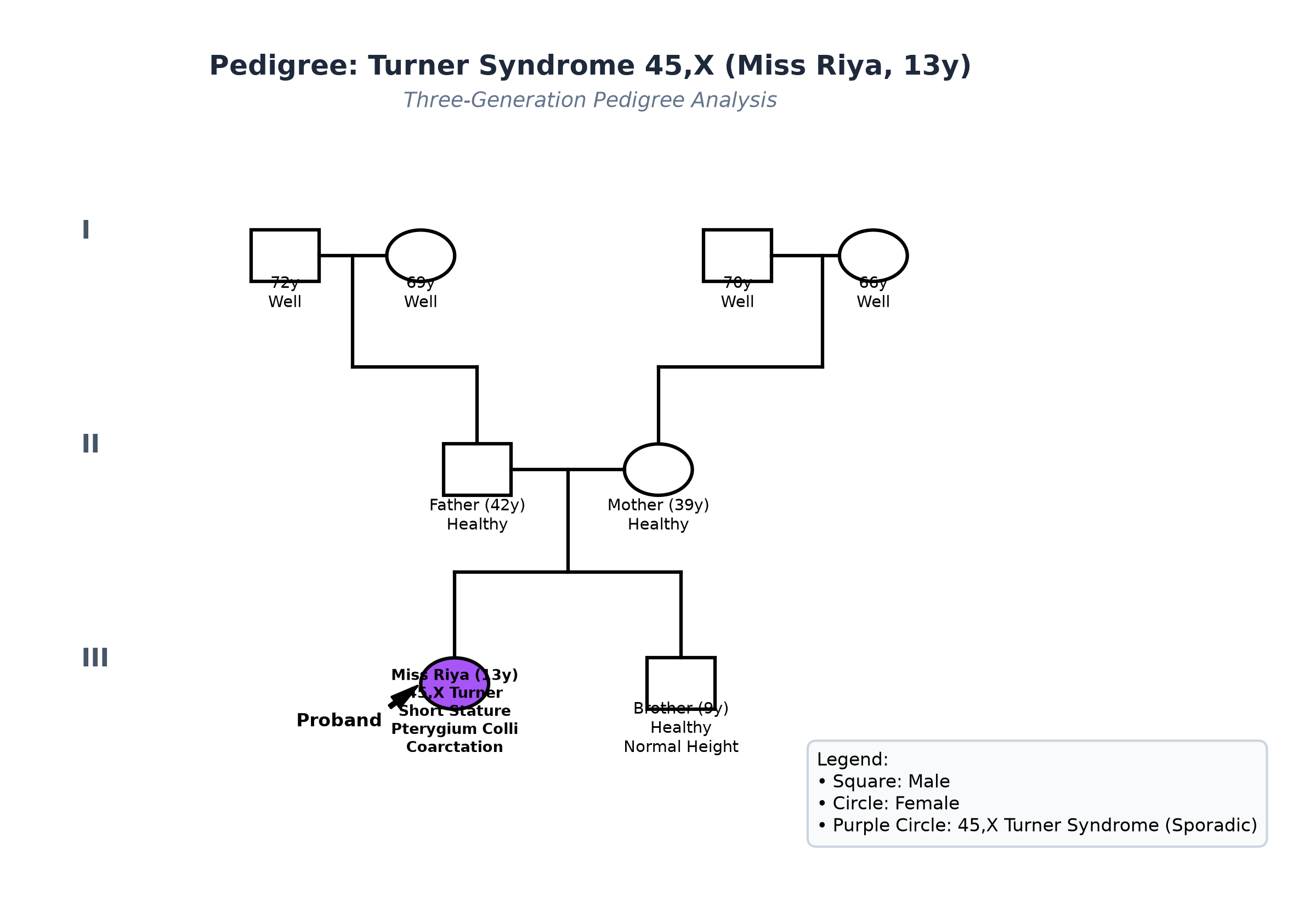
- Non-consanguineous marriage. Father's height is $170\text{ cm}$; Mother's height is $156\text{ cm}$.
- Mid-Parental Target Height (MPTH) Calculation: $$\text{Target Height} = \frac{\text{Father's Height} + \text{Mother's Height} - 13\text{ cm}}{2} = \frac{170 + 156 - 13}{2} = 156.5\text{ cm} \quad (\text{Range: } 151.5 - 161.5\text{ cm})$$
- Younger brother (9 years old) is growing along the 50th percentile with normal height ($132\text{ cm}$).
Immunization History
- Fully immunized up to age according to the National Immunization Schedule, including MMR and Tdap boosters.
Detailed Dietary History & 24-Hour Recall
The child consumes a typical vegetarian home diet:
| Food Item | Quantity | Calories (kcal) | Protein (g) |
|---|---|---|---|
| Cow's Milk (toned) | 350 mL | 210 | 10.5 |
| Roti (wheat flour + ghee) | 3 medium | 270 | 7.5 |
| Boiled Rice | 1.5 cups | 240 | 4.8 |
| Dal (Toor / Moong) | 1.5 katoris | 150 | 9.0 |
| Mixed Green Vegetables | 1 katori | 60 | 2.0 |
| Paneer Sabzi | 50 g | 140 | 8.0 |
| Apple / Seasonal Fruit | 1 medium | 70 | 0.5 |
| Snacks / Biscuits | 2 pieces | 80 | 1.2 |
| Total Observed Daily Intake | — | 1220 kcal | 43.5 g |
24-Hour Recall Deficit Analysis (ICMR-NIN 2024 Standards)
$$ \text{Ideal Body Weight (IBW for 13 years, 50th centile WHO)} = 45.0\text{ kg} $$| Nutrient | Expected Intake (ICMR-NIN 2024 for IBW 45 kg) | Observed Intake | Deficit | Percentage Deficit |
|---|---|---|---|---|
| Energy (kcal) | $45.0\text{ kg} \times 45\text{ kcal/kg} = 2025\text{ kcal}$ | 1220 kcal | 805 kcal | 39.7% Deficit |
| Protein (g) | $45.0\text{ kg} \times 0.95\text{ g/kg} = 42.8\text{ g}$ | 43.5 g | Nil (Adequate) | 0% Deficit |
The expected calories and proteins should be calculated from the ideal body weight, not from current weight.
Socioeconomic & KAP
- Modified BG Prasad Socioeconomic Class II (Upper Middle). Parents are educated and actively seeking endocrine guidance for linear growth and pubertal induction.
Summary of History
Miss Riya, a 13-year-old female adolescent, presents with severe progressive proportionate/mildly disproportionate short stature ($124\text{ cm}$, $Z$-score $-4.2\text{ SD}$, far below mid-parental target height), absent pubertal development (Tanner Stage B1P1), primary amenorrhea, neonatal history of peripheral lymphedema, recurrent otitis media, and exercise leg fatigue, without systemic GI or renal symptoms.
I would like to consider a provisional clinical diagnosis of: Turner Syndrome (Phenotype 45,X) with Severe Pathological Short Stature, Hypergonadotropic Hypogonadism (Delayed Puberty), and suspected Coarctation of the Aorta / Bicuspid Aortic Valve.
General Physical Examination
- General Appearance: Short, pleasant, alert adolescent girl with normal nutritional state; conscious, cooperative; mild pallor; no icterus, cyanosis, clubbing, or active peripheral edema. Multiple dark brown melanocytic nevi ($1-3\text{ mm}$) scattered across the neck, face, and forearms.
- Vitals & Four-Limb Blood Pressure:
- Right Arm BP: $134/86\text{ mmHg}$ ($>95^{\text{th}}\text{ percentile} + 12\text{ mmHg}$ $\to$ Stage 1 Hypertension).
- Left Arm BP: $132/84\text{ mmHg}$.
- Right Lower Limb (Popliteal) BP: $108/68\text{ mmHg}$ (Significant Upper-to-Lower Limb Systolic Gradient: $26\text{ mmHg}$).
- Peripheral Pulses: Radial and brachial pulses bounding; bilateral femoral pulses are distinctly weak, delayed, and synchronous with radial pulse (Radio-Femoral Delay).
- Heart Rate: 78 beats/minute, regular.
- Respiratory Rate: 18 breaths/minute.
- Temperature: $37.0^\circ\text{C}$ (Afebrile).
Comprehensive Anthropometry (Plotted on IAP / WHO Growth Charts)
| Parameter | Observed | Expected (50th WHO for 13y) | Z-score / Centile | Clinical Inference |
|---|---|---|---|---|
| Height | 124.0 cm | 156.5 cm | $-4.2\text{ SD}$ ($<3^{\text{rd}}$ centile) | Severe Pathological Short Stature |
| Weight | 28.5 kg | 45.0 kg | $-3.1\text{ SD}$ | Low weight for age |
| Upper Segment (US) | 64.0 cm | — | — | Measured crown to pubic symphysis |
| Lower Segment (LS) | 60.0 cm | — | — | Measured pubic symphysis to floor |
| US : LS Ratio | $1.07 : 1$ | $0.95-1.00 : 1$ for 13 years | Mildly elevated | Mild rhizomelic / short-leg disproportion |
| Arm Span | 121.5 cm | Equals height ($124\text{ cm}$) | Span is $2.5\text{ cm} <$ Height | Typical of SHOX haploinsufficiency |
| BMI | $18.5\text{ kg/m}^2$ | $18.8\text{ kg/m}^2$ | Normal centile (50th) | Well-nourished body habitus |
Characteristic Dysmorphic Stigmata Assessment
- Craniofacial Examination:
- Normal head circumference ($52.5\text{ cm}$).
- Downward slanting palpebral fissures, mild bilateral epicanthal folds, ptosis absent.
- High, narrow, arched hard palate; dental crowding with micrognathia (small recessed chin).
- Ears: Low-set, posteriorly rotated pinnae; external canals patent.
- Neck & Chest:
- Pterygium Colli (Webbing of Neck): Bilateral prominent cervical skin folds extending from mastoid processes to the acromion.
- Low Posterior Hairline: M-shaped trident hair insertion extending down to the upper cervical spine.
- Shield Chest (Pectus Carinatum / Flat Broad Chest): Broad thoracic cage with widely spaced, hypoplastic, inverted nipples (increased internipple distance index $>28\%$).
- Extremities & Musculoskeletal Stigmata:
- Cubitus Valgus: Marked carrying angle of the forearms measuring $22^\circ$ on Right and $20^\circ$ on Left (normal female $<15^\circ$).
- Short 4th Metacarpal (Archibald's Sign): A straight line drawn tangential to the heads of the 3rd and 5th metacarpals intersects the head of the 4th metacarpal bilaterally.
- Hyperconvex, narrow, deep-set finger nails.
- No active edema over feet currently.
- Sexual Maturity Rating (Tanner Staging):
- Breast (Thelarche): Stage B1 (prepubertal; elevation of papilla only, no breast bud).
- Pubic Hair (Pubarche): Stage P1 (prepubertal; no pigmented coarse hair).
- Axillary Hair: Absent.
Detailed Systemic Examination
Cardiovascular System Examination
- Inspection: Precordium quiet; no visible pulsations; no suprasternal notch pulsation.
- Palpation: Apex beat localized in 5th left intercostal space within the midclavicular line, normal character. No parasternal heave; no thrill palpable in aortic area or suprasternal notch.
- Auscultation:
- First and second heart sounds heard clearly; S2 physiologically split.
- Aortic Area & Left Sternal Border: An early systolic ejection click followed by a Grade 2/6 mid-systolic ejection murmur heard at the 2nd right and 3rd left intercostal spaces, radiating to the right clavicle and carotid artery (Bicuspid Aortic Valve flow murmur).
- Interscapular Area (Back): A soft, blowing Grade 2/6 late-systolic murmur heard best over the interscapular region of the thoracic spine (Coarctation of the Aorta).
- Femoral pulses are diminished and delayed relative to radial pulses.
Other Systems
- Abdomen: Soft, non-tender; liver and spleen not palpable. No palpable abdominal masses; no renal bruits.
- Respiratory: Clear breath sounds bilaterally; chest expansion symmetrical.
- Central Nervous System: Cranial nerves intact; motor power 5/5 in all four limbs; deep tendon reflexes $2+$ symmetrical; plantars flexor. Normal gait and cerebellar functions.
Summary
Miss Riya, a 13-year-old female adolescent, presents with severe short stature ($124\text{ cm}$, $-4.2\text{ SD}$), absent secondary sexual characteristics (Tanner B1P1, primary amenorrhea), characteristic Turner stigmata (webbed neck, shield chest, cubitus valgus, high arched palate, low posterior hairline), radio-femoral delay with upper limb hypertension, and ejection murmur.
Final Clinical Diagnosis: Turner Syndrome (Phenotype 45,X Monosomy), complicated by Severe Short Stature (SHOX Gene Haploinsufficiency), Primary Ovarian Insufficiency (Hypergonadotropic Hypogonadism), Coarctation of the Aorta with Bicuspid Aortic Valve, and Stage 1 Systemic Hypertension.
Differential Diagnosis of Short Stature in Adolescents
| Disorder | Points IN FAVOR | Points AGAINST |
|---|---|---|
| Turner Syndrome (45,X) | Short stature, webbed neck, shield chest, cubitus valgus, primary amenorrhea, high FSH/LH, coarctation | Primary Diagnosis |
| Noonan Syndrome (PTPN11) | Webbed neck, short stature, low hairline, chest deformity | Normal 46,XX karyotype; usually has right-sided cardiac lesions (pulmonary valve stenosis), pectus excavatum, ptosis, and normal ovarian function with spontaneous menarche |
| Constitutional Delay of Growth & Puberty | Short stature, delayed puberty, delayed bone age | Normal arm span:height ratio; absence of dysmorphic stigmata (no webbed neck, cubitus valgus, or coarctation); gonadotropins are low (hypogonadotropic) |
| Growth Hormone Deficiency (Isolated) | Severe short stature, decreased growth velocity | Truncal adiposity, doll-like facies, normal karyotype, absence of Turner phenotypic stigmata |
| Celiac Disease (Silent / Atypical) | Growth failure, delayed puberty, anemia | No gastrointestinal complaints; anti-tTG IgA is negative; does not cause webbed neck or bicuspid aortic valve |
Investigation Protocol & Laboratory Workup
flowchart TD
    A["Adolescent Female with Severe Short Stature & Delayed Puberty"] --> B["Gold Standard: High-Resolution G-Banded Karyotyping (minimum 30-50 cells)"]
    B --> C["Karyotype Result: Confirm 45,X Monosomy vs Mosaicism / Y Material"]
    C --> D["Hormone Panel: Serum FSH, LH, Estradiol, TSH, Free T4, Anti-TPO, IGF-1"]
    D --> E["Cardiovascular Surveillance: Transthoracic Echo & Cardiac MRI (Aortic Size Index)"]
    E --> F["Renal & Pelvic USG: Rule out Horseshoe Kidney & Confirm Infantile Uterus"]
    F --> G["Bone Age X-ray (Left Hand & Wrist): Evaluate Growth Plate Potential"]
    G --> H["Multidisciplinary Therapy: rhGH Therapy + Low-Dose Estrogen Induction at 12-13y"]
1. Cytogenetic & Hormonal Profile
| Investigation | Observed Value | Biological Reference Range (Female 13y) | Inference |
|---|---|---|---|
| Peripheral Blood Karyotype | 45,X (in all 50 metaphase spreads) | 46,XX | Classical Monosomy X (Turner Syndrome) |
| SRY Gene PCR / FISH | Negative | Negative | No occult Y chromosome material (No gonadoblastoma risk) |
| Serum FSH | $88.4\text{ mIU/mL}$ | $1.0-9.0\text{ mIU/mL}$ | Markedly elevated; confirms hypergonadotropic hypogonadism |
| Serum LH | $26.2\text{ mIU/mL}$ | $0.5-8.0\text{ mIU/mL}$ | Elevated secondary to absent ovarian negative feedback |
| Serum Estradiol ($17\beta$-E2) | $<10\text{ pg/mL}$ | $20-150\text{ pg/mL}$ | Prepubertal castrate levels (Ovarian failure) |
| Serum TSH | $3.1\text{ mIU/L}$ | $0.5-4.5\text{ mIU/L}$ | Normal thyroid function |
| Anti-TPO Antibodies | Negative ($<15\text{ IU/mL}$) | $<35\text{ IU/mL}$ | No active autoimmune thyroiditis (monitor annually) |
| Serum IGF-1 | $210\text{ ng/mL}$ | $180-450\text{ ng/mL}$ | Normal baseline IGF-1 |
| Anti-tTG IgA | $4.2\text{ U/mL}$ | $<10\text{ U/mL}$ | Negative for Celiac Disease |
2. Imaging & Organ Surveillance
- Left Wrist & Hand Radiograph (Bone Age):
- Greulich & Pyle bone age is 10.5 years at chronological age 13.0 years (2.5 years delayed, indicating significant residual open growth plate potential for catch-up growth under growth hormone).
- Transthoracic Echocardiography & Cardiac MRI:
- Aortic Valve: Functionally bicuspid aortic valve (BAV) with fusion of right and left coronary cusps; mild transvalvular peak systolic gradient of $18\text{ mmHg}$; no regurgitation.
- Aortic Arch: Discrete juxtaductal Coarctation of the Aorta with peak systolic gradient of $28\text{ mmHg}$; ascending aorta diameter $2.4\text{ cm}$ (Body Surface Area $1.02\text{ m}^2 \to \text{Aortic Size Index - ASI} = 2.35\text{ cm/m}^2$, moderate dilation requiring strict BP control and monitoring).
- Abdominal & Pelvic Ultrasound:
- Kidneys: Classic Horseshoe Kidney; lower poles fused across the anterior midline over the lumbar spine; normal corticomedullary differentiation; no hydronephrosis.
- Pelvis: Small infantile uterus ($2.8 \times 0.9\text{ cm}$); ovaries small, elongated, fibrous 'streak gonads'.
Comprehensive Multidisciplinary Management Plan
1. Growth Hormone Replacement Therapy
- Recombinant Human Growth Hormone (rhGH):
- Dose: $0.045-0.050\text{ mg/kg/day}$ ($1.4\text{ mg/m}^2/\text{day}$) administered subcutaneously once daily at bedtime.
- Goal: Accelerate growth velocity to $>7-8\text{ cm/year}$ to optimize final adult height.
- Monitor: Height and growth velocity every 3 months; bone age and Serum IGF-1 annually (keep IGF-1 between $+1.5$ and $+2.0\text{ SD}$).
2. Pubertal Induction Protocol (Estrogen Replacement)
- Phase 1: Estrogen Priming (Initiated at Age 13y):
- Transdermal $17\beta$-Estradiol Patch: Preferred over oral ethinyl estradiol (avoids hepatic first-pass metabolism, does not impair IGF-1 generation, lower thromboembolic risk).
- Start at low dose: $6.25\text{ mcg/day}$ ($1/4\text{ of a }25\text{ mcg patch}$) applied continuously twice weekly.
- Titrate upward every 6-12 months ($12.5 \to 25 \to 37.5 \to 50\text{ mcg/day}$) over 2 to 3 years to induce physiological breast development (Tanner Stage B4).
- Phase 2: Cyclic Progestin Addition (Strict Rule):
- Do NOT add progestins for at least 2 years of estrogen therapy OR until breakthrough bleeding occurs.
- Once bleeding starts or after 2 years: Add oral Micronized Progesterone $100-200\text{ mg/day}$ (or Medroxyprogesterone $5-10\text{ mg/day}$) on calendar days 1 to 12 of each month to induce regular shedding and prevent endometrial hyperplasia.
3. Cardiovascular & Blood Pressure Management
- Antihypertensive Therapy: Initiate oral Amlodipine ($5\text{ mg}$ once daily) or beta-blocker (Atenolol $25-50\text{ mg}$ daily) to maintain resting blood pressure $<90^{\text{th}}$ percentile for age and height ($<115/75\text{ mmHg}$), minimizing wall shear stress on the dilated ascending aorta.
- Cardiology Surveillance: Regular follow-up with pediatric cardiologist; evaluate coarctation for transcatheter balloon angioplasty/stenting if upper-to-lower limb systolic gradient persists $>20\text{ mmHg}$.
- Repeat cardiac MRI every 3-5 years to monitor the Aortic Size Index.
4. Long-Term Surveillance Protocol
- Annual: Thyroid function tests (TSH, Free T4) and Fasting Blood Glucose / HbA1c.
- Every 2-3 Years: Celiac serology (anti-tTG IgA) and pure tone audiometry (sensorineural and conductive hearing loss surveillance).
- Bone Mineral Density: Dual-energy X-ray absorptiometry (DEXA) scan at age 18 to screen for osteopenia; ensure daily Calcium ($1000-1200\text{ mg}$) and Vitamin D3 ($800-1000\text{ IU}$).
- Psychological Support: Counseling regarding infertility, Turner syndrome support groups, and cognitive support for visual-spatial learning.