
Miss Priya, an 8-year-old girl, 2nd order child of non-consanguineous marriage from Salem, Tamil Nadu presented with complaints of involuntary, fidgety, jerky movements of both hands and face, progressive clumsiness with dropping of glasses and pencils, deterioration in handwriting, and excessive crying and emotional outbursts noticed over the past 3 weeks.
- Rapid, jerky, involuntary movements of hands, face, and feet
- Clumsiness, dropping objects, and handwriting deterioration
- Facial grimacing, involuntary tongue movements, and speech changes
- Emotional lability, obsessive-compulsive traits, and behavioral changes
- Symptoms disappear during sleep and worsen under emotional stress
HOPI
- Onset & Evolution of Involuntary Movements:
- The child was previously well until 3 weeks ago, when parents and teachers noticed that she had become unusually restless and "fidgety" in class.
- She developed rapid, involuntary, non-rhythmic, jerky twitches in both upper extremities, particularly affecting the fingers and wrists.
- She frequently dropped water tumblers, pencils, and spoons; her school notebooks demonstrated a progressive deterioration in handwriting from neat cursive script to illegible, jagged scrawls.
- The mother observed that the child attempted to disguise these involuntary movements by pretending to smooth her hair, adjust her dress, or scratch her nose (semi-purposeful camouflage).
- Facial & Speech Involvement:
- Over the last 2 weeks, frequent involuntary facial grimacing, twitching of the eyelids, pouting of lips, and clicking sounds of the tongue emerged.
- Speech became hesitant, soft, and occasionally explosive / staccato.
- The involuntary movements characteristically disappear completely when the child is asleep and become markedly exaggerated when she is self-conscious, anxious, or asked to perform motor tasks.
- Behavioral & Emotional Changes:
- Parents noted marked emotional lability over the past 3 weeks: sudden unprovoked crying spells, irritability, anxiety, and new-onset obsessive hand-washing behaviors.
- Antecedent Streptococcal Illness:
- 2 months prior to the onset of chorea, the child had an episode of severe high-grade fever with sore throat, painful swallowing, and tender cervical swelling, which was treated with over-the-counter paracetamol syrup for 3 days without systemic antibiotics.
Pertinent Negatives in HOPI:
- No history of joint pain, swelling, redness, or heat in knees/ankles (no active polyarthritis).
- No history of breathlessness on exertion, palpitations, chest pain, or orthopnea (no overt clinical carditis).
- No history of malar rash, photosensitivity, hair loss, or oral ulcers (rules out Systemic Lupus Erythematosus).
- No history of jaundice, high-colored urine, chronic liver disease, or declining scholastic performance before this illness (rules out Wilson disease).
- No history of chronic medication use (neuroleptics, antiemetics, methylphenidate, or antiepileptics).
- No history of repetitive stereotyped tics preceded by an irresistible premonitory urge (rules out Tourette syndrome).
Past History
- History of untreated febrile sore throat (pharyngitis) 2 months ago.
- No history of previous episodes of chorea, rheumatic fever, or hospital admissions.
- No known drug allergies.
Family history
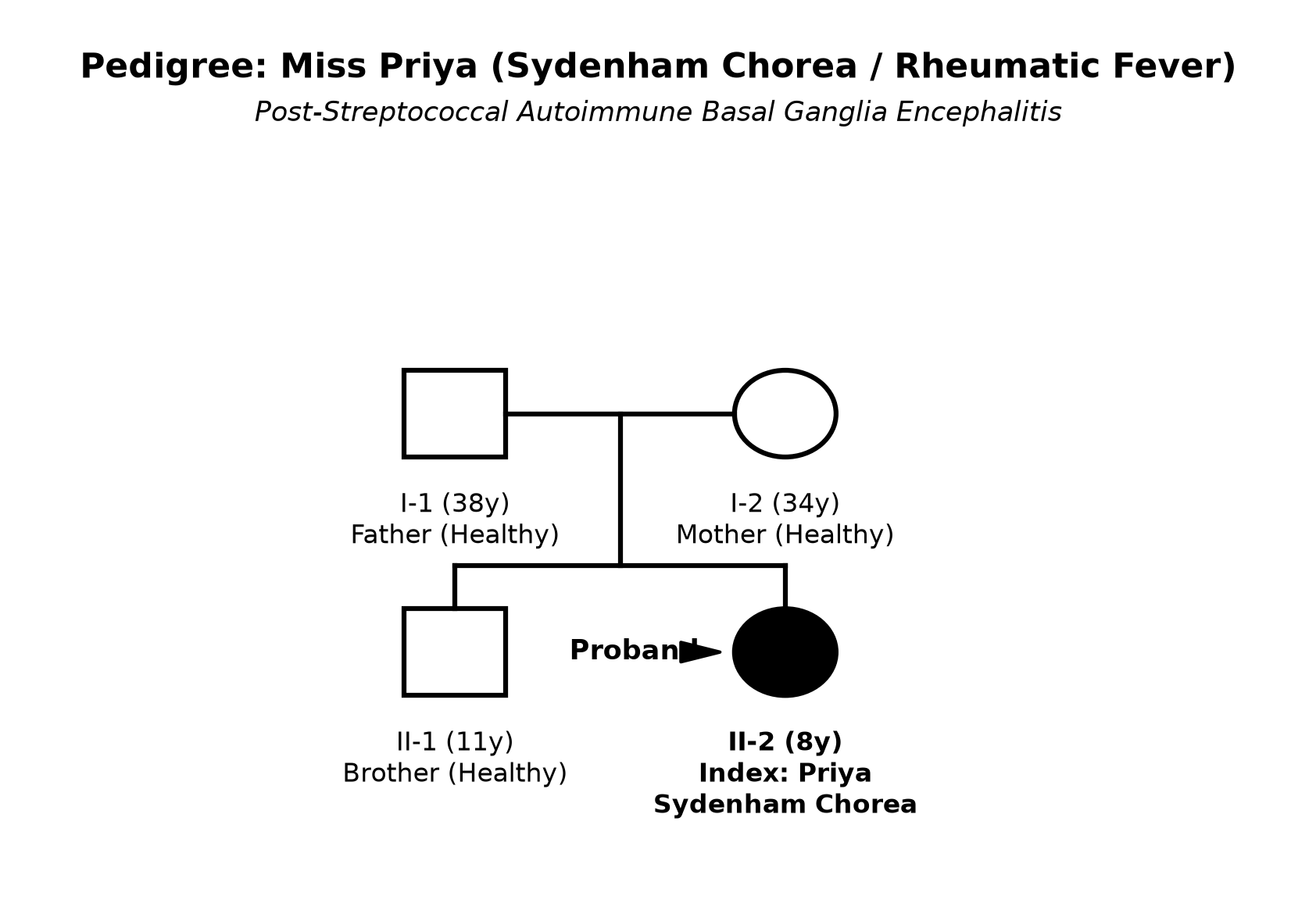
- 2nd-order female child born to non-consanguineously married parents.
- Elder brother (11 years old) is healthy and asymptomatic.
- No family history of rheumatic heart disease, early chorea, or neuropsychiatric disorders.
Immunization history
- Completely immunized for age per National Immunization Schedule (BCG, OPV, Pentavalent 1-3, fIPV, MR 1-2, DPT booster).
- BCG scar is present over the left deltoid.
Dietary history
- Regular mixed family diet; feeds with spoon in left hand; requires parental assistance due to hand chorea.
| Food Item | Quantity | Calories (kcal) | Protein (g) |
|---|---|---|---|
| Idli with Sambar | 2 pieces (~80 g) | 130 | 3.5 |
| Rice with Vegetable Dhal | 1 medium plate (~150 g) | 240 | 5.0 |
| Boiled Egg (Whole) | 1 egg (~50 g) | 75 | 6.0 |
| Cow's Milk | 300 mL | 200 | 9.0 |
| Total Daily Intake | 645 | 23.5 |
| 24-Hour Recall | Expected (for Ideal Body Weight ~25 kg) | Observed | Deficit / Surplus |
|---|---|---|---|
| Calories | 1750 kcal (~70 kcal/kg) | 645 kcal | 1105 kcal (63.1% deficit) |
| Protein | 25.0 g (1.0 g/kg) | 23.5 g | -1.5 g (Near Adequate) |
The expected calories and proteins should be calculated from the ideal body weight, not from current weight.
Socioeconomic and KAP
- Family resides in a pucca house with piped municipal water and sanitation in Salem.
- Father is a bank clerk; Mother is a homemaker.
- Socioeconomic Status: Upper-middle class (Modified Kuppuswamy Score: 18).
- Parents are receptive to starting long-term secondary penicillin prophylaxis for rheumatic fever prevention.
Summary of History
"Miss Priya, an 8-year-old female child, 2nd-order offspring of non-consanguineous parents, with a history of untreated streptococcal pharyngitis 2 months ago, presented with insidious onset, progressive, involuntary, jerky, non-repetitive choreiform movements of both hands and face of 3 weeks duration.
The movements are accompanied by functional clumsiness, handwriting deterioration, and emotional lability, characteristically disappearing during sleep and worsening with emotional stress, with strictly preserved higher cognitive functions, and absence of joint pains or dyspnea.
In view of the classical choreiform hyperkinesia, distal predilection, emotional changes, and latency period following pharyngitis, I would like to consider a clinical diagnosis of Acute Rheumatic Fever (Major Manifestation), clinically presenting as Sydenham's Chorea (Rheumatic Chorea / St. Vitus' Dance), with No active polyarthritis, and No overt clinical evidence of congestive cardiac failure."
General head to toe examination
Pre-Examination Child Behavioral State
- Child State: Alert, self-conscious, emotionally labile, displaying continuous fidgety and choreic twitches of fingers, lips, and feet (Active hyperkinetic state).
Vitals & Anthropometry
- Pulse Rate: 88 bpm, regular, normal volume.
- Blood Pressure: 100/64 mmHg (normal for age and height).
- Respiratory Rate: 18/min, regular, vesicular breathing.
- Anthropometry: Weight 24.2 kg (50th percentile), Height 127 cm (50th percentile), BMI 15.0 kg/m² (normal).
Classical Semiological Signs of Chorea (Granular Assessment)
- Pronator Sign: Markedly Positive. When the child raises both arms straight above her head, the forearms involuntarily hyperpronate such that the palms turn outwards and the dorsa of both hands face each other.
- Choreic Hand (Dish / Spoon Hand): Positive Bilaterally. When arms are extended forward, wrists show involuntary flexion while metacarpophalangeal joints hyperextend.
- Milkmaid's Grip (Trombone Grip): Positive. When squeezing the examiner's fingers, the child cannot maintain a sustained grip; rhythmic waxing and waning contractions are felt.
- Jack-in-the-Box / Chameleon Tongue: Positive. When asked to protrude the tongue and hold it steady, the tongue involuntarily darts back into the mouth within 3–4 seconds.
- Hung-up Reflex (Gordon's Knee Jerk / Pendular Jerk): Positive Bilaterally. On tapping the patellar tendon with legs dangling, the leg extends and pauses momentarily at the peak of contraction before swinging pendularly back.
Systemic Examination
CNS Examination
- Cranial Nerves: Visual acuity, extraocular movements, facial sensations, and hearing are normal; involuntary twitching of facial muscles and tongue noted.
- Motor System:
- Bulk: Symmetrical, normal.
- Tone: Generalized Hypotonia (joints show marked flappability and passive hyperextensibility).
- Power: Grade 5/5 in all muscle groups (motor power is fully preserved despite movement discoordination).
- Reflexes: Deep tendon reflexes are normal to pendular (Gordon's knee jerk); Plantar response is flexor bilaterally.
- Sensory & Cerebellar System: Normal primary sensation; no true cerebellar intention tremor, past-pointing, or dysmetria.
- Gait: Choreic Gait (walks with an irregular, dance-like, lurching gait with frequent compensatory body swerves).
Cardiovascular System (Screening for Subclinical Rheumatic Carditis)
- Precordium: Apex beat in 5th intercostal space in left midclavicular line, normal character.
- Auscultation: S1, S2 heard normally; a soft, Grade 2/6 apical pansystolic murmur radiating to the left axilla is audible (indicating mild mitral regurgitation / subclinical rheumatic carditis).
other systems
- Respiratory System: Vesicular breath sounds bilaterally; clear lungs.
- Abdomen: Soft, non-tender; no hepatosplenomegaly.
- Musculoskeletal & Skin: No active arthritis, joint swelling, subcutaneous nodules, or erythema marginatum.
Summary
"Miss Priya, an 8-year-old girl, with an untreated episode of pharyngitis 2 months ago, presented with a 3-week history of involuntary choreic movements of both upper extremities and face, handwriting deterioration, emotional lability, and functional clumsiness.
Physical examination confirms classical chorea semiology with positive Pronator sign, Choreic hand, Milkmaid's grip, Chameleon tongue, and Hung-up knee jerks, associated with generalized hypotonia and choreic gait. Cardiovascular auscultation reveals an apical pansystolic murmur of mild mitral regurgitation.
Final Diagnosis: I formulate my diagnosis as Acute Rheumatic Fever, presenting with Sydenham's Chorea as a Major Manifestation, associated with Mild Rheumatic Carditis (Mitral Regurgitation), with No active polyarthritis or subcutaneous nodules, and No congestive cardiac failure."
Differential Diagnosis
| Disease Entity | Points in Favor in this Case | Points Against / Differentiating Features |
|---|---|---|
| Sydenham's Chorea (Rheumatic Fever) | Female child (8y), onset 2 months post-strep throat, distal chorea, emotional lability, milkmaid grip, chameleon tongue, apical MR murmur. | Classic presentation; fulfills revised Jones criteria (Chorea alone is sufficient for ARF diagnosis). |
| Systemic Lupus Erythematosus (SLE / APLA) | Female child, chorea, joint or cardiac involvement. | Absence of malar rash, oral ulcers, alopecia, cytopenias, or proteinuria; negative ANA / anti-dsDNA. |
| Wilson Disease (Hepatolenticular Degeneration) | Involuntary movements, behavioral changes, school deterioration. | Wilson disease typically presents with "wing-beating" tremors, dystonia, dysarthria, and Kayser-Fleischer (KF) rings on slit-lamp exam with hepatic involvement; serum ceruloplasmin is low. |
| Huntington Disease (Juvenile HD) | Involuntary movements, emotional changes. | Autosomal dominant family history; juvenile HD classically presents as the Westphal variant with rigidity, seizures, and severe dementia rather than pure chorea. |
| Motor Tics / Tourette Syndrome | Involuntary twitches of face and hands. | Tics are stereotyped, repetitive, coordinated, preceded by an irresistible premonitory sensory urge, and can be voluntarily suppressed for a short duration. |
Investigation Protocol & Diagnostic Workup
flowchart TD
    A["Suspected Sydenham Chorea"] --> B["1. Revised Jones Criteria Workup: 2D Echocardiography"]
    B --> C["Color Doppler Confirms Mitral Regurgitation / Subclinical Carditis"]
    A --> D["2. Streptococcal Serology & Inflammatory Markers: ASO Titre, Anti-DNase B, ESR, CRP"]
    A --> E["3. Rule-out Differential Tests: Slit-lamp for KF Rings, Serum Ceruloplasmin, ANA Profile"]
    A --> F["4. MRI Brain (Usually normal or shows transient hyperintensity in Caudate/Putamen)"]
1. Rheumatic & Streptococcal Serology
- ASO Titre & Anti-DNase B:
- Anti-Streptolysin O (ASO) titre may have declined due to the long latent period (1–6 months); Anti-DNase B remains elevated longer and provides higher diagnostic yield for post-streptococcal chorea.
- Inflammatory Markers: ESR and CRP are frequently normal by the time isolated chorea manifests.
2. Cardiac Evaluation (Mandatory in ALL Chorea Cases)
- 2D Echocardiography with Color Doppler:
- Screens for subclinical rheumatic carditis (mitral regurgitation with jet length $>2\text{ cm}$, peak velocity $>3\text{ m/s}$, or aortic regurgitation per 2015 Revised Jones Criteria).
3. Metabolic & Autoimmune Rule-Out Panel
- Slit-Lamp Examination: Screens for Kayser-Fleischer (KF) rings in Descemet's membrane (Wilson disease).
- Serum Ceruloplasmin & 24-Hour Urinary Copper: Normal levels rule out Wilson disease.
- Antinuclear Antibodies (ANA) & Antiphospholipid Antibodies (aCL, LAC): Negative panel rules out lupus chorea.
Management Plan
flowchart LR
    A["Sydenham Chorea Management"] --> B["1. Secondary Penicillin Prophylaxis"]
    A --> C["2. Symptomatic Anti-Choreic Pharmacotherapy"]
    A --> D["3. Anti-Inflammatory / Steroid Therapy"]
    A --> E["4. Rest & Multidisciplinary Care"]
1. Secondary Rheumatic Prophylaxis (Mandatory for ALL Patients)
- Intramuscular Benzathine Penicillin G:
- Dose: $1.2\text{ million units}$ (or $600,000\text{ units}$ if $<27\text{ kg}$) deep intramuscularly every 3 to 4 weeks.
- Alternative (Penicillin Allergy): Oral Erythromycin ($250\text{ mg}$ BD) or Azithromycin.
- Duration of Prophylaxis (Per Revised Jones / WHO Guidelines):
- Chorea with Carditis (with residual valvular disease): For 10 years after last episode OR until 25–40 years of age (often lifelong).
- Chorea without Carditis: For 5 years after last attack OR until 21 years of age, whichever is longer.
2. Symptomatic Anti-Choreic Pharmacotherapy
- First-Line Drug (Sodium Valproate):
- Dosage: $15\text{–}30\text{ mg/kg/day}$ orally in 2 to 3 divided doses; highly effective in reducing choreic movement amplitude and improving motor control with minimal extrapyramidal side effects.
- Alternative Anti-Dopaminergic Agents:
- Haloperidol: $0.02\text{–}0.05\text{ mg/kg/day}$ (monitor for acute dystonic reactions).
- Carbamazepine: $10\text{–}20\text{ mg/kg/day}$.
3. Immunomodulatory Therapy (for Severe / Refractory Chorea)
- Oral Prednisolone:
- $1\text{–}2\text{ mg/kg/day}$ for 2 to 4 weeks, followed by gradual tapering over 2 weeks; significantly shortens the duration and severity of chorea by suppressing basal ganglia autoimmune inflammation.
- IVIG / Plasma Exchange: Reserved for severe, bedridden Chorea Paralytica unresponsive to steroids.
4. Supportive & Psycho-educational Care
- Calm Environment: Minimize stress, sensory stimulation, and anxiety; provide rest and emotional reassurance.
- School Support: Inform teachers that fidgeting and handwriting difficulties are involuntary and will completely resolve within 2 to 6 months with treatment.