
Master Yuvan, a 3-month-old male infant, 2nd order child born of a non-consanguineous marriage to healthy parents from Chennai, Tamil Nadu, presented to the Pediatric Otolaryngology & Airway Clinic with chief complaints of chronic, high-pitched, musical, fluttering respiratory noises on inspiration (inspiratory stridor) noticed since 2 weeks of age, which has progressively intensified over the past month, characteristically worsening when placed in the supine position, during vigorous crying, agitation, and active bottle/breastfeeding, and dramatically lessening or disappearing when placed in the prone position with the neck slightly extended, associated with intermittent feeding fatigue, frequent pauses during breastfeeding, prolonged feed duration ($>40\text{ minutes}$), and intermittent suprasternal and subcostal retractions, with completely normal phonation, vigorous normal cry, and absence of cyanotic spells, whose awake flexible fiberoptic laryngoscopy demonstrated classic pathognomonic features of Severe Congenital Laryngomalacia consisting of an Omega-shaped ($\Omega$) Epiglottis, Markedly Shortened Aryepiglottic Folds, and Excessive Redundant Flaccid Cuneiform and Corniculate Mucosa that Prolapses Inward into the Glottis during Inspiration, complicated by Gastroesophageal Reflux Disease (GERD) and Failure to Thrive, successfully managed with Anti-Reflux Therapy (Proton Pump Inhibitor), Nutritional Fortification, and scheduled for Endoscopic Supraglottoplasty.
When examining an infant with stridor, examiners evaluate candidates on four fundamental clinical axes:
- Phase of Respiration (The Anatomical Key):
- Inspiratory Stridor: Supraglottic or glottic obstruction (dynamic negative intraluminal pressure collapses floppy extrathoracic structures $\to$ Laryngomalacia, vocal cord paralysis).
- Biphasic Stridor: Subglottic obstruction (fixed, non-compliant cartilaginous narrowing $\to$ Subglottic Stenosis, Croup, Subglottic Hemangioma).
- Expiratory Stridor / Wheeze: Intrathoracic tracheal or bronchial obstruction (positive pleural pressure collapses airway on expiration $\to$ Tracheomalacia, vascular ring, foreign body).
- Quality of Cry & Voice: A normal, strong, clear cry localizes the pathology to the supraglottic larynx (laryngomalacia) or subglottis, completely sparing the true vocal cords! A muffled cry indicates supraglottic mass (epiglottitis/abscess); a weak or hoarse cry points directly to a vocal cord lesion (vocal cord palsy/papillomatosis).
- Positional Modulation: Highlight that laryngomalacia stridor characteristically worsens in the supine position (gravity pulls the tongue and collapsed epiglottis backward over the laryngeal inlet) and improves in the prone position with the neck extended.
- The Synchronous Airway Lesion Warning (Viva Trap): Up to $15-20\%$ of infants with laryngomalacia have a second synchronous airway anomaly (subglottic stenosis or tracheomalacia).
Chief Complaints
- High-pitched, noisy breathing during inspiration noticed since 2-3 weeks of age.
- Worsening of breathing sounds while lying flat on back, crying, and feeding for 1 month.
- Prolonged feeding times with frequent coughing, spluttering, and sweating for 4 weeks.
- Inadequate weight gain over the past month.
HOPI
Master Yuvan was born at full term following an uncomplicated pregnancy and was completely asymptomatic at birth, with normal breathing and a clear, vigorous cry during the first 10 days of life:
- Onset & Temporal Profile of Stridor:
- Around 2 weeks of age, parents first noticed a faint, high-pitched fluttering noise whenever the baby inhaled.
- The noise was strictly inspiratory: it occurred as the baby breathed in, while expiration was silent and smooth.
- Over the past 6 weeks, the noise became progressively louder and harsh, described by the mother as a 'musical, rooster-like purring sound'.
- Dynamic Positional Modulation:
- The stridor worsens dramatically when the infant is laid flat on his back (supine position), during vigorous crying, and when agitated.
- The stridor markedly diminishes or completely disappears when the infant is turned onto his stomach (prone position) with the neck supported in extension, or when held upright over the mother's shoulder.
- During quiet, peaceful sleep in the lateral position, the sound softens considerably.
- Feeding Difficulties & Failure to Thrive:
- Over the past month, feeding has become increasingly difficult and stressful.
- The infant latches onto the breast or bottle, but after 3-4 sucks, stops abruptly, gasps for air with prominent stridor, splutters, and requires multiple rest pauses.
- Feeds take $>40-45\text{ minutes}$ to complete; the baby frequently sweats profusely during feeds and tires out before taking an adequate volume.
- Weight has plateaued at $4.6\text{ kg}$ between 2 and 3 months of age (weight-for-age falling from the 50th centile to $<10\text{th}$ centile on the WHO growth chart).
- Gastroesophageal Reflux Symptoms:
- Mother reports frequent regurgitation of curdled milk after almost every feed, often accompanied by arching of the back (Sandifer syndrome sign) and irritability.
- Pathophysiological Link: The severe negative intrathoracic pressure generated during inspiration against the collapsed supraglottis sucks gastric acid upwards across the lower esophageal sphincter, causing Laryngopharyngeal Reflux (LPR), which produces mucosal edema and worsens laryngeal collapse in a vicious cycle.
- Respiratory Distress & Retractions:
- Mother noted visible inward sucking of the skin at the base of the throat (suprasternal notch) and beneath the rib cage (subcostal retractions) whenever the baby cries or feeds.
- Absence of Red Flags: No history of cyanotic spells, turning blue, or episodes of sudden cessation of breathing (apnea). No aspiration pneumonia or hospitalizations for lower respiratory infection.
- Cry and Voice Character:
- The infant's cry has always been completely normal, clear, loud, and vigorous, confirming normal vocal cord mobility and vibration.
Past History
- No history of endotracheal intubation or neonatal intensive care stay (excludes acquired subglottic stenosis from trauma).
- No history of choking on foreign body (too young, no older siblings offering small objects).
- No cutaneous hemangiomas on the beard distribution (reduces probability of subglottic hemangioma).
Antenatal, Natal, and Developmental History
- Antenatal: Uneventful; full-term normal vaginal delivery; cried immediately; birth weight $3200\text{ grams}$.
- Developmental: Normal social smile attained at 2 months; normal visual tracking; good neck control in prone position.
Family History
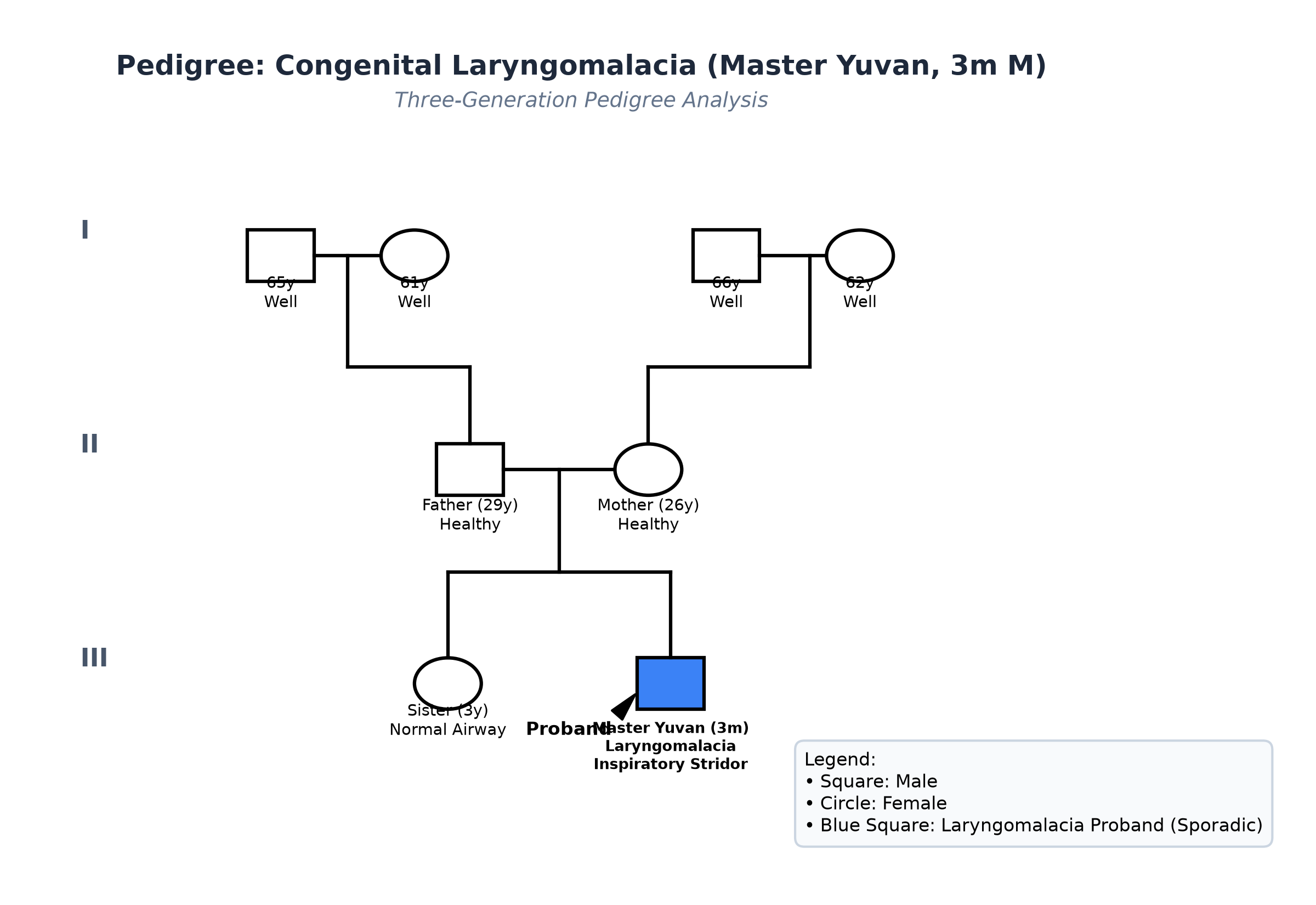
- Non-consanguineous marriage. Parents healthy; older sister (3 years old) had no history of noisy breathing or airway surgery.
Immunization History
- Fully immunized up to age according to the National Immunization Schedule (Birth doses of BCG, OPV, Hep B; 6-week and 10-week Pentavalent, Rotavirus, and IPV vaccines received).
Detailed Feeding History & Nutritional Deficit Analysis
The infant is predominantly breastfed, supplemented with occasional expressed breast milk:
- Current weight: $4.6\text{ kg}$ (Expected for 3 months: $6.0\text{ kg}$).
- The infant attempts feeds every 2.5-3 hours, but feed duration is prolonged ($40-45\text{ minutes}$).
- Due to feeding fatigue, estimated daily intake is only $550\text{ mL/day}$ ($120\text{ mL/kg/day}$), failing to meet the target fluid intake of $150-160\text{ mL/kg/day}$.
| Feed Parameter | Observed Daily Delivery | Target Requirement (Infant) | Deficit / Adequacy |
|---|---|---|---|
| Volume (EBM / Breast Milk) | $550\text{ mL/day}$ ($120\text{ mL/kg}$) | $700\text{ mL/day}$ ($150\text{ mL/kg}$) | $150\text{ mL/day}$ Deficit (21.4%) |
| Caloric Intake | $368\text{ kcal/day}$ ($80\text{ kcal/kg}$) | $500\text{ kcal/day}$ ($108\text{ kcal/kg}$) | $132\text{ kcal/day}$ Deficit (26.4%) |
| Protein Intake | $6.6\text{ g/day}$ ($1.43\text{ g/kg}$) | $8.0\text{ g/day}$ ($1.75\text{ g/kg}$) | $1.4\text{ g/day}$ Deficit |
The expected calories and proteins should be calculated from the target weight and gestation.
Socioeconomic & KAP
- Modified BG Prasad Socioeconomic Class II. Parents are extremely anxious about the baby choking and are seeking definitive specialist evaluation.
Summary of History
Master Yuvan, a 3-month-old male infant, presents with high-pitched inspiratory stridor noticed since 2 weeks of age, which worsens in the supine position and during feeding/crying, and improves in the prone position with neck extension, associated with feeding fatigue, prolonged feed duration, gastroesophageal reflux, subcostal retractions, and failure to thrive, with a preserved, vigorous normal cry.
Provisional Clinical Diagnosis: Congenital Stridor, clinically most consistent with Severe Laryngomalacia (Type 1 and Type 2), complicated by Gastroesophageal Reflux Disease (GERD) and Failure to Thrive (Weight Plateauing).
General Physical & Airway Examination
- General Appearance: Alert, conscious, comfortable at rest while sleeping on his side, but upon waking and crying develops marked inspiratory flutter and stridor; pink in room air; no central or peripheral cyanosis.
- Vitals:
- Heart Rate: 130 beats/minute, regular.
- Respiratory Rate: 38 breaths/minute at rest, increases to 52/min during feeds.
- Temperature: $36.8^\circ\text{C}$ (Afebrile).
- $\text{SpO}_2$: 98% in room air at rest; dips transiently to 93% during vigorous feeding.
- Capillary Refill Time: $<2$ seconds.
- Anthropometry (Plotted on WHO 2006 Infant Growth Standards):
- Weight: $4.6\text{ kg}$ vs $6.0\text{ kg}$ (Expected 50th centile WHO for 3m, $Z$-score: $-2.1\text{ SD}$, Underweight).
- Length: $58.5\text{ cm}$ vs $61.5\text{ cm}$ (Expected 50th centile WHO, $Z$-score: $-1.3\text{ SD}$).
- Head Circumference: $39.8\text{ cm}$ (50th centile, normal brain growth).
- Weight-for-Length: $<10^{\text{th}}$ centile (Mild-to-moderate wasting from feeding fatigue).
Detailed Bedside Airway & Stridor Demonstration
- Stridor Characterization:
- High-pitched, musical, fluttering noise generated strictly during the inspiratory phase.
- Expiration is completely quiet and unlabored.
- Positional Maneuvers:
- Supine Position: Stridor becomes loud, harsh, and accompanied by suprasternal notch indrawing.
- Prone Position with Neck Extension: Stridor softens dramatically and becomes almost inaudible.
- Phonation & Cry:
- When the infant is stimulated to cry, the cry is loud, resonant, clear, and perfectly phonated, confirming that the true vocal cords approximate and vibrate normally.
- Retraction Severity Scoring:
- Suprasternal retractions: Moderate (visible notch indrawing).
- Subcostal retractions: Mild-to-moderate.
- Intercostal retractions: Absent at rest, minimal on crying.
- No pectus excavatum deformity.
- Head & Neck Inspection:
- Trachea is central; normal neck mobility; no retrognathia or micrognathia (mandible is normal size, excluding Pierre Robin sequence); palate is intact, no cleft.
- No cutaneous hemangiomas in the 'beard distribution' (preauricular, chin, lower lip, anterior neck) which would suggest an underlying subglottic hemangioma.
Detailed Systemic Examination
Respiratory System
- Symmetrical chest expansion; respiratory rate 38/min; bilateral air entry is vesicular and equal in all lung zones; no crackles, wheezes, or transmitted rhonchi; no prolonged expiratory phase.
Cardiovascular System
- Precordium quiet; apex beat in 4th left intercostal space at midclavicular line; normal S1, S2; no murmurs; peripheral pulses normal and equal bilaterally.
Abdomen & Central Nervous System
- Abdomen: Soft, non-distended; liver palpable $1.0\text{ cm}$ below costal margin, soft; spleen not palpable; no umbilical hernia.
- Neurological: Alert; age-appropriate social interactions; normal muscle tone (no hypotonia); primitive reflexes (Moro, rooting, grasp) strong and symmetrical.
Summary
Master Yuvan, a 3-month-old male infant, presents with classical features of severe congenital laryngomalacia: early-onset inspiratory stridor worsening in the supine position and with crying, resolving in the prone position, accompanied by feeding fatigue, prolonged feeds ($>40\text{ mins}$), GERD, failure to thrive ($Z$-score $-2.1\text{ SD}$), and suprasternal retractions, with a normal, strong cry.
Final Clinical Diagnosis: Congenital Stridor, clinically and endoscopically diagnostic of Severe Laryngomalacia (Type 1 and Type 2 Supraglottic Collapse), complicated by Gastroesophageal Reflux Disease (GERD) and Failure to Thrive (Feeding Impairment), meeting criteria for Endoscopic Supraglottoplasty.
Differential Diagnosis of Infant Stridor
| Disorder | Points IN FAVOR | Points AGAINST |
|---|---|---|
| Laryngomalacia (Congenital) | Onset 2-3 weeks, high-pitched inspiratory stridor, worse supine, better prone, normal clear cry, feeding fatigue | Primary Diagnosis |
| Vocal Cord Paralysis (Unilateral/Bilateral) | Stridor in early infancy, feeding difficulty | Cry is weak, hoarse, or completely aphonic; stridor is usually biphasic or inspiratory with severe aspiration risk |
| Subglottic Stenosis (Congenital / Acquired) | Stridor in early infancy, retractions | Stridor is BIPHASIC (inspiratory and expiratory); barking cough present; no positional variation; history of prior intubation usually present |
| Subglottic Hemangioma | Onset at 2-6 weeks, progressive stridor | Stridor is BIPHASIC; barking cough; often associated with cutaneous 'beard' hemangiomas; responds dramatically to oral Propranolol |
| Vascular Ring (Double Aortic Arch) | Noisy breathing, stridor in infancy | Stridor is EXPIRATORY or biphasic, accompanied by prominent dysphagia ('dysphagia lusoria'); breathing worsens during feeding rather than position |
Investigation Protocol & Endoscopic Confirmation
flowchart TD
    A["Infant with Chronic Inspiratory Stridor & Positional Variation"] --> B["Gold Standard: Awake Flexible Fiberoptic Laryngoscopy (FFL) in Clinic"]
    B --> C["Endoscopic Evaluation: Omega Epiglottis, Short AE Folds, Arytenoid Prolapse"]
    C --> D{"Assess Severity: Feeding Failure, Failure to Thrive, Pectus, Apnea?"}
    D -->|Mild-Moderate (85%)| E["Conservative Medical Care: Prone Positioning + Anti-Reflux PPI Therapy"]
    D -->|Severe (15%)| F["Direct Microlaryngoscopy & Bronchoscopy (MLB) under General Anesthesia"]
    F --> G["Rule out Synchronous Second Airway Lesion (Subglottic Stenosis/Tracheomalacia)"]
    G --> H["Definitive Surgical Treatment: Endoscopic Supraglottoplasty (Cold / Laser)"]
1. Awake Flexible Fiberoptic Laryngoscopy (FFL - Gold Standard)
- Procedure: Performed in the outpatient clinic without general anesthesia; passed transnasally while the infant breathes spontaneously and cries.
- Endoscopic Findings:
- Type 1 Laryngomalacia: Excessive, redundant, edematous mucosa over the corniculate and cuneiform cartilages that prolapses forward and inward over the posterior vocal cords on every inspiration.
- Type 2 Laryngomalacia: Markedly shortened aryepiglottic (AE) folds that tether the epiglottis tightly to the arytenoids, reducing the anteroposterior diameter of the laryngeal inlet.
- Epiglottic Morphology: Characteristic Omega-shaped ($\Omega$) tubular epiglottis that curls acutely upon itself.
- Vocal Cords: True vocal cords are completely normal, pearly white, with full symmetrical bilateral abduction and adduction.
- Subglottis: No subglottic mass, cyst, or hemangioma visible on dynamic pass.
2. Ancillary & Supportive Investigations
- High-Kilovoltage Airway Radiographs (AP and Lateral Neck):
- Normal subglottic airway column; no 'steeple sign' (rules out croup); no retrovisceral soft tissue widening.
- Barium Swallow Study:
- Normal esophageal transit; no extrinsic posterior esophageal indentation (excludes vascular ring / aberrant right subclavian artery).
- Moderate gastroesophageal reflux demonstrated with reflux episodes reaching the upper third of the esophagus.
- Polysomnography (Sleep Study):
- Mild obstructive sleep apnea with Apnea-Hypopnea Index (AHI) $4.2\text{ events/hr}$; minimum $\text{SpO}_2\text{ }91\%$.
Comprehensive Multidisciplinary Management Plan
1. Surgical Management: Endoscopic Supraglottoplasty
- Indications Met:
- Failure to thrive with weight falling across percentiles ($Z$-score $-2.1\text{ SD}$).
- Severe feeding impairment with prolonged feed duration ($>40\text{ minutes}$).
- Significant suprasternal and subcostal retractions.
- Operative Procedure (Suspension Microlaryngoscopy):
- Performed under general anesthesia with spontaneous ventilation.
- Using cold micro-scissors or micro-debrider:
- Bilateral Division of Short Aryepiglottic Folds: Incision of the tight folds immediately releases the tethered epiglottis, allowing it to spring forward away from the glottic aperture.
- Judicious Trimming of Redundant Cuneiform Mucosa: Careful excision of floppy mucosal wedges over the arytenoid cartilages, strictly preserving the interarytenoid space to prevent posterior glottic stenosis.
- Expected Outcome: Immediate postoperative resolution of $>85-90\%$ of inspiratory stridor, normalization of feeding speed, and accelerated catch-up growth within 2-4 weeks.
2. Medical Anti-Reflux Management
- Proton Pump Inhibitor (PPI): Oral Omeprazole at $1.0\text{ mg/kg/day}$ administered once daily before morning feeds for 8-12 weeks.
- Rationale: Neutralizes gastric acidity, reduces chemical arytenoid edema, and breaks the vicious cycle between reflux and supraglottic collapse.
- Positioning & Feeding Modifications:
- Upright holding for 30 minutes following every feed.
- Thickened feeds or frequent small-volume feeds.
- Prone sleeping under direct parental supervision during daytime.
3. Postoperative Follow-up & Red Flags
- Monitor in the high-dependency unit for 24 hours postoperatively for potential transient laryngeal edema.
- Review at 2 weeks, 6 weeks, and 3 months with repeat flexible laryngoscopy to verify wide, stable airway opening and documented weight catch-up.