
Master Dev, a 6 year old boy, 1st order child born of a non-consanguineous marriage from Pune, Maharashtra presented with complaints of acute onset of severe breathlessness, chest tightness, and continuous coughing since 12 hours, inability to speak full sentences, and poor response to home Salbutamol inhaler puffs, on a background of recurrent episodic wheezing since 3 years of age.
- Acute onset of breathlessness, dry brassy cough, and audible wheezing
- Decreased response or failure of home-prescribed short-acting beta-2 agonist (SABA) reliever inhalers
- Inability to speak full sentences (speaks in single words or short gasps)
- Chest tightness and profound agitation or drowsiness (hypoxia / hypercapnia)
- Prior emergency department visits or PICU admissions for severe wheezing
HOPI
The history is dated back to 2 days ago when the child developed clear rhinorrhea, sneezing, and low-grade fever (viral upper respiratory tract infection).
Always establish:
- Trigger: Viral infection, cold air, exercise, pollen, house dust mites, NSAIDs.
- Rapidity of Onset: Sudden acute bronchospasm vs subacute worsening over several days with mucous plugging.
- Current Exacerbation Severity: Speech pattern, reliever frequency, sleep disturbance.
- Chronic Baseline Control (GINA 2024): Frequency of daytime symptoms, nighttime awakenings, reliever use, and physical limitation in the preceding 4 weeks.
- High-Risk Features for Fatal Asthma: Prior PICU admission, mechanical ventilation, recent oral steroid burst, poor perception of airflow limitation.
- Acute Breathlessness & Onset of Exacerbation:
- Breathlessness worsened dramatically 12 hours ago during the early hours of the morning (around 3 AM).
- Rapidly progressive; child became restless, preferred sitting bolt upright leaning forward on hands (tripod position), and could not lie down flat.
- Cough became continuous, dry, hacking, and associated with loud whistling sounds (wheezing) audible from the bedside without a stethoscope.
- Speech Pattern & Effort of Breathing:
- Mother noticed that the child was unable to complete a sentence in one breath and spoke only in short, broken single words ("water... pain...").
- Marked chest wall retractions: Mother observed deep sucking in of the skin below the ribs (subcostal), between the ribs (intercostal), and at the base of the neck (suprasternal).
- Failure of Home Rescue Medication:
- Mother administered 4 puffs of Levosalbutamol via MDI with a spacer every 20 minutes for 3 cycles, but the child experienced only transient, minimal relief for 10-15 minutes before breathlessness recurred severely.
- Baseline Chronic Asthma History (GINA Assessment):
- First episode of wheezing occurred at 3 years of age following an episode of viral bronchiolitis.
- Over the past 6 months, he has had daytime symptoms 3-4 times a week, woke up coughing at night twice a week, and used his reliever inhaler $>3\text{ times/week}$ (Uncontrolled Asthma as per GINA 2024 criteria).
- Prescribed low-dose Inhaled Corticosteroid (Fluticasone $50\text{ mcg}$ 1 puff twice daily), but parents discontinued it 2 months ago because "he was feeling well" (poor controller compliance).
- Personal and Family Atopic Diathesis:
- History of infantile atopic dermatitis (flexural eczema) between 6 months and 2 years of age.
- History of allergic rhinitis with recurrent morning sneezing, clear rhinorrhea, and allergic salute.
- Negative History:
- No history of sudden choking on food items, peanuts, or small toy parts Rules out acute foreign body aspiration into the tracheobronchial tree.
- No history of high-grade fever with chills, foul sputum, or unilateral chest pain Rules out lobar consolidation / parapneumonic effusion.
- No history of barking seal-like cough, hoarseness, or inspiratory stridor Rules out viral croup / acute laryngotracheobronchitis.
- No history of prior endotracheal intubation or mechanical ventilation for asthma.
Past History
- Three emergency room visits in the past year requiring nebulization and short courses of oral prednisolone.
- No history of drug allergies or aspirin sensitivity.
Family history
- Non-consanguineous marriage.
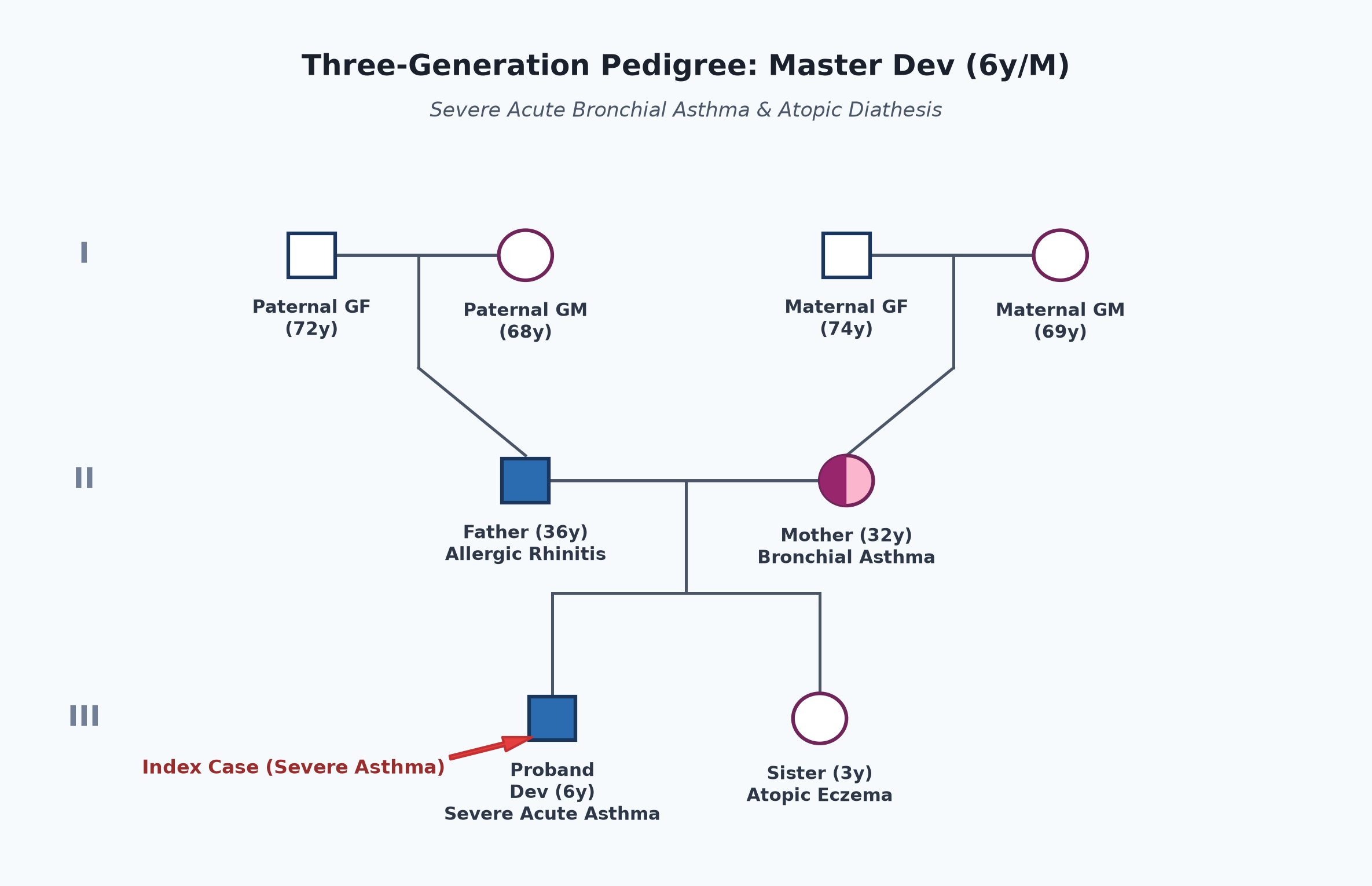
- Father 36 years, software engineer, has allergic rhinitis.
- Mother 32 years, architect, has physician-diagnosed bronchial asthma managed with inhalers.
- Younger sister (3 years) has atopic eczema.
- Strong family history of atopy in first-degree relatives (Modified Asthma Predictive Index [mAPI] positive).
Immunization history
- Received all UIP vaccines up to 5 years (including DPT boosters).
- Received annual influenza vaccination 8 months ago.
Dietary history
- Normal mixed diet. No identified food triggers or anaphylactic food allergies.
| Food Item | Quantity | Calories (kcal) | Protein (g) |
|---|---|---|---|
| Milk | 250 mL | 175 | 8.0 |
| Chapati with dal & vegetables | 2 chapatis + dal | 380 | 11.2 |
| Rice with curd | 1 bowl | 220 | 5.5 |
| Fruits | 1 apple | 60 | 0.5 |
| Total Observed Intake | — | 835 kcal | 25.2 g |
24-Hour Recall Deficit Analysis
$$ \text{Ideal Body Weight (IBW for 6-year-old boy, 50th centile WHO)} = 20.5\text{ kg} $$| Nutrient | Expected Intake (ICMR-NIN 2024 for 4-6 years) | Observed Intake | Deficit | Percentage Deficit |
|---|---|---|---|---|
| Energy (kcal) | $1360\text{ kcal/day}$ | 835 kcal | 525 kcal | 38.6% Deficit |
| Protein (g) | $16.0\text{ g/day}$ | 25.2 g | 0 g | No Deficit |
The expected calories and proteins should be calculated from the ideal body weight, not from current weight.
Socioeconomic and KAP
- Modified BG Prasad Class I (Upper Socioeconomic Class).
- Urban apartment in Pune with carpeted flooring and indoor potted plants (potential dust mite and mold aeroallergen exposure).
- Parents possessed an inhaler and spacer, but lacked an individualized written Asthma Action Plan.
Summary of History
Master Dev, a 6-year-old male child with a known background of uncontrolled bronchial asthma and atopic diathesis, presented with acute onset of severe breathlessness, continuous cough, chest tightness, inability to speak full sentences, and poor response to home bronchodilator puffs following a viral upper respiratory infection, without history of foreign body inhalation.
I would like to think of a Severe Acute Exacerbation of Bronchial Asthma (Status Asthmaticus / Acute Severe Asthma), triggered by a viral respiratory infection, in a child with uncontrolled asthma and poor controller adherence.
General head to toe examination
- Child Behavioral State: Anxious, agitated, upright in tripod position, speaking in short single words only (Prechtl State 4 / Distressed).
- Vitals:
- Heart Rate: 148 beats/minute (marked tachycardia), regular, pulses synchronous.
- Pulsus Paradoxus: Exaggerated drop in systolic blood pressure during inspiration $= 18\text{ mmHg}$ ($>10-15\text{ mmHg}$ indicates severe air-trapping and intrathoracic pressure swings).
- Respiratory Rate: 52 breaths/minute (severe tachypnea), thoracoabdominal with prolonged expiratory phase.
- Blood Pressure: Right arm sitting: $108/68\text{ mmHg}$.
- Temperature: $37.2^\circ\text{C}$ (afebrile).
- Oxygen Saturation ($SpO_2$): 89% on room air; improves to 95% with $6\text{ L/min}$ oxygen via face mask.
- Anthropometry:
| Parameter | Observed | Expected (50th WHO) | Z-score / Centile | Inference |
|---|---|---|---|---|
| Weight | 19.8 kg | 20.5 kg | Normal | Normal Weight |
| Height | 115 cm | 115.5 cm | Normal | Normal Linear Growth |
| BMI | $15.0\text{ kg/m}^2$ | $15.3\text{ kg/m}^2$ | $50^{\text{th}}\text{ centile}$ | Normal Nutritional Status |
- Head to Toe Findings:
- Stigmata of Atopy:
- Allergic shiners (dark infraorbital circles).
- Dennie-Morgan lines (prominent double folds under the lower eyelids).
- Transverse nasal crease (from frequent upward rubbing / "allergic salute").
- No cyanosis, clubbing, generalized lymphadenopathy, or pedal edema.
- Accessory Muscle Use: Vigorous contraction of sternocleidomastoids and scalene muscles; prominent suprasternal, intercostal, and subcostal retractions with tracheal tug.
- Stigmata of Atopy:
Systemic Examination
Respiratory System
- Inspection:
- Shape: Hyperinflated, barrel-shaped chest contour with increased anteroposterior diameter and fullness of intercostal spaces.
- Respiratory cycle: Markedly prolonged expiratory phase with active abdominal muscle contraction during expiration (Inspiratory:Expiratory ratio reversed, $I:E = 1:3\text{ to } 1:4$).
- Accessory muscles: SCM prominently standing out like cords during inspiration.
- Palpation:
- Trachea is central.
- Tactile Vocal Fremitus (TVF): Symmetrically decreased throughout both lung fields (due to air-trapping / hyperinflation).
- Rhonchial fremitus palpable diffusely over anterior chest.
- Percussion:
- Percussion note is diffusely hyperresonant over all lung fields bilaterally.
- Obliteration of superficial cardiac dullness.
- Upper border of liver dullness is displaced downwards to the $6^{\text{th}}$ or $7^{\text{th}}$ intercostal space (pulmonary hyperinflation pushing diaphragm downwards).
- Auscultation:
- Breath Sounds: Harsh vesicular breath sounds with marked prolongation of expiration throughout all lung fields.
- Air Entry: Markedly reduced bilaterally at the lung bases.
- Adventitious Sounds:
- High-pitched, polyphonic, musical expiratory and inspiratory wheezes (rhonchi) heard diffusely over all lung zones bilaterally.
- No coarse crackles or localized bronchial breathing.
- Vocal Resonance: Symmetrically reduced bilaterally.
Pediatric Respiratory Assessment Measure (PRAM Score)
| Clinical Parameter | Patient Finding | Score Assigned |
|---|---|---|
| Suprasternal Retractions | Clearly visible, marked | 2 (0 = none, 1 = mild, 2 = moderate/severe) |
| Scalene Muscle Contraction | Visible, clearly palpable | 2 (0 = none, 2 = visible/palpable) |
| Air Entry | Markedly reduced at bases | 2 (0 = normal, 1 = reduced bases, 2 = reduced widespread, 3 = minimal/none) |
| Wheezing | Widespread throughout expiration & inspiration | 2 (0 = none, 1 = expiratory only, 2 = both exp & insp, 3 = silent chest) |
| $SpO_2$ on Room Air | 89% ($<92\%$) | 1 (0 = $\ge 95\%$, 1 = $92-94\%$, 2 = $<92\%$) |
| Total PRAM Score | — | 9 / 12 (Severe Asthma Exacerbation) |
Score Interpretation: 1–3: Mild; 4–7: Moderate; 8–12: Severe Exacerbation.
other systems
- Cardiovascular System: Marked sinus tachycardia ($148\text{ bpm}$); heart sounds muffled due to intervening hyperinflated lung tissue; no murmurs.
- Abdomen: Soft, non-tender; liver edge felt 2.5 cm below costal margin due to depressed diaphragm (normal liver span of $8\text{ cm}$); spleen not palpable.
- Central Nervous System: Anxious, irritable, no focal neurological deficits, no meningism.
Summary
Master Dev, a 6-year-old male child with a known background of uncontrolled bronchial asthma and atopy, presented with acute onset of severe breathlessness, continuous dry cough, inability to speak full sentences, and poor response to home beta-2 agonist inhalers following a viral upper respiratory infection.
On examination, he has tachypnea ($52\text{ cpm}$), tachycardia ($148\text{ bpm}$), pulsus paradoxus ($18\text{ mmHg}$), $SpO_2$ 89%, severe suprasternal and scalene contractions, hyperresonant percussion note with liver dullness pushed down, prolonged expiration, diffuse polyphonic wheezing, and a PRAM score of 9/12.
Probable Clinical Diagnosis: Severe Acute Exacerbation of Bronchial Asthma (Status Asthmaticus / PRAM Score 9/12), triggered by a viral upper respiratory infection, complicated by Severe Airway Obstruction and Hypoxemia, in a child with chronic uncontrolled atopic asthma.
Differential Diagnosis
| Disease | Points IN FAVOR | Points AGAINST |
|---|---|---|
| Severe Acute Asthma | • History of atopy and recurrent wheezing • Diffuse bilateral polyphonic wheezes • Hyperinflated chest + prolonged expiration • Elevated PRAM score (9/12) | Primary Diagnosis |
| Foreign Body Aspiration | • Acute breathlessness, wheezing, distress | • No history of sudden choking/gagging episode • Wheeze in asthma is bilateral and polyphonic; foreign body wheeze is unilateral and monophonic |
| Acute Bronchiolitis | • Viral prodrome, wheezing, hyperinflation | • Bronchiolitis is restricted to infants $<12-24\text{ months}$ of age; child is 6 years old |
| Anaphylaxis | • Acute bronchospasm, breathlessness | • No urticaria, angioedema, stridor, hypotension, or history of allergen/food exposure |
Investigation Protocol & Diagnostic Workup
flowchart TD
    A["Severe Acute Asthma Exacerbation (Master Dev)"] --> B["1. Emergency Bedside Assessment (DO NOT DELAY TREATMENT)"]
    B --> C["Continuous Pulse Oximetry (Target SpO2 94-98%)"]
    B --> D["Serial PRAM Scoring (Pre & Post Nebulization)"]
    B --> E["Peak Expiratory Flow Rate (PEFR if Child Able: <50% Predicted)"]

    A --> F["2. Blood Gas & Laboratory Profile"]
    F --> G["Arterial / Capillary Blood Gas (ABG: Assess PaCO2 & Exhaustion)"]
    F --> H["Serum Electrolytes (Baseline Potassium prior to high-dose SABA)"]

    A --> I["3. Selective Radiological Indications"]
    I --> J["Chest X-Ray (CXR AP/PA: ONLY if Pneumothorax, Pneumomediastinum, or No Response)"]
1. Pulse Oximetry & Serial PRAM Assessment
- Continuous $SpO_2$ monitoring is mandatory; initial value $89\%$ on room air.
- Serial PRAM score calculated every 30 minutes to objectively assess response to stepwise bronchodilator therapy.
2. Blood Gas Analysis (ABG / VBG)
- Clinical Significance of $PaCO_2$:
- In acute asthma, hyperventilation normally blows off $CO_2$, producing a respiratory alkalosis ($PaCO_2 < 35\text{ mmHg}$).
- Patient's ABG: $$ \text{pH} = 7.34, \quad PaCO_2 = 41\text{ mmHg}, \quad PaO_2 = 64\text{ mmHg}, \quad HCO_3^- = 22\text{ mEq/L} $$
- VIVA TRAP ALERT: A "normal" $PaCO_2$ ($41\text{ mmHg}$) in a severely tachypneic child in status asthmaticus is an OMINOUS WARNING SIGN of impending respiratory muscle fatigue and hypercapnic respiratory failure!
3. Serum Electrolytes & Glucose
- Serum Potassium $= 4.1\text{ mEq/L}$ (monitored closely because repetitive high-dose beta-2 agonists drive potassium intracellularly, predisposing to hypokalemia).
- Blood glucose $= 118\text{ mg/dL}$ (mild stress hyperglycemia).
4. Chest Radiography (Selective Indications)
- Not routinely recommended in all asthma exacerbations. Indicated here due to severe disease to rule out pneumothorax, pneumomediastinum, and lobar atelectasis / pneumonia.
- Findings: Bilateral hyperinflated lung fields with flattened diaphragms and $>9$ posterior ribs visible; no pneumothorax or mediastinal air.
Management Plan
1. Emergency Department Stepwise Protocol (GINA 2024 / PRAM Protocol)
Triage: Immediately transfer to pediatric resuscitation bay; position in upright position.
Oxygen Therapy: Administer humidified oxygen via face mask or nasal cannula to maintain target $SpO_2$ between 94% and 98%.
Step 1: Repetitive Inhaled Bronchodilator Therapy (First Hour):
- Inhaled Salbutamol: Nebulization with $2.5-5.0\text{ mg}$ ($0.5-1.0\text{ mL}$ of $0.5\%$ respiratory solution diluted in $3\text{ mL}$ normal saline driven by $6-8\text{ L/min}$ oxygen) every 20 minutes for 3 doses, OR 6-8 puffs via MDI with spacer every 20 minutes.
- Inhaled Ipratropium Bromide: Add $250\text{ mcg}$ to the first 3 doses of Salbutamol nebulization in the first hour. (Synergistic anticholinergic bronchodilation reduces hospital admissions by $>30\%$).
Step 2: Early Systemic Corticosteroids (CRITICAL):
- Initiate within the first 60 minutes: Oral Prednisolone ($1-2\text{ mg/kg}$, max 40 mg), OR if vomiting/unable to take orally, IV Hydrocortisone ($4\text{ mg/kg}$ IV Q6H) or IV Methylprednisolone ($1-2\text{ mg/kg}$ IV load followed by $1\text{ mg/kg}$ Q12H). Continue for 3 to 5 days (no taper needed if $<7\text{ days}$).
Step 3: Second-Line Rescue Therapy for Refractory Severe Exacerbation (Hour 2):
- If PRAM score remains $\ge 8$ after the first hour:
- Intravenous Magnesium Sulfate ($MgSO_4$):
- Dose: $40-50\text{ mg/kg}$ (max 2 g) IV infusion in $100\text{ mL}$ normal saline over 20 to 30 minutes with continuous ECG and blood pressure monitoring.
- Mechanism: Potent physiological calcium channel blocker; directly relaxes bronchial smooth muscle and inhibits acetylcholine release at motor end-plates.
Step 4: Non-Invasive Respiratory Support / Advanced Pharmacotherapy:
- High-Flow Nasal Cannula (HFNC): $1.5-2.0\text{ L/kg/min}$ with warmed, humidified gas (delivers mild positive airway pressure, reduces dead space, and assists work of breathing).
- Continuous IV Terbutaline Infusion: $2-10\text{ mcg/kg}$ IV bolus over 10 min followed by $0.2-0.4\text{ mcg/kg/min}$ titrated up to $2-3\text{ mcg/kg/min}$ in PICU.
- Ketamine: Dissociative bronchodilating anesthetic agent ($1-2\text{ mg/kg}$ IV) if impending respiratory arrest.
2. Discharge Planning & Long-Term Controller Optimization (GINA Track 1 / Track 2)
- Step-Up Controller Therapy (GINA Step 3 for Children 6–11 Years):
- Do not discharge on SABA alone!
- Initiate medium-dose Inhaled Corticosteroid (ICS) plus Long-Acting Beta-2 Agonist (LABA):
- Fluticasone-Salmeterol (100/50 mcg) 1 puff twice daily via spacer, OR
- Budesonide-Formoterol (100/6 mcg) maintenance and reliever therapy (MART).
- Inhaler Technique & Spacer Training: In-person demonstration and "teach-back" verification with child and parents.
- Written Asthma Action Plan (WAAP): Color-coded traffic-light action plan detailing Green (well), Yellow (cough/mild wheeze - step up reliever), and Red (severe distress - emergency dosing and hospital contact).
- Environmental Aeroallergen Control: Mattress encasings, removal of carpets, avoid passive tobacco smoke exposure, and annual influenza vaccination.
- Follow-up: Mandatory review visit in 2 to 4 days post-discharge, and subsequently at 4-6 weeks.