
Baby of Rekha, a 6-hour-old preterm male neonate, 2nd order child born of a non-consanguineous marriage to a 30-year-old mother with Gestational Diabetes Mellitus (GDM) on insulin therapy from Gwalior, Madhya Pradesh, born at 32 completed weeks of gestation by emergency Lower Segment Cesarean Section (LSCS) for fetal distress (recurrent late decelerations) with clear amniotic fluid, birth weight 1920 grams (AGA, 50th centile), presented immediately after birth with progressive respiratory distress manifested by severe tachypnea (respiratory rate $78\text{ breaths/minute}$), prominent alar flaring, marked intercostal and subcostal retractions, xiphoid retractions, audible expiratory grunting, and central cyanosis in room air, corresponding to a Silverman-Anderson Retraction Score (SARS) of 7/10 and a Downe Score of 6/10, diagnosed with Severe Respiratory Distress Syndrome (Hyaline Membrane Disease - Surfactant Deficiency), successfully stabilized with Bubble Continuous Positive Airway Pressure (Bubble CPAP at $6\text{ cm }\text{H}_2\text{O}$) and Early Targeted Surfactant Replacement Therapy (Poractant alfa $200\text{ mg/kg}$ via Less Invasive Surfactant Administration - LISA).
When examining a case of neonatal respiratory distress, the examiner expects an immediate, sharp clinical approach organized around four cardinal questions:
- Maturity vs. Term Profile: Is this a preterm infant ($<34$ weeks $\to$ Respiratory Distress Syndrome is top differential) or a term/post-term infant ($\to$ Meconium Aspiration Syndrome, Transient Tachypnea of the Newborn - TTNB, or Persistent Pulmonary Hypertension - PPHN)?
- Quantification of Severity: Rapidly calculate the Silverman-Anderson Score (for preterms: thoracoabdominal synchrony, intercostal retractions, xiphoid retractions, alar flaring, grunting) vs. the Downe Score (for term infants: adds cyanosis and air entry). A score $\ge 6$ represents impending respiratory failure!
- The Maternal Context: Maternal diabetes delays surfactant maturation by hyperinsulinemia-mediated suppression of surfactant protein SP-A and SP-B synthesis. Maternal fever or prolonged rupture of membranes points toward Early-Onset Neonatal Sepsis / Congenital Pneumonia.
- Timing & Interventions: Emphasize early Bubble CPAP within the golden first 15 minutes of life to establish functional residual capacity, followed by the LISA / MIST technique over invasive mechanical ventilation.
Chief Complaints & Presentation at Birth
Referred to Level III NICU at 20 minutes of life with:
- Rapid breathing noticed immediately after delivery.
- Deep chest indrawings (subcostal and intercostal retractions).
- Audible grunting on expiration.
- Bluish discoloration of lips and tongue in room air ($ ext{SpO}_2\text{ }78\%$).
HOPI
Baby of Rekha was delivered at 32 weeks of gestation by emergency LSCS. At birth, the baby cried within 30 seconds, but immediately developed rapid, labored breathing with prominent grunting:
- Evolution of Respiratory Distress:
- In the labor room under radiant warmer, breathing rate was counted at $78\text{ breaths/minute}$.
- The chest wall showed marked inward collapsing of the lower ribs (subcostal retractions) and intercostal spaces during inspiration.
- The xiphoid process showed deep indrawing with each breath.
- Alar flaring was prominent and continuous.
- An expiratory grunt was easily audible to the naked ear standing at the bedside.
- Silverman-Anderson Retraction Score (SARS): Upper chest lag (1), marked lower chest retractions (2), marked xiphoid retractions (2), marked flaring (1), naked-ear expiratory grunt (2) = Total Score: 7/10 (Severe Respiratory Distress).
- Pulse oximetry on the right hand showed oxygen saturation of $78\%$ in room air, which improved to $88\%$ on free-flow oxygen via T-piece resuscitator.
- Immediate NICU Stabilization:
- Placed on Bubble CPAP at $6\text{ cm }\text{H}_2\text{O}$ PEEP with heated humidified blender oxygen delivering $\text{FiO}_2\text{ }0.35$.
- Despite CPAP, the infant required escalation of $\text{FiO}_2$ to $0.45$ over the next 2 hours to maintain target pre-ductal saturations ($90-94\%$) with persistent moderate retractions.
- Arterial blood gas (ABG) via right radial puncture: $\text{pH } 7.22$, $\text{PaCO}_2\text{ }62\text{ mmHg}$, $\text{PaO}_2\text{ }48\text{ mmHg}$, $\text{HCO}_3^-\text{ }24.5\text{ mEq/L}$, Base Deficit $-3.2\text{ mmol/L}$ (Respiratory Acidosis with Moderate Hypoxemia).
- Chest radiograph confirmed Stage III Respiratory Distress Syndrome: diffuse fine reticulogranular 'ground-glass' opacities with prominent air bronchograms extending to the periphery and low lung volumes (6 posterior rib spaces visible).
- Targeted Surfactant Therapy via LISA Technique:
- At 3 hours of life, the infant met European and NNF consensus criteria for surfactant therapy on CPAP (preterm $<34$ weeks requiring $\text{FiO}_2 >0.30$ to maintain $\text{SpO}_2 >90\%$ on CPAP $\ge 6\text{ cm }\text{H}_2\text{O}$).
- Under direct laryngoscopy, without general anesthesia or muscle relaxation, a flexible 16G Angiocath / Surfactant catheter was guided into the vocal cords while the infant breathed spontaneously on CPAP.
- Natural porcine surfactant (Poractant alfa - Curosurf at $200\text{ mg/kg}$ = $384\text{ mg} = 4.8\text{ mL}$) was instilled in two aliquots over 2 minutes.
- The catheter was withdrawn immediately; CPAP was continued uninterrupted.
- Within 30 minutes post-surfactant administration, chest compliance improved markedly; the expiratory grunt disappeared, retractions diminished to mild (SARS reduced from 7 to 2), and $\text{FiO}_2$ was rapidly weaned from $0.45$ down to $0.25$.
Past & Maternal History
- Maternal Gestational History:
- 30-year-old Gravida 2, Para 1, Living 1 mother with Gestational Diabetes Mellitus diagnosed at 22 weeks on 75g OGTT (Fasting $112\text{ mg/dL}$, 2-hour $178\text{ mg/dL}$).
- Blood sugar was suboptimally controlled; required Inj. Regular Insulin and NPH insulin.
- Pathophysiological Link: Fetal hyperinsulinemia acts as an antagonist to fetal glucocorticoids, down-regulating the transcriptional activation of surfactant protein genes (SP-A and SP-B) in type II pneumocytes, thereby increasing the incidence of severe RDS six-fold even at late preterm gestations!
- Received single dose of Inj. Betamethasone $12\text{ mg IM}$ 6 hours prior to emergency delivery (incomplete steroid coverage; $<24$ hours elapsed).
- Natal History:
- Delivered at 32 weeks gestation by emergency LSCS for acute fetal distress (persistent non-reassuring CTG with late decelerations).
- Liquor was clear, non-foul smelling. Placenta was large, weighing 550g.
- Baby cried at 30 seconds; Apgar scores were 6 at 1 minute and 8 at 5 minutes; birth weight $1920\text{ grams}$, birth length $44.0\text{ cm}$, birth head circumference $30.5\text{ cm}$.
Family History
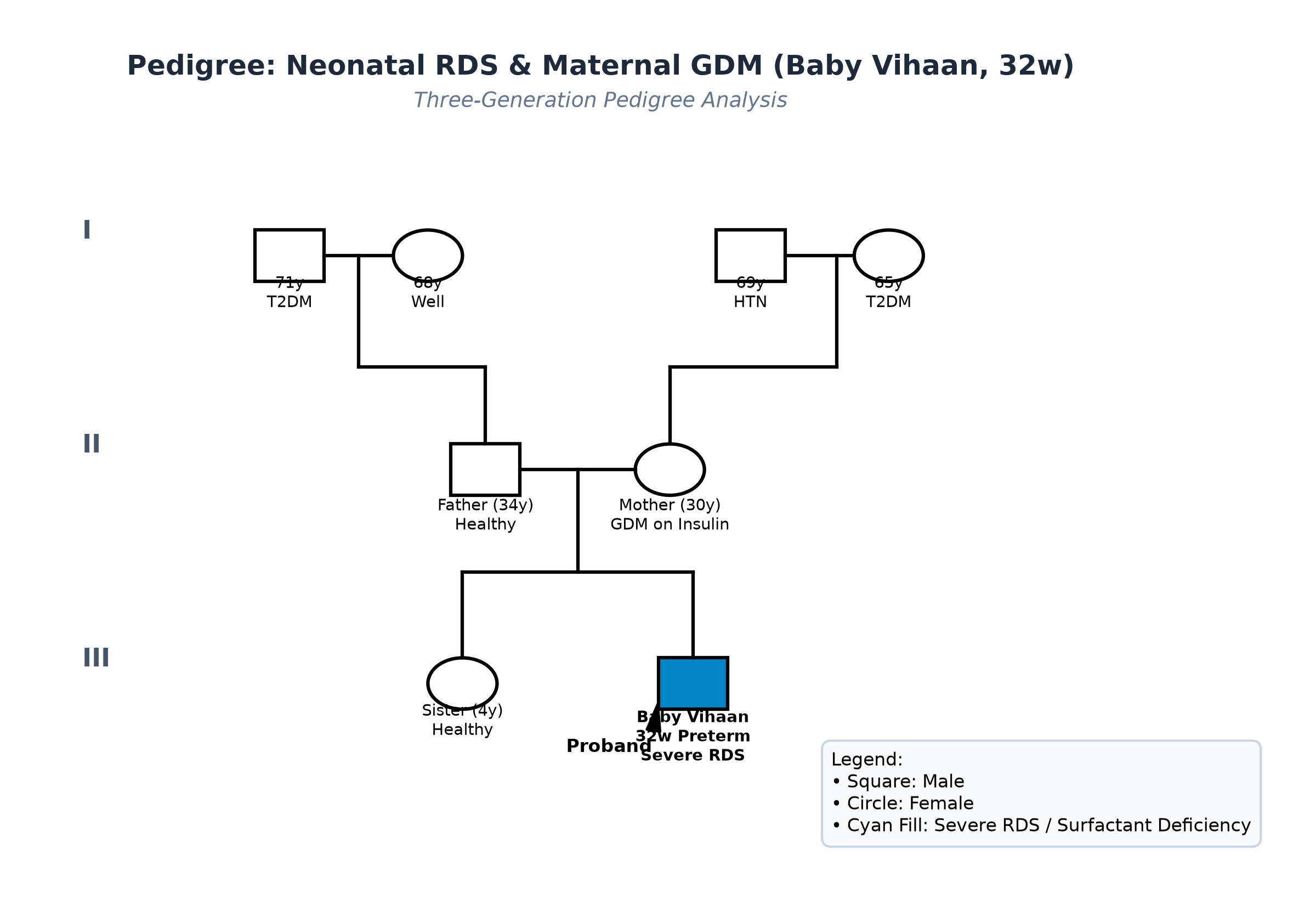
- Non-consanguineous marriage. Elder sister (4 years old) was born at term, healthy, with normal birth weight. No family history of neonatal deaths or congenital lung anomalies.
Nutritional & Fluid Strategy in Acute RDS
During the acute phase of RDS, excess fluid administration increases the risk of patent ductus arteriosus (PDA), pulmonary edema, and bronchopulmonary dysplasia (BPD):
- Day 1 Fluid Protocol:
- Kept Nil per Os (NPO) with an umbilical venous catheter (UVC) in situ.
- Total Fluid Intake (TFI) restricted to $60\text{ mL/kg/day}$ with 10% Dextrose in Water (GIR: $4.2\text{ mg/kg/min}$).
- Serum electrolytes, blood glucose (screen for hypoglycemia secondary to maternal GDM), and urine output monitored every 4-6 hours.
- Trophic feeds (colostrum $10-15\text{ mL/kg/day}$) planned once respiratory distress resolves and SARS $<2$ on low CPAP settings.
The expected calories and proteins should be calculated from the target weight and gestation.
Summary of History
Baby of Rekha, a 6-hour-old preterm male neonate born at 32 weeks gestation to a diabetic mother by emergency LSCS, birth weight 1920g (AGA), presented immediately after birth with severe respiratory distress (Silverman-Anderson score 7/10, grunt, cyanosis, ground-glass opacities on CXR), who was stabilized on Bubble CPAP and received Poractant alfa ($200\text{ mg/kg}$) via LISA, with dramatic reduction of oxygen requirement and work of breathing.
Provisional Diagnosis: Preterm Male Neonate (Gestational Age: 32 Weeks, Chronological Age: 6 Hours), Appropriate for Gestational Age, with Severe Respiratory Distress Syndrome (Hyaline Membrane Disease - Surfactant Deficiency), secondary to Prematurity and Maternal Gestational Diabetes Mellitus, Post-Surfactant Administration (LISA) on Bubble CPAP.
Physical Examination (At 6 Hours of Life on Bubble CPAP)
- General Appearance: Infant resting comfortably under radiant warmer on Bubble CPAP with binasal prongs; pink; active movements; no peripheral edema or petechiae.
- Vitals:
- Heart Rate: 142 beats/minute, regular, strong peripheral pulses.
- Respiratory Rate: 46 breaths/minute (decreased from initial 78/min post-surfactant).
- Temperature: $36.7^\circ\text{C}$ (Axillary, normothermic).
- Capillary Refill Time: $<2$ seconds.
- $\text{SpO}_2$: 94% on CPAP $5\text{ cm }\text{H}_2\text{O}$ and $\text{FiO}_2\text{ }0.24$.
- Anthropometry:
- Weight: 1920 g (50th percentile Fenton 2013).
- Length: 44.0 cm (50th percentile).
- Head Circumference: 30.5 cm (50th percentile).
Detailed Respiratory Scoring Evaluation
| Clinical Sign | At Admission (Hour 1) | Current (Hour 6 Post-LISA) | Score System |
|---|---|---|---|
| Thoracoabdominal Movement | Lag on inspiration (1) | Synchronized (0) | Silverman-Anderson Score |
| Lower Chest Retractions | Marked (2) | Just visible (1) | Silverman-Anderson Score |
| Xiphoid Retraction | Marked (2) | Just visible (1) | Silverman-Anderson Score |
| Nares Flaring | Marked (1) | None (0) | Silverman-Anderson Score |
| Expiratory Grunting | Audible to naked ear (2) | None (0) | Silverman-Anderson Score |
| Total Silverman Score | 7 / 10 (Impending Failure) | 2 / 10 (Mild Distress) | Marked Clinical Recovery |
Detailed Chest Examination
- Inspection: Chest symmetrical; respiratory rate 46/min; minimal subcostal indrawing; no suprasternal retractions; no chest wall deformity.
- Palpation: Trachea central; apex impulse palpable in 4th left intercostal space at midclavicular line; no subcutaneous emphysema (rules out pneumothorax post-CPAP).
- Percussion: Resonant over bilateral lung fields; no localized dullness.
- Auscultation: Bilateral air entry vesicular, symmetrical, and greatly improved post-surfactant; no rales, crackles, or tubular bronchial breathing.
Other Systemic Examinations
- Cardiovascular System: Heart rate 142/min; S1 and S2 heard normally; no murmur audible; peripheral pulses normal; pre-ductal and post-ductal $\text{SpO}_2$ gradient is $1\%$ ($94\%$ vs $93\%$, excludes persistent pulmonary hypertension / PPHN).
- Abdomen: Soft, non-distended; liver palpable $1.0\text{ cm}$ below right costal margin, soft; spleen not palpable; umbilicus clean with umbilical venous catheter secured at $7.5\text{ cm}$.
- Central Nervous System: Alert; normal neonatal posture with flexed upper limbs and semi-flexed lower limbs; normal tone; vigorous non-nutritive suck; complete Moro reflex.
Summary
Baby of Rekha, a 6-hour-old 32-week preterm male infant born to a GDM mother, had severe respiratory distress at birth with high oxygen requirement and reticulogranular infiltrates on CXR, treated promptly with Bubble CPAP and LISA-administered surfactant ($200\text{ mg/kg}$), showing prompt clinical resolution with Silverman score reducing from 7 to 2 and $\text{FiO}_2$ requirement falling to 0.24.
Final Clinical Diagnosis: Preterm Male Infant (32 Weeks Gestation, Day 1 of Life), Appropriate for Gestational Age, with Severe Respiratory Distress Syndrome (Surfactant Deficiency), Successfully Managed with Non-Invasive Bubble CPAP and Surfactant Replacement Therapy via LISA Protocol.
Differential Diagnosis of Neonatal Respiratory Distress
| Disorder | Points IN FAVOR | Points AGAINST |
|---|---|---|
| Respiratory Distress Syndrome (RDS) | Preterm 32w, diabetic mother, immediate distress at birth, expiratory grunt, ground-glass opacities on CXR, dramatic response to surfactant | Primary Diagnosis |
| Transient Tachypnea of Newborn (TTNB) | LSCS without prior labor, tachypnea | TTNB is typical of term/near-term infants, causes hyperinflation with fluid in interlobar fissures, resolves spontaneously, does not produce severe respiratory acidosis or ground-glass opacities |
| Congenital Pneumonia / Sepsis | Early respiratory distress, grunting, retractions | No maternal fever, chorioamnionitis, or prolonged rupture of membranes; blood counts and CRP normal; blood culture sterile |
| Meconium Aspiration Syndrome (MAS) | Respiratory distress, retractions | Amniotic fluid was completely clear; MAS occurs in post-term or term asphyxiated infants |
| Congenital Diaphragmatic Hernia (CDH) | Cyanosis, acute respiratory failure at birth | Abdomen is normal/full (not scaphoid); bilateral breath sounds equal; heart sounds normally localized; CXR excludes bowel loops in chest |
Investigation Protocol & Laboratory Workup
flowchart TD
    A["Preterm Infant with Tachypnea, Retractions & Grunting at Birth"] --> B["Immediate Bedside Stabilization: Bubble CPAP (5-6 cm H2O) + Pre-ductal SpO2"]
    B --> C["Arterial Blood Gas (ABG): Assess pH, PaCO2, PaO2 & Base Deficit"]
    C --> D["Chest Radiograph (Anteroposterior): Reticulogranular Pattern & Air Bronchograms"]
    D --> E{"FiO2 >0.30 on CPAP to keep SpO2 >90%?"}
    E -->|Yes| F["Early Surfactant Administration via LISA / MIST (Poractant 200 mg/kg)"]
    E -->|No| G["Continue Bubble CPAP & Monitor Work of Breathing"]
    F --> H["Rapidly Wean CPAP Pressure & FiO2 as Lung Compliance Improves"]
1. Arterial Blood Gas Surveillance (Serial ABG)
| Parameter | Observed (Pre-Surfactant) | Observed (Post-Surfactant) | Biological Target Range | Inference |
|---|---|---|---|---|
| $\text{pH}$ | 7.22 | 7.36 | $7.35-7.45$ | Severe respiratory acidosis $\to$ Normalized |
| $\text{PaCO}_2$ | $62\text{ mmHg}$ | $44\text{ mmHg}$ | $40-50\text{ mmHg}$ | Severe alveolar hypoventilation $\to$ Corrected |
| $\text{PaO}_2$ | $48\text{ mmHg}$ | $68\text{ mmHg}$ | $50-70\text{ mmHg}$ | Hypoxemia on 45% O2 $\to$ Normoxemia on 24% O2 |
| $\text{HCO}_3^-$ | $24.5\text{ mEq/L}$ | $23.8\text{ mEq/L}$ | $22-26\text{ mEq/L}$ | Normal metabolic reserve |
| Base Deficit | $-3.2\text{ mmol/L}$ | $-1.8\text{ mmol/L}$ | $\pm 3.0\text{ mmol/L}$ | No significant lactic acidosis |
2. Imaging & Sepsis Markers
- Chest Radiograph (AP View):
- Bilateral symmetrical reticulogranular appearance ('ground-glass' haze).
- Prominent air bronchograms extending into peripheral zones.
- Hypoaeration with 6 posterior rib spaces visible above diaphragmatic dome.
- No pneumothorax, pneumomediastinum, or cardiomegaly.
- Infection Screen:
- Total Leukocyte Count: $12,400/\mu\text{L}$ (Neutrophils 56%, Band forms 4%, Lymphocytes 40%).
- Immature to Total (I:T) Neutrophil Ratio: $0.06$ (normal $<0.20$, rules out early sepsis).
- High-sensitivity CRP: $0.3\text{ mg/L}$ (normal $<6.0\text{ mg/L}$).
- Blood Culture: Sterile after 48 hours of incubation.
- Serum Glucose: $58\text{ mg/dL}$ (monitored closely due to maternal GDM; maintained $>45\text{ mg/dL}$).
Multidisciplinary Management & Respiratory Protocol
1. Non-Invasive Respiratory Strategy & Weaning
- Continue Bubble CPAP with PEEP $5\text{ cm }\text{H}_2\text{O}$ and $\text{FiO}_2\text{ }0.21-0.25$.
- Target oxygen saturations: $90\%\text{ to }94\%$ (avoid hyperoxia to prevent retinopathy of prematurity).
- CPAP Weaning Criteria:
- Maintain $\text{FiO}_2 = 0.21$ (room air) for $>12-24\text{ hours}$ with normal work of breathing (SARS $<2$).
- Wean PEEP by $1\text{ cm }\text{H}_2\text{O}$ steps down to $4\text{ cm }\text{H}_2\text{O}$.
- Transition to high-flow nasal cannula (HFNC at $2-4\text{ L/min}$) or direct room air trial.
2. Enteral Nutrition Initiation
- As respiratory distress is mild (SARS 2) and abdominal exam normal, initiate Minimal Enteral Nutrition (MEN) on Day 2 of life with mother's expressed colostrum at $10-15\text{ mL/kg/day}$ via orogastric tube.
- Advance feeds by $20\text{ mL/kg/day}$ as tolerated; progress toward full enteral feeds ($150\text{ mL/kg/day}$).
3. Supportive & Preventive Measures
- Thermal Care: Maintain neutral thermal environment under radiant warmer/incubator ($36.5-37.5^\circ\text{C}$).
- Caffeine Citrate Therapy: Administer oral/IV Caffeine Citrate ($20\text{ mg/kg}$ loading, then $5-10\text{ mg/kg/day}$) to stimulate the medullary respiratory center and prevent post-extubation apnea of prematurity.
- Antibiotic Stewardship: Empirical IV Ampicillin and Gentamicin discontinued at 48 hours as blood culture was sterile and CRP remained negative.