
Baby of Sunita, a 36-day-old male infant, 1st living child born of a non-consanguineous marriage to a 28-year-old mother from Bhopal, Madhya Pradesh, born at 30 weeks of gestation by emergency Lower Segment Cesarean Section (LSCS) indicated for severe maternal pre-eclampsia with absent end-diastolic flow (AEDF) on umbilical artery Doppler, with a birth weight of 1150 grams (VLBW, SGA $<10^{\text{th}}$ percentile on Fenton growth chart), currently at a Post-Menstrual Age (PMA) of 35 weeks and 1 day with a current weight of 1720 grams, presented in the High-Risk Neonatal Follow-up Clinic for assessment of growth, nutritional progression, thermal stability under Kangaroo Mother Care (KMC), and multisystem screening for retinopathy of prematurity (ROP), metabolic bone disease, and hearing impairment.
In a growing preterm case, the opening statement must immediately establish the four cardinal axes:
- Chronological Age (days/weeks since birth) vs. Post-Menstrual Age (PMA) (Gestational Age at birth + Chronological Age in weeks).
- Birth Weight Category: Low Birth Weight (LBW $<2500\text{ g}$), Very Low Birth Weight (VLBW $<1500\text{ g}$), or Extremely Low Birth Weight (ELBW $<1000\text{ g}$).
- Intrauterine Growth Classification: Appropriate for Gestational Age (AGA, 10th-90th centile), Small for Gestational Age (SGA $<10\text{th}$ centile), or Large for Gestational Age (LGA $>90\text{th}$ centile) plotted strictly on Fenton 2013 or INTERGROWTH-21st Preterm Growth Charts.
- Corrected Age (Post-Term Age): Chronological age in weeks minus the number of weeks the infant was born before 40 completed weeks. Used for developmental milestones and growth tracking up to 2-3 years of life!
Chief Complaints & NICU Course Summary
The infant was admitted in the Level III NICU since birth (total duration 32 days) and transferred to the KMC step-down ward 4 days ago with:
- Preterm birth at 30 weeks gestation with respiratory distress at birth managed with bubble CPAP for 72 hours.
- Neonatal indirect hyperbilirubinemia managed with double-surface phototherapy for 48 hours.
- Establishment of enteral feeds via orogastric tube, followed by paladai and direct breastfeeding.
- Weight gain progression under Kangaroo Mother Care.
- Current referral for retinopathy of prematurity (ROP) laser follow-up, hearing screen, and neurodevelopmental evaluation.
HOPI
The infant was delivered preterm at 30 weeks gestation following an emergency LSCS. Immediately after delivery, the infant cried feebly, had retractions with a Silverman-Anderson score of 5/10, and was resuscitated under radiant warmer with CPAP $5\text{ cm }\text{H}_2\text{O}$ and transferred to Level III NICU.
A DNB postgraduate must present the neonatal course systematically divided by organ systems:
- Respiratory: Duration and mode of respiratory support (Invasive MV vs nCPAP vs HFNC vs room air), surfactant administration (timing, doses, technique: INSURE vs LISA), episodes of apnea of prematurity (AOP, defined as cessation of breathing $>20\text{ s}$ or shorter with bradycardia $<100\text{ bpm}$ or $\text{SpO}_2 <85\%$), and caffeine citrate therapy.
- Cardiovascular: Clinical signs of Patent Ductus Arteriosus (PDA: hyperdynamic precordium, bounding peripheral pulses, wide pulse pressure, systolic/continuous murmur at left upper sternal border), echocardiography confirmation, and medical closure with oral Paracetamol or Ibuprofen.
- Gastrointestinal & Nutrition: Time of initiation of Minimal Enteral Nutrition (Trophic feeds), rate of feed advancement ($15-20\text{ mL/kg/day}$), feeding intolerance signs (abdominal distension, bile-stained aspirates $>50\%$, occult blood in stool), necrotizing enterocolitis (Bell's staging), and time to reach full enteral feeds ($150\text{ mL/kg/day}$).
- Infectious & Hematologic: Early-onset vs late-onset sepsis workup, antibiotic duration, peak total serum bilirubin, phototherapy duration, exchange transfusion, and PRBC transfusions.
- Neurologic: Cranial ultrasound screening for Intraventricular Hemorrhage (IVH, Papile grading I-IV) and Periventricular Leukomalacia (PVL).
- Respiratory Course:
- Placed on Bubble CPAP ($5\text{ cm }\text{H}_2\text{O}$, $\text{FiO}_2\text{ }0.30$) within 15 minutes of life for RDS.
- Received single dose of natural porcine surfactant (Poractant alfa $200\text{ mg/kg}$) via Less Invasive Surfactant Administration (LISA) technique at 3 hours of life.
- Successfully weaned off CPAP by day 4 of life to room air.
- Experienced 3 episodes of apnea of prematurity between days 5 and 9 of life, successfully controlled with oral Caffeine Citrate (loading dose $20\text{ mg/kg}$, maintenance $5-10\text{ mg/kg/day}$), which was stopped at 34 weeks PMA.
- Cardiovascular Course:
- Developed a soft systolic murmur on day 3 of life with bounding pedal pulses; bedside echo confirmed a hemodynamically significant PDA ($2.6\text{ mm}$, left-to-right shunt, left atrium to aortic root ratio $\text{LA:Ao} = 1.6$).
- Successfully treated with oral Paracetamol ($15\text{ mg/kg/dose}$ Q6H for 3 days), with complete echocardiographic closure on day 7.
- Nutritional & Enteral Progression:
- Minimal Enteral Nutrition (MEN) initiated on day 2 of life with mother's own colostrum at $10\text{ mL/kg/day}$ via orogastric tube.
- Parenteral nutrition (amino acids starting at $2.0\text{ g/kg/day}$ advanced to $3.5\text{ g/kg/day}$, 10% dextrose, and 20% lipid emulsion) provided until day 9.
- Enteral feeds advanced by $15-20\text{ mL/kg/day}$; reached full enteral feeds ($150\text{ mL/kg/day}$) by day 11 of life, when TPN was discontinued.
- Human Milk Fortifier (HMF: 1 sachet per $50\text{ mL}$ of EBM) started on day 14 of life once feeds exceeded $100\text{ mL/kg/day}$.
- Transitioned from orogastric tube feeds to paladai feeds at 33 weeks PMA, and to direct breast feeds with paladai supplementation at 34 weeks PMA.
- Infection & Jaundice:
- Blood culture at admission and day 10 remained sterile; CRP remained negative ($<0.6\text{ mg/dL}$).
- Developed hyperbilirubinemia on day 3 with peak TSB of $12.8\text{ mg/dL}$ (below exchange line on Bhutani/AAP nomogram for 30 weeks); resolved after 48 hours of phototherapy.
- Neurological & Screening Status:
- Serial neurosonograms on day 3, day 7, and day 28 were normal; no IVH or cystic PVL.
- First ROP screening done at 4 weeks chronological age (34 weeks PMA): Zone II, Stage 1 ROP without plus disease; scheduled for follow-up retinal exam this week.
- Automated Otoacoustic Emission (OAE) hearing screen passed in both ears.
Past History
- No history of mechanical ventilation, shock, cardiopulmonary resuscitation, or blood transfusions.
- No history of exchange transfusion, seizures, or surgery.
Antenatal, Natal, and Postnatal History
- Antenatal:
- Mother: 28-year-old primigravida, registered in 1st trimester; took iron and folic acid supplements.
- Anomaly scan at 19 weeks: normal anatomy.
- At 28 weeks, mother developed pregnancy-induced hypertension (BP $160/110\text{ mmHg}$) with proteinuria ($3+$) and oligohydramnios (AFI $4.2\text{ cm}$).
- Umbilical artery Doppler showed absent end-diastolic flow (AEDF).
- Received complete course of antenatal corticosteroids (two doses of Inj. Betamethasone $12\text{ mg IM}$ given 24 hours apart at 29 weeks).
- Received intrapartum Magnesium Sulfate ($4\text{ g IV}$ loading followed by $1\text{ g/hr}$) for neuroprotection and seizure prophylaxis.
- Natal:
- Delivered at 30 completed weeks by emergency LSCS under spinal anesthesia; liquor was clear, non-foul smelling.
- Baby cried feebly at birth; Apgar scores were 6 at 1 minute and 8 at 5 minutes; birth weight $1150\text{ grams}$, birth length $37.5\text{ cm}$, birth head circumference $26.5\text{ cm}$.
- Postnatal:
- Immediate cord clamping delayed by 60 seconds (delayed cord clamping practiced).
- Resuscitated under radiant warmer with early CPAP; transferred to NICU in a transport incubator maintaining axillary temperature at $36.8^\circ\text{C}$.
Family History
- Non-consanguineous marriage. No family history of premature births, congenital malformations, recurrent pregnancy losses, or unexplained infant deaths.
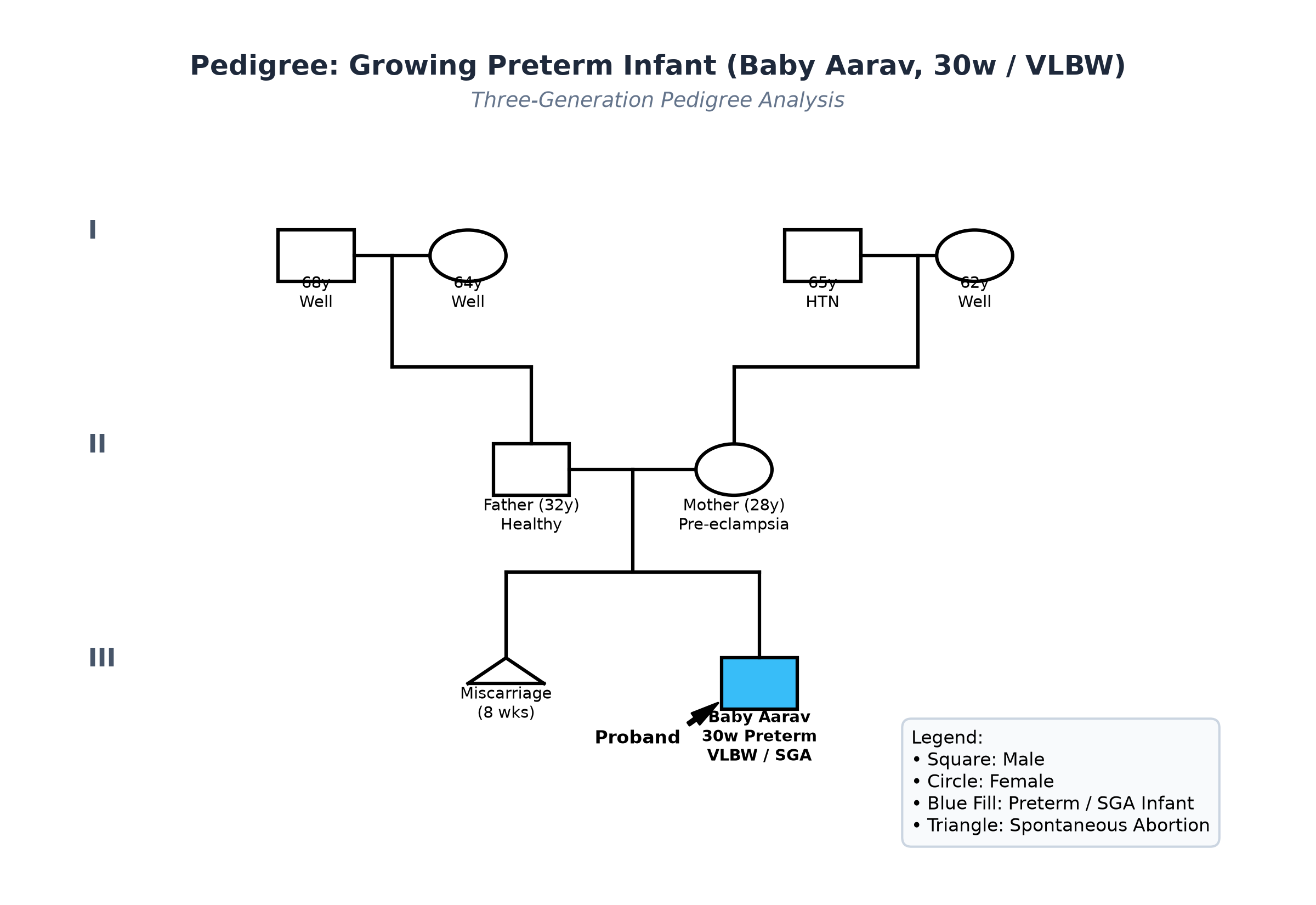
Immunization History
- Received Birth doses of Hepatitis B vaccine ($0.5\text{ mL IM}$ in anterolateral thigh), Oral Polio Vaccine (zero dose), and BCG vaccine ($0.05\text{ mL intradermal}$) once clinically stable and weight reached $>1.5\text{ kg}$.
- Mother counselled that future vaccinations are administered strictly as per chronological age, not corrected age!
Detailed Nutritional & Feeding History
The infant is currently receiving expressed breast milk fortified with multi-nutrient Human Milk Fortifier (HMF) via direct breastfeeding supplemented with paladai:
- Current weight: $1.72\text{ kg}$.
- Total daily feed volume: $160\text{ mL/kg/day}$ = $1.72 \times 160 = 275\text{ mL/day}$ divided into 8 feeds ($34-35\text{ mL}$ every 3 hours).
- Breast milk fortification: 1 sachet HMF added per $50\text{ mL}$ EBM, providing approximately $80\text{ kcal/100 mL}$ and $2.2\text{ g protein/100 mL}$.
| Feeding Modality | Volume / Day | Caloric Delivery | Protein Delivery |
|---|---|---|---|
| Fortified EBM ($80\text{ kcal/dL}$) | 275 mL | $220\text{ kcal/day}$ ($128\text{ kcal/kg/day}$) | $6.05\text{ g/day}$ ($3.52\text{ g/kg/day}$) |
| Target Daily Requirement (VLBW) | $150-180\text{ mL/kg/day}$ | $110-130\text{ kcal/kg/day}$ | $3.5-4.5\text{ g/kg/day}$ |
| Deficit / Adequacy | Adequate ($160\text{ mL/kg}$) | Optimal target met ($128\text{ kcal/kg}$) | Optimal target met ($3.52\text{ g/kg}$) |
The expected calories and proteins should be calculated from the target weight and gestation.
- Micronutrient Supplementation:
- Elemental Iron: Started at 2 weeks postnatal age at $3\text{ mg/kg/day}$ ($5.1\text{ mg/day}$ oral drops).
- Vitamin D3: $800\text{ IU/day}$ oral drops started from day 7 of life.
- Calcium & Phosphorus: Syrup delivering elemental Calcium $150\text{ mg/kg/day}$ and Phosphorus $75\text{ mg/kg/day}$ for metabolic bone disease prevention.
- Multivitamin drops: $0.5\text{ mL}$ daily providing Vitamin A, C, E, and B-complex.
Socioeconomic and KAP
- Modified Kuppuswamy Class II (Upper Middle). Parents are literate (Father an engineer, Mother a schoolteacher).
- Mother demonstrates flawless technique of Kangaroo Mother Care, hand hygiene, and expressed breast milk expression and cup/paladai feeding.
Summary of History
Baby of Sunita, a 36-day-old male infant born at 30 weeks gestation by emergency LSCS for severe maternal pre-eclampsia with AEDF, birth weight 1150g (VLBW, SGA), now at PMA 35 weeks 1 day weighing 1720g, with a NICU course complicated by respiratory distress syndrome managed with LISA and CPAP, hemodynamically significant PDA closed medically with paracetamol, indirect hyperbilirubinemia treated with phototherapy, now thriving on fortified breast milk and KMC with an average weight gain of $22\text{ g/kg/day}$ over the last 10 days, without active sepsis or neurological deficits.
I would like to formulate a provisional clinical diagnosis of: Growing Preterm Infant (Gestational Age: 30 weeks, Chronological Age: 36 days, Post-Menstrual Age: 35 weeks 1 day, Corrected Age: Minus 5 weeks), born Very Low Birth Weight (VLBW) and Small for Gestational Age (SGA), recovering from Respiratory Distress Syndrome and Hemodynamically Significant PDA, currently in the Growing Phase on Enteral Feeding and KMC.
General Physical & Anthropometric Examination
- General Appearance: Sleeping peacefully in Kangaroo Mother Care position between mother's breasts; comfortable in room air; no respiratory distress; pink; no jaundice, cyanosis, clubbing, or peripheral edema.
- Vitals:
- Heart Rate: 138 beats/minute, regular, normal volume, all peripheral pulses palpable and equal bilaterally.
- Respiratory Rate: 42 breaths/minute, unlabored, no retractions, Silverman-Anderson score 0/10.
- Axillary Temperature: $36.8^\circ\text{C}$ (Normothermic under KMC).
- Capillary Refill Time: $<2$ seconds.
- $\text{SpO}_2$: 97% in room air.
Detailed Anthropometry & Growth Velocity (Fenton 2013 Preterm Growth Chart)
| Parameter | At Birth (30 wks) | Current (35w 1d PMA) | Centile (Birth) | Centile (Current) | Growth Velocity / Inference |
|---|---|---|---|---|---|
| Weight | 1150 g | 1720 g | $<10^{\text{th}}$ centile (SGA) | $15^{\text{th}}-25^{\text{th}}$ centile | $+22.6\text{ g/kg/day}$ (Target $\ge 15-20$) |
| Length | 37.5 cm | 42.0 cm | $<10^{\text{th}}$ centile | $10^{\text{th}}-25^{\text{th}}$ centile | $+0.9\text{ cm/week}$ (Target $\ge 0.8-1.0$) |
| Head Circumference | 26.5 cm | 29.5 cm | $10^{\text{th}}$ centile | $25^{\text{th}}$ centile | $+0.6\text{ cm/week}$ (Target $\ge 0.5-0.7$) |
- Growth Velocity Calculation: $$\text{Weight Velocity (g/kg/day)} = \frac{\text{Current Wt (g)} - \text{Regained Birth Wt (g)}}{\text{Mean Weight (kg)} \times \text{Days Elapsed}} = \frac{1720 - 1150}{1.435 \times 22} = 22.6\text{ g/kg/day}$$ (Target intrauterine growth velocity is achieved: $>15-20\text{ g/kg/day}$).
Systematic Physical Examination
- Head to Toe Examination:
- Head: Normocephalic, anterior fontanelle is flat, soft ($1.5 \times 1.5\text{ cm}$), sutures are normal, no overlapping or wide gaping; posterior fontanelle admits fingertip; no craniotabes; no caput or cephalhematoma.
- Facies: Normal neonatal facies; no dysmorphism.
- Eyes: Normal palpebral fissures; red reflex present bilaterally; pupils equal and briskly reactive to light.
- Ears: Pinna well formed with quick recoil (consistent with 35 weeks PMA maturity); external auditory canals patent.
- Oral Cavity: Pink mucosa, intact palate, vigorous non-nutritive and nutritive suckling reflexes.
- Skin: Pink, smooth, minimal lanugo remaining over back, no jaundice, no superficial skin peeling, no purpura.
- Spine: Straight, no sacral dimple, no tuft of hair or hemangioma.
- Genitalia: Male infant; bilateral testes descended into upper scrotum; well-formed scrotal rugae covering anterior scrotum; stretched penile length $3.2\text{ cm}$.
Detailed Systemic Examination
Central Nervous System & Neonatal Neurological Assessment
- Sensorium: Alert, cyclic periods of quiet wakefulness, active sleep, and alert feeding readiness.
- Posture: Semi-flexed posture of all four limbs with moderate abduction of hips (consistent with 35 weeks PMA).
- Tone Assessment (Amiel-Tison / Ballard):
- Heel-to-Ear Maneuver: Popliteal angle $110^\circ$ (flexor tone improving).
- Scarf Sign: Elbow meets midline of thorax with resistance (matures from floppy 30-week posture).
- Ventral Suspension: Head momentarily aligned with trunk, limbs flexed.
- Primitive Reflexes:
- Rooting Reflex: Well elicited, turns head briskly to tactile stimulus.
- Sucking Reflex: Well developed; smooth suck-swallow-breath coordination demonstrated during feeding.
- Moro Reflex: Complete; brisk abduction and extension of upper limbs with gentle adduction.
- Palmar & Plantar Grasp: Strong and symmetrical bilaterally.
Cardiovascular System
- Inspection: Precordium quiet, no visible apical impulse, no sternal hyperactivity.
- Palpation: Apex impulse in 4th left intercostal space just lateral to midclavicular line; no heave, thrill, or pulsations.
- Auscultation: First and second heart sounds heard clearly; S2 physiologically split; no murmurs heard currently (resolving/closed PDA). Peripheral pulses (femoral, brachial, radial) normal and equal bilaterally with no radio-femoral delay.
Respiratory System
- Inspection: Chest symmetrical, respiratory rate 42/min, regular, abdominal-predominant breathing without subcostal or intercostal retractions.
- Auscultation: Bilateral vesicular breath sounds equal in all lung zones; no crepitations, rhonchi, or stridor.
Abdomen & Gastrointestinal System
- Inspection: Abdomen slightly rounded, soft, moves uniformly with respiration; umbilicus healthy, cord fell off on day 8 without discharge or hernia.
- Palpation: Soft, non-tender, no guarding. Liver palpable $1.5\text{ cm}$ below right costal margin, soft, smooth, non-tender. Spleen not palpable. No palpable renal masses or fullness.
- Auscultation: Normal bowel sounds present (4-6 per minute).
Summary
Baby of Sunita, a 36-day-old male infant born at 30 weeks gestation with birth weight 1150g (VLBW, SGA), currently at 35 weeks 1 day PMA weighing 1720g, demonstrates excellent catch-up growth velocity ($22.6\text{ g/kg/day}$), established oral suck-swallow coordination, normothermia in KMC, normal systemic examination, and no signs of neurodevelopmental compromise.
Final Clinical Diagnosis: Growing Preterm Male Infant (30 weeks Gestation, Chronological Age 36 Days, Post-Menstrual Age 35 Weeks 1 Day, Corrected Age Minus 5 Weeks), born Very Low Birth Weight (VLBW) and Small for Gestational Age (SGA), recovering successfully from Respiratory Distress Syndrome and Hemodynamically Significant PDA, currently thriving on Fortified Enteral Nutrition and Kangaroo Mother Care.
Differential / Problem-Oriented Risk Evaluation
| Clinical Problem | Risk Factors Present | Current Status & Surveillance Plan |
|---|---|---|
| Extrauterine Growth Restriction (EUGR) | Preterm 30w, SGA, initial TPN dependency | Overcoming with fortified breast milk; gaining $22.6\text{ g/kg/day}$; weight moved from $<10\text{th}$ to $20\text{th}$ centile |
| Retinopathy of Prematurity (ROP) | Preterm $<32\text{w}$, VLBW $<1500\text{g}$, supplemental oxygen | Screened at 4 weeks: Zone II, Stage 1 without plus disease; repeat indirect ophthalmoscopy weekly |
| Metabolic Bone Disease of Prematurity | Gestation $<32\text{w}$, VLBW, rapid postnatal bone growth | Screen at 4-6 weeks with Serum ALP, Calcium, Phosphorus, and Urine TRP; supplement Ca, P, Vit D3 |
| Anemia of Prematurity | Shortened gestation, iatrogenic phlebotomy losses | Hemoglobin $10.8\text{ g/dL}$; on oral elemental iron $3\text{ mg/kg/day}$; monitor reticulocytes and Hb |
| Neurodevelopmental Impairment | Preterm 30w, SGA with antenatal AEDF | Normal serial neurosonograms; normal tone and primitive reflexes; enrol in Infant Stimulation program |
Investigation & Surveillance Protocol
flowchart TD
    A["Growing Preterm Infant (35 Weeks PMA, Wt 1720g)"] --> B["Growth & Nutrition: Serial Weight, Length, HC plotted on Fenton 2013"]
    B --> C["Metabolic Surveillance (4-6 wks): Ca, PO4, ALP, Spot Urine Ca/Cr, TRP"]
    C --> D["Hematologic: CBC, Peripheral Smear, Reticulocyte Count (Anemia of Prematurity)"]
    D --> E["ROP Screening: Serial Indirect Ophthalmoscopy until Full Vascularization (Zone III)"]
    E --> F["Hearing Screen: BERA / AABR prior to Discharge"]
    F --> G["Neuroimaging: High-Resolution Neurosonogram (rule out late PVL)"]
    G --> H["Discharge Readiness: ≥1.8 kg, Stable Temp in Room Air, Confident KMC"]
1. Metabolic & Hematologic Panel
| Parameter | Observed Value | Normal Reference Range (Preterm) | Inference |
|---|---|---|---|
| Hemoglobin | $10.8\text{ g/dL}$ | $10.0-14.0\text{ g/dL}$ (at 1 month) | Physiological Anemia of Prematurity (Stable) |
| Serum Ferritin | $85\text{ ng/mL}$ | $>50\text{ ng/mL}$ | Adequate iron stores under supplementation |
| Serum Calcium | $9.4\text{ mg/dL}$ | $8.8-10.2\text{ mg/dL}$ | Normocalcemia |
| Serum Phosphorus | $5.2\text{ mg/dL}$ | $4.5-6.5\text{ mg/dL}$ | Normal; excludes acute phosphate depletion |
| Alkaline Phosphatase (ALP) | $540\text{ IU/L}$ | $<800\text{ IU/L}$ | Normal; no active metabolic bone disease ($>900$ is abnormal) |
| Tubular Resorption of Phosphate (TRP) | $88\%$ | $80-95\%$ | Normal renal handling of phosphate |
2. Specialized Screening Modalities
- Indirect Ophthalmoscopy (Retinopathy of Prematurity):
- Dilated fundus examination using $2.5\%$ Phenylephrine and $0.5\%$ Tropicamide drops.
- Findings: Zone II, Stage 1 (demarcation line) without plus disease; avascular retina in anterior Zone II/III; follow-up examination in 1 week.
- Hearing Screening: Automated Auditory Brainstem Response (AABR) showed normal bilateral wave V latencies at $35\text{ dB nHL}$ (Pass).
- Neurosonogram: Normal ventricular dimensions; Evans index $<0.30$; no subependymal hemorrhage; no periventricular echogenicity.
Comprehensive Multidisciplinary Management Plan
1. Kangaroo Mother Care (KMC) Protocol
- Provide at least 12 to 16 hours of continuous skin-to-skin contact daily by the mother, supported by the father and grandmother.
- Maintain infant in upright frog-leg position between maternal breasts; head turned sideways with neck in neutral position to prevent upper airway obstruction.
- Benefits reinforced to parents: reduces mortality by $40\%$, hypothermia by $70\%$, and serious infections by $65\%$, while accelerating weight gain and exclusive breastfeeding.
2. Nutritional Optimization & Feed Advancement
- Continue direct breastfeeding on cue supplemented with expressed breast milk (EBM) fortified with multi-nutrient HMF ($80\text{ kcal/100 mL}$).
- Target feed volume: $160-180\text{ mL/kg/day}$ delivering $125-135\text{ kcal/kg/day}$ and $3.5-4.0\text{ g/kg/day}$ of protein.
- Maintain daily weight checks using electronic infant weighing scale (accuracy $\pm 5\text{ g}$); target weight gain is $\ge 15-20\text{ g/kg/day}$.
3. Micronutrient Prophylaxis
- Elemental Iron: Continue $3\text{ mg/kg/day}$ of elemental iron orally until 12 months of chronological age.
- Vitamin D3: Continue $800\text{ IU/day}$ orally until 40 weeks PMA, then $400\text{ IU/day}$ until 1 year of age.
- Calcium & Phosphorus: Continue supplementation until full solid weaning diet is established and ALP remains $<600\text{ IU/L}$.
4. Discharge Criteria & Follow-Up Schedule
- Discharge Readiness Check:
- Infant is gaining weight consistently at $\ge 15-20\text{ g/kg/day}$ for 3 consecutive days.
- Maintaining body temperature ($36.5-37.5^\circ\text{C}$) in room air without KMC for at least 4-6 hours.
- Taking all feeds by breast or paladai with full suck-swallow-breath coordination; no apnea or bradycardia for $>48-72\text{ hours}$.
- Weight reached $\ge 1.8\text{ kg}$ and mother is confident in danger sign recognition.
- High-Risk Clinic Follow-up Schedule:
- Weekly until 40 weeks PMA (term equivalent).
- Every 2 weeks until 3 months corrected age.
- Monthly until 6 months corrected age, then every 3 months until 2 years of age.
- Neurodevelopmental assessment using the Development Assessment Scale for Indian Infants (DASII) or Amiel-Tison evaluation at 3, 6, 9, 12, 18, and 24 months corrected age.