
Miss Tanushree, a 5 year old girl, 1st order child born of a non-consanguineous marriage from Bhubaneswar, Odisha presented with complaints of low-to-moderate grade fever with evening rise since 4 weeks, persistent unremitting cough since 3.5 weeks, loss of appetite and progressive weight loss since 1 month, and a history of close household contact with an adult treated for pulmonary tuberculosis.
- Persistent, low-to-moderate grade fever $>2\text{ weeks}$ (characteristically with an evening rise and night sweats)
- Unremitting, persistent dry or moist cough $>2\text{ weeks}$ (unresponsive to standard broad-spectrum oral antibiotics)
- Failure to thrive or documented weight loss ($>5\%$ over 3 months or crossing two percentile lines downwards)
- Anorexia, apathy, decreased playful activity, and fatigue
- History of close contact with an active adult pulmonary TB patient in the household within the preceding 24 months
HOPI
The history is dated back to 4 weeks ago when the child developed an insidious onset of fever.
Always establish:
- Presumptive TB Definition (NTEP): Persistent fever $>2\text{ weeks}$, cough $>2\text{ weeks}$, or unexplained weight loss/FTT.
- Index Contact Details: Proximity, duration of exposure, sputum AFB/CBNAAT status of the contact, and whether child received TB Preventive Therapy (TPT).
- Absence of Typical Adult Features: Hemoptysis, chest pain, and copious sputum are RARE in young children (paucibacillary, primary disease with lymphadenopathy rather than cavitary disease).
- Fever:
- Present for 4 weeks, low-to-moderate grade ($38.0^\circ\text{C}$ to $38.5^\circ\text{C}$).
- Characteristically rises in the evening and late afternoon, accompanied by night sweats (mother notes child waking up with damp clothes and scalp sweating).
- Subsided transiently with oral paracetamol and an outpatient course of oral amoxicillin-clavulanate for 7 days, but fever recurred immediately upon stopping antibiotics.
- Cough:
- Began 3.5 weeks ago, insidious, dry, and irritating at first, becoming brassy/paroxysmal over the past 2 weeks Brassy paroxysmal cough points to enlarged subcarinal / tracheobronchial lymph nodes compressing the trachea or mainstem bronchi.
- Persistent throughout day and night; child does not expectorate sputum but swallows secretions.
- No history of post-tussive vomiting, inspiratory whoop, or cyanosis during cough spasms (rules out Pertussis).
- Nutritional Decline (Weight Loss & Anorexia):
- Marked loss of appetite over the past month; child refuses home-cooked meals and prefers only liquids.
- Documented weight 1 month ago at local Anganwadi center was $16.5\text{ kg}$; current weight is $14.2\text{ kg}$ (weight loss of $2.3\text{ kg} = 13.9\%$ of body weight, fulfilling NTEP criteria for significant weight loss).
- Mother reports the child has become quiet, irritable, and reluctant to play with other children.
- History of Contact with Active Tuberculosis (Critical Epidemiological Link):
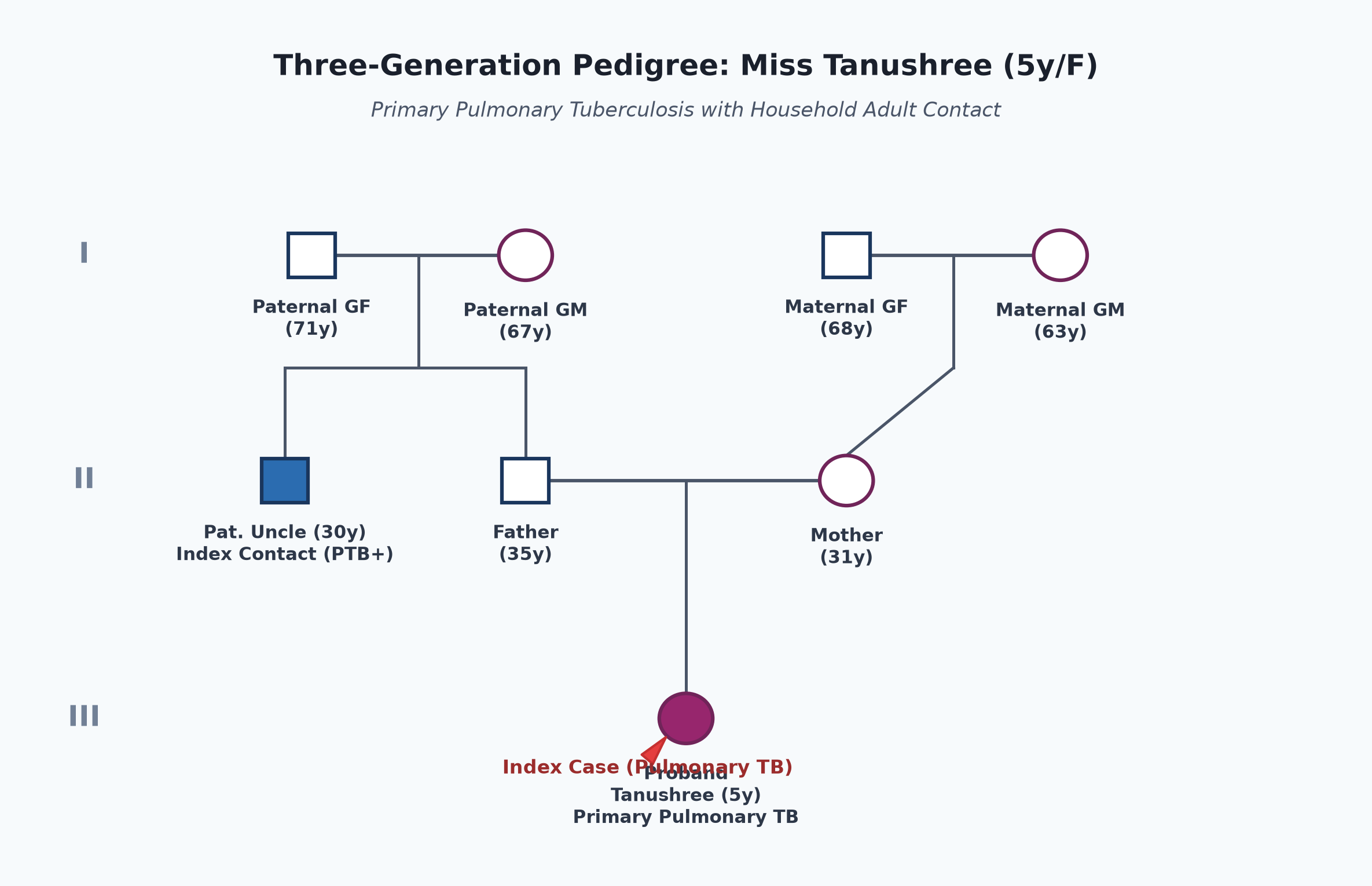
- Paternal uncle (30 years) living in the same undivided household was diagnosed with Microbiologically Confirmed Pulmonary Tuberculosis (Sputum Smear 3+ AFB & CBNAAT positive, Rifampicin-sensitive) 3 months ago.
- The child frequently spent several hours daily in the uncle's room before he was initiated on anti-tubercular therapy.
- Uncle is currently in the continuation phase of NTEP treatment.
- Crucial Examiner Trap: The child was NOT screened or initiated on TB Preventive Therapy (TPT / Isoniazid prophylaxis) at the time of the uncle's diagnosis, representing a missed opportunity for prevention!
- Negative History:
- No history of hemoptysis (coughing blood) Cavitation is rare in primary pediatric pulmonary TB; hemoptysis usually occurs only in adolescent post-primary adult-type cavitary TB.
- No history of headache, projectile vomiting, seizures, abnormal behavior, or altered sensorium Rules out central nervous system tuberculosis (Tubercular Meningitis / Tuberculoma).
- No history of neck swellings or discharging sinuses Rules out scrofuloderma / peripheral tubercular cervical lymphadenitis.
- No history of joint pains, limp, back pain, or spinal deformity Rules out skeletal TB / Pott's spine.
- No history of abdominal distension, ascites, or chronic diarrhea Rules out abdominal / peritoneal tuberculosis.
Past History
- Born at term; uneventful neonatal period; normal developmental milestones.
- History of measles vaccination received at 9 months; no history of recent exanthematous fever (measles) or chickenpox in the past 6 months (which would cause temporary cell-mediated immunosuppression and tuberculin skin test anergy).
- No prior history of receiving Anti-Tubercular Therapy (ATT).
Family history
- Non-consanguineous marriage.
- Father 35 years, clerk; mother 31 years, teacher. Both healthy.
- Paternal uncle (30 years) residing in the same household treated for active smear-positive pulmonary TB.
- No family history of multi-drug resistant tuberculosis (MDR-TB).
Immunization history
- Fully immunized up to age as per the National Immunization Schedule (UIP).
- BCG vaccine administered at birth on the left upper arm.
- Presence of a well-formed, healthy BCG scar (5 mm diameter) over the left deltoid insertion.Examiner Pearl: BCG Scar Interpretation
The presence of a BCG scar confirms receipt of the vaccine (protecting against severe disseminated forms like TBM and miliary TB), but DOES NOT rule out primary pulmonary tuberculosis!
Dietary history
- Normal mixed vegetarian family diet prior to illness; appetite significantly decreased over the past 4 weeks.
| Food Item | Quantity | Calories (kcal) | Protein (g) |
|---|---|---|---|
| Milk with sugar | 300 mL | 210 | 9.0 |
| Rice with dal | 1 small plate | 280 | 7.5 |
| Biscuits | 2 biscuits | 70 | 1.0 |
| Total Observed Intake | — | 560 kcal | 17.5 g |
24-Hour Recall Deficit Analysis
$$ \text{Ideal Body Weight (IBW for 5-year-old girl, 50th centile WHO)} = 18.2\text{ kg} $$| Nutrient | Expected Intake (ICMR-NIN 2024 for 4-6 years) | Observed Intake | Deficit | Percentage Deficit |
|---|---|---|---|---|
| Energy (kcal) | $1360\text{ kcal/day}$ | 560 kcal | 800 kcal | 58.8% Deficit |
| Protein (g) | $16.0\text{ g/day}$ | 17.5 g | 0 g | No Deficit |
The expected calories and proteins should be calculated from the ideal body weight, not from current weight.
Socioeconomic and KAP
- Modified BG Prasad Class II (Upper Middle Class).
- Urban pucca house with tap water.
- Parents were hesitant to disclose the uncle's TB status due to social stigma, leading to delayed medical presentation.
Summary of History
Miss Tanushree, a 5-year-old girl, presented with 4 weeks of persistent low-grade fever with evening rise, 3.5 weeks of dry brassy cough, documented significant weight loss ($13.9\%$), and anorexia, with documented close household contact with an adult smear-positive pulmonary TB patient, without central nervous system, gastrointestinal, or skeletal complaints.
I would like to think of a Presumptive Pediatric Pulmonary Tuberculosis (fulfilling NTEP 2024 clinical criteria), anatomically consistent with Primary Complex / Intrathoracic Lymphadenopathy, in a BCG-vaccinated child, complicated by moderate acute malnutrition.
General head to toe examination
- Child Behavioral State: Calm, conscious, subdued, cooperative (Prechtl State 3).
- Vitals:
- Heart Rate: 104 beats/minute, regular, normal volume.
- Respiratory Rate: 26 breaths/minute, normal pattern, no grunting, no retractions at rest.
- Blood Pressure: Right arm supine: $92/58\text{ mmHg}$ (normal for age/sex).
- Temperature: $37.9^\circ\text{C}$ (evening recorded temperature).
- Oxygen Saturation ($SpO_2$): 98% on room air.
- Anthropometry:
| Parameter | Observed | Expected (50th WHO) | Z-score / Centile | Inference |
|---|---|---|---|---|
| Weight | 14.2 kg | 18.2 kg | $-2.4\text{ SD}$ | Moderate Underweight |
| Height | 107 cm | 109.5 cm | Normal | Normal Linear Growth |
| Weight-for-Height | 14.2 kg for 107 cm | 17.6 kg | $-2.2\text{ SD}$ | Moderate Acute Malnutrition (Wasting) |
| Mid-Upper Arm Circumference | 12.8 cm | >13.5 cm | Normal-Borderline | Borderline Wasting |
- Head to Toe Findings:
- BCG Scar: Present over left deltoid, 5 mm, well-healed, non-keloidal.
- Pallor: Mild palpebral conjunctival pallor.
- Lymphadenopathy: No palpable cervical, axillary, or epitrochlear lymph nodes $>1\text{ cm}$; no matted nodes.
- No icterus, cyanosis, clubbing, or pedal edema.
- Skin: No erythema nodosum, no scrofuloderma, no phlyctenular keratoconjunctivitis on eye examination.
Systemic Examination
Respiratory System
- Inspection:
- Symmetrical chest, normal shape, no chest wall deformity, no prominent veins.
- Bilateral symmetrical respiratory movements; no intercostal or subcostal indrawing at rest.
- Trachea is central; suprasternal notch inspection normal.
- Palpation:
- Trachea is midline.
- Chest expansion is symmetrical ($3.0\text{ cm}$ excursion).
- Tactile Vocal Fremitus (TVF): Normal and symmetrical throughout all lung zones.
- Percussion:
- Resonant percussion note heard symmetrically over all bilateral lung zones anteriorly, laterally, and posteriorly.
- D'Espine Sign: Positive (percussion over the upper thoracic spinous processes yields a dull/impaired note below T3/T4 level, pointing to enlarged subcarinal / tracheobronchial lymph nodes).
- Auscultation:
- Breath Sounds: Normal vesicular breath sounds audible over both lung fields.
- Monophonic Wheeze: Localized, fixed, unilateral monophonic expiratory wheeze audible over the right interscapular and axillary areas Caused by partial extrinsic compression of the right main bronchus by enlarged subcarinal / tracheobronchial tubercular lymph nodes.
- Adventitious Sounds: Scattered fine inspiratory crackles (post-tussive crepitations) audible in the right infraclavicular area after coughing.
- Vocal resonance: Symmetrical, no bronchophony.
other systems
- Cardiovascular System: Normal heart sounds ($S_1, S_2$), no murmurs, no pericardial rub.
- Abdomen:
- Soft, non-tender; liver palpable 1 cm below right costal margin (soft, normal span); spleen not palpable.
- No doughy abdomen, no palpable mesenteric lymph node masses, no ascites.
- Central Nervous System: Normal higher mental functions; no cranial nerve palsy; neck supple; Kernig sign negative.
Summary
Miss Tanushree, a 5-year-old girl, presented with 4 weeks of persistent low-grade evening fever, 3.5 weeks of unremitting brassy cough, $13.9\%$ documented weight loss, and anorexia, with close household contact with an adult smear-positive pulmonary TB index case.
On examination, she has a 5 mm BCG scar, moderate wasting ($-2.2\text{ SD}$ weight-for-height), localized monophonic wheeze and post-tussive crackles over the right upper zone, and a positive D'Espine sign, with no palpable peripheral lymphadenopathy or hepatosplenomegaly.
Probable Clinical Diagnosis: Pediatric Primary Pulmonary Tuberculosis (Microbiologically Confirmed or Clinically Diagnosed), manifesting as Primary Complex with Tracheobronchial Lymphadenopathy and Localized Right Upper Lobe Infiltration, complicated by Moderate Acute Malnutrition (MAM), in a BCG-vaccinated child.
Differential Diagnosis
| Disease | Points IN FAVOR | Points AGAINST |
|---|---|---|
| Pediatric Pulmonary Tuberculosis | • Prolonged fever $>2$ weeks + cough $>2$ weeks • Household contact with smear-positive adult TB • Significant weight loss ($>5\%$), anorexia • Localized monophonic wheeze, positive D'Espine | Primary Diagnosis |
| Atypical Pneumonia (Mycoplasma) | • Persistent dry cough, low fever, normal breath sounds | • Resolves within 2-3 weeks; does not cause profound progressive weight loss or history of household TB contact |
| Foreign Body Inhalation (Retained) | • Localized monophonic wheeze, unremitting cough | • Sudden acute onset of choking/gagging is absent • Does not explain prolonged fever and night sweats |
| Childhood Bronchial Asthma | • Recurrent cough, wheeze | • Cough is paroxysmal and responsive to bronchodilators • Bilateral polyphonic wheezing, not localized monophonic wheezing • No fever, night sweats, or weight loss |
Investigation Protocol & Diagnostic Workup
flowchart TD
    A["Presumptive Pediatric Pulmonary TB (Miss Tanushree)"] --> B["1. Microbiological Confirmation (UPFRONT MOLECULAR TESTING)"]
    B --> C["Early Morning Gastric Aspirate / Lavage on 2 Consecutive Days"]
    C --> D["Upfront CBNAAT / GeneXpert MTB/RIF Ultra"]
    D --> E["Detect MTB + Rifampicin Resistance Status within 2 Hours"]
    C --> F["Fluorescent Smear Microscopy (LED-FM) & Liquid Culture (MGIT 960)"]

    A --> G["2. Immunological & Radiological Staging"]
    G --> H["Tuberculin Skin Test (Mantoux Test: 2 TU PPD RT-23)"]
    G --> I["Digital Chest Radiography (CXR PA & Right Lateral)"]

    A --> J["3. Baseline & Safety Tests"]
    J --> K["HIV Rapid Diagnostic Test (Mandatory Provider-Initiated Testing)"]
    J --> L["Liver Function Tests (Baseline AST, ALT, Bilirubin)"]
1. Specimen Collection: Early Morning Gastric Aspirate (GA)
- In children $<8\text{ years}$, voluntary expectoration is not possible.
- Protocol: Fasting for at least 4-6 hours overnight. An 8-10 Fr nasogastric tube is inserted at the bedside before the child awakens/mobilizes on 2 consecutive mornings. Gastric contents ($5-10\text{ mL}$) aspirated; if empty, lavage with $20\text{ mL}$ sterile normal saline and aspirate.
- Specimen Handling: Transport immediately or neutralize with $100\text{ mg}$ sodium bicarbonate if transport delay $>2\text{ hours}$.
2. Upfront Molecular Testing (CBNAAT / GeneXpert MTB/RIF Ultra)
- Result: Mycobacterium tuberculosis DETECTED; Rifampicin Resistance NOT DETECTED.
- High sensitivity and specificity; provides definitive microbiological confirmation and drug susceptibility within 120 minutes.
3. Tuberculin Skin Test (Mantoux Test)
- Method: Intradermal injection of 2 TU of PPD RT-23 with Tween-80 on the volar aspect of the left forearm, raising a discrete $6-10\text{ mm}$ wheal.
- Reading at 48-72 Hours: Measured across the transverse axis of the forearm using a flexible ruler to record the induration (palpable hardness), NOT the erythema: $$ \text{Transverse Induration} = 16\text{ mm} \quad (\ge 10\text{ mm} \text{ is POSITIVE in non-HIV/immunocompetent children}) $$
4. Chest Radiography (Digital CXR - PA and Right Lateral Views)
- Primary Complex / Ranke Complex:
- Right hilar and paratracheal lymphadenopathy with widening of the mediastinal silhouette.
- Subpleural parenchymal focus (Ghon focus) in the right upper zone with draining lymphangitis.
- Right lateral view confirms enlargement of the anterior and middle mediastinal lymph nodes.
5. Ancillary Blood & Screening Tests
- HIV Serology: Negative (mandatory provider-initiated screening as per NTEP).
- CBC: $Hb = 10.4\text{ g/dL}$, $WBC = 9,800/\mu\text{L}$ with mild lymphocytosis ($54\%$), ESR $= 48\text{ mm/hr}$.
- Liver Function Tests: Total Bilirubin $0.6\text{ mg/dL}$, AST $28\text{ U/L}$, ALT $24\text{ U/L}$ (normal baseline prior to starting hepatotoxic ATT).
Management Plan
1. NTEP 2024 Pediatric Anti-Tubercular Therapy (ATT)
For Drug-Susceptible Pediatric Pulmonary Tuberculosis (Weight Band: 12 to 15 kg, current weight $14.2\text{ kg}$):
- Regimen: 2HRZE + 4HRE (Daily, weight-banded therapy using child-friendly dispersible Fixed-Dose Combinations [FDCs]):
- Intensive Phase (IP - 2 Months): Isoniazid (H), Rifampicin (R), Pyrazinamide (Z), Ethambutol (E) daily.
- Continuation Phase (CP - 4 Months): Isoniazid (H), Rifampicin (R), Ethambutol (E) daily.
- Formulation & Daily Dosing (Weight Band 12–15 kg):
- 3-FDC (Dispersible tablet): Containing Isoniazid ($50\text{ mg}$) + Rifampicin ($75\text{ mg}$) + Pyrazinamide ($150\text{ mg}$).
- Dose: 3 tablets daily during the 2-month Intensive Phase.
- Ethambutol (Dispersible tablet 100 mg):
- Dose: 2 tablets (200 mg) daily throughout the 6 months (IP & CP).
- 2-FDC (Dispersible tablet): Containing Isoniazid ($50\text{ mg}$) + Rifampicin ($75\text{ mg}$).
- Dose: 3 tablets daily during the 4-month Continuation Phase.
- 3-FDC (Dispersible tablet): Containing Isoniazid ($50\text{ mg}$) + Rifampicin ($75\text{ mg}$) + Pyrazinamide ($150\text{ mg}$).
- Administration Instruction: Dissolve dispersible tablets in $10-15\text{ mL}$ of boiled, cooled water or breast milk and administer as a single morning dose on an empty stomach (30-60 minutes before breakfast).
2. Pyridoxine (Vitamin B6) Supplementation
- Administer Pyridoxine $10\text{ mg}$ orally once daily throughout ATT therapy to prevent Isoniazid-induced peripheral neuropathy, particularly important due to moderate acute malnutrition.
3. Monitoring for Drug-Induced Liver Injury (DILI)
- Educate parents on early warning signs of hepatotoxicity: persistent vomiting, dark yellow urine, scleral icterus, or abdominal pain.
- Routine biochemical LFT monitoring is not required unless the child becomes clinically symptomatic.
- If ALT rises $>5\text{ times}$ upper limit of normal (ULN) or $>3\text{ times}$ ULN with jaundice, discontinue HRZ immediately.
4. Nutritional Rehabilitation
- Provide high-protein, calorie-dense supplementary nutrition ($150\text{ kcal/kg/day}$ of IBW) via local Anganwadi POSHAN Abhiyaan.
- Link family to Ni-kshay Poshan Yojana (direct benefit cash transfer of ₹500/month for nutritional support during treatment).
5. Household Contact Tracing & TB Preventive Therapy (TPT)
- Screen all household members for symptoms and chest radiography.
- Any child contacts $<5\text{ years}$ without active disease MUST receive TB Preventive Therapy (TPT):
- 6H: Daily oral Isoniazid ($10\text{ mg/kg/day}$) for 6 months, OR
- 3HR: Daily Isoniazid + Rifampicin for 3 months.