
Master Harish, a 9-year-old male child, 1st order child born of a non-consanguineous marriage from Mysuru, Karnataka, presented with complaints of failure to gain height noted over the past 3 to 4 years, lagging significantly behind his classmates, infantile facial appearance, and disproportionate weight gain relative to height.
- Failure to outgrow clothes or change shoe size over 1 to 2 years
- Standing as the shortest child in the classroom or school assembly queue
- Babyish or doll-like facial features with high-pitched voice
- Delayed motor milestones or delayed onset of puberty
- Lethargy, cold intolerance, constipation (if hypothyroid)
- Truncal adiposity with slender extremities (in growth hormone deficiency or Cushing syndrome)
HOPI
The history is dated back to approximately 4 years ago (around 5 years of age) when the parents first observed that the child was barely growing in height compared to his peers in kindergarten and primary school.
Always determine whether the short stature is Normal Variant (Constitutional Delay of Growth and Puberty [CDGP] or Familial Short Stature [FSS]) or Pathological. The single most discriminating clinical parameter is the Annual Growth Velocity: a child growing at $\ge 5\text{ cm/year}$ almost always has a normal variant, whereas a growth velocity $< 4\text{ cm/year}$ is unequivocally pathological! Inquire meticulously about birth weight (SGA/IUGR), systemic symptoms (chronic diarrhea, recurrent respiratory infections, vomiting, headache, visual field defects), and calculate Mid-Parental Height (MPH).
- Failure of Linear Growth & Subnormal Growth Velocity:
- Parents noticed that the child had not changed school uniform sizes or trouser lengths for over 2.5 years.
- Serial school health cards revealed an average height gain of only $2.5\text{ to } 2.8\text{ cm/year}$ over the last 3 years Growth velocity $< 4\text{ cm/year}$ definitively confirms Pathological Short Stature.
- When standing in school assembly, he was placed at the very front of the line, even shorter than 6-year-old first-grade children.
- Infantile Facial Appearance & Truncal Adiposity:
- Despite reaching 9 years of age, he retained chubby, rounded, "doll-like" or cherubic facial features, with a prominent forehead and depressed nasal bridge.
- His voice remained distinctly high-pitched.
- Over the past 2 years, mother observed that while his height remained stagnant, he accumulated fat around the abdomen, chest, and hips, while his limbs remained slender Points to Growth Hormone Deficiency (GHD), where absence of GH lipolytic action promotes centripetal fat accumulation.
- Dentition & Micropenis:
- Primary teeth erupted late; shed his first milk tooth late at 8 years of age.
- Parents noticed that his external genitalia appeared unusually small compared to age-matched boys.
- Negative History:
- No history of chronic headache, early morning vomiting, blurred vision, or bumping into doorways Rules out intracranial space-occupying lesions (craniopharyngioma) compressing the optic chiasm and pituitary stalk.
- No history of polyuria, nocturia, or intense unquenchable thirst Rules out central Diabetes Insipidus (posterior pituitary involvement).
- No history of cold intolerance, sluggishness, hoarse cry, dry coarse skin, or chronic constipation Rules out primary hypothyroidism.
- No history of chronic loose stools, abdominal distension, recurrent aphthous ulcers, or pale greasy stools Rules out celiac disease, inflammatory bowel disease, and cystic fibrosis.
- No history of prolonged oral steroid intake, puffiness of face, purple abdominal striae, or easy bruising Rules out endogenous Cushing syndrome or steroid-induced growth failure.
- No history of bony deformities, bowed legs, joint swellings, or fractures Rules out skeletal dysplasias (achondroplasia, hypochondroplasia) and refractory rickets.
Past History
- Full-term normal vaginal delivery at hospital; birth weight 2.8 kg (appropriate for gestational age, AGA); length 49 cm.
- Neonatal period: Had an episode of asymptomatic hypoglycemia on Day 2 of life (blood glucose $32\text{ mg/dL}$), managed with IV dextrose; prolonged unconjugated neonatal jaundice lasting 3 weeks; no exchange transfusion required Neonatal hypoglycemia and prolonged cholestasis/jaundice are classic early neonatal heralds of Congenital Hypopituitarism!
- No history of cranial irradiation, head trauma, meningitis, or encephalitis.
Family history
- Born of a non-consanguineous marriage.
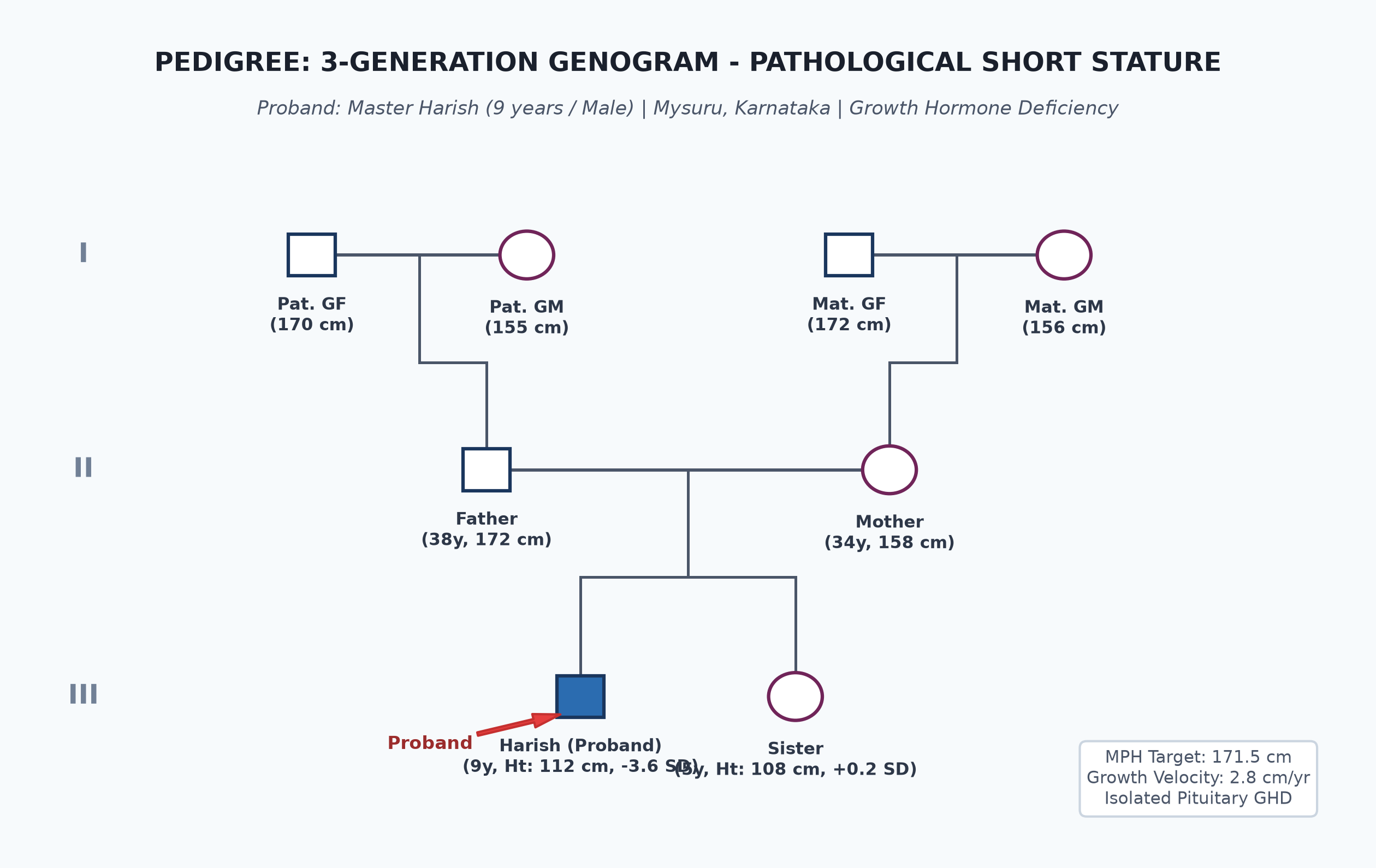
- Father 38 years old, height 172 cm.
- Mother 34 years old, height 158 cm.
- Younger sister (5 years old) is healthy with normal height (108 cm, $50^{\text{th}}$ centile).
- Both parents had normal pubertal timing (mother attained menarche at 13 years; father attained adult height by 17 years; no family history of constitutional delay).
Mid-Parental Height (MPH) Target Calculation
$$ \text{MPH for a Boy} = \frac{\text{Father's Height} + (\text{Mother's Height} + 13)}{2} = \frac{172 + (158 + 13)}{2} = \frac{172 + 171}{2} = 171.5\text{ cm} $$$$ \text{Target Height Range} = 171.5 \pm 5\text{ cm} \quad (166.5\text{ cm to } 176.5\text{ cm}) $$The child's projected adult height from his current percentile is $< 145\text{ cm}$, far below the mid-parental target range, ruling out Familial Short Stature.
Immunization history
- Fully immunized up to age as per UIP, including BCG, Pentavalent, OPV, fIPV, Rotavirus, PCV, MR (1 and 2), and DPT boosters.
Dietary history
- Consumes a normal balanced home diet of rice, sambar, vegetables, milk, and eggs.
- Dietary recall confirms adequate caloric and protein intake meeting 100% of ICMR-NIN RDA for age, ruling out primary nutritional stunting.
Socioeconomic and KAP
- Modified BG Prasad Socioeconomic Class I (Upper Class).
- Both parents are college-educated; seeking specialized endocrine evaluation.
Summary of History
Master Harish, a 9-year-old boy born of non-consanguineous parentage from Mysuru, presented with severe chronic growth failure with subnormal growth velocity ($2.8\text{ cm/year}$), cherubic infantile facies, high-pitched voice, truncal obesity, micropenis, delayed dental shedding, and neonatal history of hypoglycemia and jaundice, in the absence of neurological signs, hypothyroidism, malabsorption, or skeletal dysplasia, with parents of normal adult stature.
I would like to think of Pathological Proportionate Short Stature, most likely Isolated Growth Hormone Deficiency (GHD), presenting in prepubertal phase without features of raised intracranial pressure or panhypopituitarism.
General head to toe examination
- Behavioral State: Alert, cheerful, cooperative, bright and interactive, age-appropriate cognitive performance.
- Vitals:
- Pulse Rate: 84 beats/minute, regular, normal volume.
- Respiratory Rate: 18 breaths/minute, regular.
- Blood Pressure: $96/62\text{ mmHg}$ ($50^{\text{th}}$ centile, normotensive).
- Temperature: $36.8^\circ\text{C}$ (afebrile).
- Comprehensive Anthropometry:
| Parameter | Observed | Expected (50th IAP / WHO) | Z-score / Centile | Inference |
|---|---|---|---|---|
| Chronological Age | 9 years 0 months | — | — | — |
| Height | 112.0 cm | 132.5 cm | $< -3.6\text{ SD}$ | Severe Short Stature ($<3^{\text{rd}}$ centile) |
| Height Age | 5 years 6 months | — | — | Markedly delayed |
| Weight | 22.5 kg | 28.0 kg | $-1.5\text{ SD}$ | Relatively preserved weight |
| Weight Age | 6 years 6 months | — | — | Weight age > Height age |
| BMI | $17.9\text{ kg/m}^2$ | $15.5\text{ kg/m}^2$ | $+1.5\text{ SD}$ | Overweight / Truncal adiposity |
| Annual Growth Velocity | $2.8\text{ cm/year}$ | $\ge 5.0\text{ cm/year}$ | $< -2.5\text{ SD}$ | Pathological Growth Failure |
| Upper Segment (US) | 57.5 cm | — | — | Sitting height |
| Lower Segment (LS) | 54.5 cm | — | — | Height minus US |
| US : LS Ratio | $57.5 : 54.5 = \mathbf{1.05}$ | Expected for 9y: $1.00 - 1.05$ | Normal | Proportionate Short Stature |
| Arm Span | 111.5 cm | — | $\Delta = -0.5\text{ cm}$ | Normal (Arm span equals height $\pm 2$ cm) |
- Physical Stigmata & Specific Findings:
- Facies: Rounded, infantile, "cherubic" / "doll-like" facies with chubby cheeks, prominent forehead, and depressed nasal bridge.
- Voice: High-pitched, childlike voice.
- Body Habitus: Centripetal / truncal adiposity with excess subcutaneous fat over abdomen and chest (pseudogynecomastia); extremities appear relatively thin.
- Skin & Hair: Fine, soft skin; scalp hair normal, no frontal balding; no purple striae, no hirsutism, no acanthosis nigricans.
- Head & Neck: Head circumference 52.0 cm (normal); no goiter; thyroid gland non-palpable; no webbing of neck, no low posterior hairline (rules out Turner/Noonan).
- Hands & Feet: No brachydactyly, no short 4th/5th metacarpals (rules out Pseudohypoparathyroidism / Albright hereditary osteodystrophy); carry angle normal ($10^\circ$).
- Genitalia & Pubertal Staging (Tanner Staging):
- Pubic Hair: Stage P1 (none).
- Axillary Hair: Absent.
- Testes: Bilateral descended in scrotum; testicular volume 2 mL bilaterally (Prader orchidometer) -> Prepubertal.
- Stretched Penile Length (SPL): 2.8 cm (Normal for 9y is $6.0 \pm 1.0\text{ cm}$; $< -2.5\text{ SD}$ -> Micropenis).
Systemic Examination
- Central Nervous System:
- Fully oriented, intelligent, normal speech articulation.
- Cranial Nerves: Visual acuity 6/6 bilaterally; Visual confrontation test normal (no bitemporal hemianopia); cranial nerves I-XII normal.
- Fundoscopy: Bilateral optic disc margins sharp and distinct; cup-to-disc ratio 0.3; no papilledema, no optic atrophy.
- Motor and sensory examinations completely normal.
- Cardiovascular & Respiratory Systems: Clinically normal; no cardiac murmurs.
- Abdomen: Soft, protuberant due to laxity and subcutaneous fat, no organomegaly; liver and spleen not palpable.
Summary
Master Harish, a 9-year-old prepubertal boy born of non-consanguineous parents, presents with severe proportionate short stature (Height 112 cm, $<-3.6$ SD; Height age 5.5 years), subnormal growth velocity ($2.8\text{ cm/year}$), cherubic doll-like facies, high-pitched voice, truncal adiposity, micropenis (SPL 2.8 cm), delayed bone age, and neonatal history of hypoglycemia and jaundice, in the absence of neurological signs, visual field defects, chronic systemic illness, or skeletal dysplasia, with parents of normal adult height.
Final Clinical Diagnosis: Pathological Proportionate Short Stature, most likely Isolated Growth Hormone Deficiency (GHD) (congenital / idiopathic), currently in prepubertal stage without features of multiple pituitary hormone deficiency or craniopharyngioma.
Differential Diagnosis
| Disorder | Points IN FAVOR | Points AGAINST |
|---|---|---|
| Isolated Growth Hormone Deficiency (GHD) | Growth velocity $<4$ cm/yr, Height $<-3$ SD, cherubic facies, high-pitched voice, truncal obesity, micropenis, neonatal hypoglycemia | Primary Diagnosis |
| Constitutional Delay of Growth & Puberty (CDGP) | Short stature, delayed bone age, normal physical exam | Growth velocity is normal ($\ge 5\text{ cm/yr}$) in CDGP; no micropenis; family history of delayed puberty present in CDGP (absent here) |
| Familial Short Stature (FSS) | Proportionate short stature, prepubertal | Parents are tall/normal ($MPH = 171.5\text{ cm}$); bone age is normal in FSS (delayed in GHD); growth velocity is normal in FSS |
| Primary Hypothyroidism | Severe growth arrest, delayed bone age, sluggish growth velocity | Normal intelligence, no constipation, no cold intolerance, no dry skin, no goiter, normal pulse rate |
| Craniopharyngioma / Pituitary Adenoma | GH deficiency, hypopituitarism | Normal visual fields (no bitemporal hemianopia), normal fundus (no papilledema/atrophy), no headache or vomiting |
| Celiac Disease (Atypical / Silent) | Severe stunting, delayed puberty | No chronic diarrhea, abdominal pain, or recurrent anemia; BMI is elevated/adipose in GHD, whereas celiac children are typically wasted |
| Cushing Syndrome | Growth deceleration with weight gain / obesity | Normal blood pressure, no purple violaceous striae, no buffalo hump, no facial plethoric mooning |
Investigation Protocol & Diagnostic Workup
flowchart TD
    A["Child with Height < -3 SD or Growth Velocity < 4 cm/year"] --> B["Calculate US:LS Ratio & Arm Span"]
    B --> C{"Proportionate or Disproportionate?"}
    C -->|Disproportionate| D["Skeletal Dysplasia / Rickets Workup"]
    C -->|Proportionate| E["Left Wrist X-Ray for Bone Age (Greulich-Pyle)"]
    E --> F["Screening: CBC, ESR, RFT, LFT, Celiac Serology (anti-tTG), Free T4, TSH"]
    F --> G{"Systemic Tests Normal & Bone Age Delayed?"}
    G -->|Yes| H["Serum IGF-1 & IGFBP-3 Levels"]
    H --> I{"Subnormal IGF-1?"}
    I -->|Yes| J["GH Stimulation Tests: Clonidine + Glucagon / Insulin Tolerance"]
    J --> K{"Peak GH < 7 to 10 ng/mL?"}
    K -->|Confirmed GHD| L["Brain & Sellar MRI with Contrast"]
1. Radiological Bone Age
- Left Hand and Wrist Radiograph (AP view):
- Evaluated using the Greulich-Pyle Atlas or Tanner-Whitehouse method.
- Observed Bone Age: 5 years 6 months (delayed by $3.5\text{ years}$ compared to chronological age of 9.0 years).
- Demonstrates marked skeletal maturation delay commensurate with height age.
2. Baseline Screening Tests (Exclude Secondary Stunting)
- Complete Blood Count & ESR: Normal (Hb $12.8\text{ g/dL}$, excludes anemia and occult inflammatory bowel disease).
- Renal & Liver Function Tests: Serum Creatinine $0.4\text{ mg/dL}$, normal electrolytes, normal urinalysis (excludes chronic kidney disease).
- Anti-Tissue Transglutaminase (anti-tTG) IgA & Total IgA: Negative ($<2\text{ U/mL}$ with normal serum IgA) -> definitively excludes celiac disease.
- Thyroid Profile: Free T4 $1.3\text{ ng/dL}$ (normal), TSH $2.4\text{ mIU/L}$ (normal) -> rules out primary hypothyroidism.
3. Growth Hormone Axis Evaluation
- Note: Random serum GH is clinically useless due to pulsatile secretion (often $<0.5\text{ ng/mL}$ in normal children between pulses).
- Serum Insulin-like Growth Factor 1 (IGF-1): Severely low ($28\text{ ng/mL}$, age- and sex-matched normal $80-320\text{ ng/mL}$).
- Serum IGFBP-3: Severely reduced ($1.1\text{ mg/L}$, normal $2.2-4.8\text{ mg/L}$).
- Growth Hormone Stimulation / Provocation Tests:
- Mandatory protocol: Must perform two separate pharmacological stimulation tests (e.g., Clonidine and Glucagon) to establish definitive GHD.
- Clonidine Stimulation Test ($0.15\text{ mg/m}^2$ orally): Peak GH at 60 minutes = $3.2\text{ ng/mL}$.
- Glucagon Stimulation Test ($0.03\text{ mg/kg}$ IM): Peak GH at 120 minutes = $2.9\text{ ng/mL}$.
- Diagnostic Confirmation: Both peak stimulated GH levels are $< 7.0\text{ ng/mL}$ (or $<10\text{ ng/mL}$ by stringent criteria), confirming Growth Hormone Deficiency.
4. Neuroimaging
- Contrast-Enhanced MRI of Brain, Hypothalamus, and Pituitary Fossa:
- Evaluates for pituitary hypoplasia, ectopic posterior pituitary bright spot, transected pituitary stalk, or sellar mass (craniopharyngioma, optic glioma).
- Findings in congenital isolated GHD: Small anterior pituitary gland with normal infundibulum and normally positioned posterior pituitary bright spot.
Therapeutic Management Protocol
1. Recombinant Human Growth Hormone (rhGH) Therapy
- Drug of Choice: Somatropin (recombinant human GH).
- Dosage for Growth Hormone Deficiency:
- $0.025\text{ to } 0.035\text{ mg/kg/day}$ ($25-35\text{ mcg/kg/day}$ or $0.16-0.24\text{ mg/kg/week}$), administered as a daily subcutaneous injection.
- Given subcutaneously at bedtime using a pen device (mimics physiological nocturnal GH secretion).
- Treatment Goals:
- Catch-up Growth: First-year growth velocity typically accelerates dramatically to $10\text{ to } 12\text{ cm/year}$.
- Normalize adult height within the mid-parental target range ($171.5\text{ cm}$).
- Improve body composition (decrease truncal adiposity, increase lean muscle mass and bone mineral density).
- Monitoring During rhGH Therapy:
- Height and growth velocity checked every 3 months.
- Serum IGF-1 measured every 6 months (titrate dose to keep IGF-1 between $0\text{ and } +2\text{ SD}$).
- Thyroid profile (Free T4) monitored at 3 and 6 months (GH accelerates peripheral T4 to T3 conversion and can unmask central hypothyroidism).
- Fasting blood glucose and HbA1c monitored annually.
- Annual left wrist radiograph to ensure bone age does not advance disproportionately.
- Safety & Adverse Effects Surveillance:
- Slipped capital femoral epiphysis (SCFE): Inquire about hip or knee pain and limp.
- Pseudotumor cerebri (benign intracranial hypertension): Inquire about headache, visual disturbances, vomiting.
- Scoliosis progression during rapid growth spurts.