
🧠 Neuroregression (SSPE) - Case Presentation
1. Patient Bio-Demographic Profile
- Name: Master Aditya
- Age / Sex: 9 Years / Male
- Informant: Mother & Father (Reliable)
- Address: Rural district, Uttar Pradesh (referred to tertiary center)
- Socioeconomic Status: Modified BG Prasad Class IV (Lower Socioeconomic Class)
- Handedness: Right-handed
- Date of Examination: 19th September 2024
2. Chief Complaints
1. Progressive decline in school performance and memory loss since 6 months
2. Sudden involuntary jerking movements and frequent falling episodes since 4 months
3. Progressive stiffness of limbs and difficulty in walking since 2 months
4. Slurred speech and difficulty in swallowing since 1 month
3. History of Present Illness (HPI)
"Master Aditya, a 9-year-old right-handed male child, born of a non-consanguineous marriage, with normal initial developmental milestones and excellent scholastic performance until 8.5 years of age, presented with a 6-month history of insidious-onset progressive neuroregression manifesting sequentially with cognitive and behavioral decline, stereotyped periodic myoclonic drop attacks, spastic quadriparesis, and pseudobulbar symptoms, preceded by an episode of natural measles infection at 11 months of age."
A. Chronological Elaboration of Neuroregression
1. Stage 1: Cognitive, Behavioral & Scholastic Decline (6 to 4 months ago)
- The child was previously studying in Class 4 and was among the top students in his class.
- Insidious onset of forgetfulness, inability to perform simple mental arithmetic, and deteriorating handwriting (dysgraphia).
- Parents noted subtle behavioral changes including emotional lability, unprovoked bouts of crying or laughing, social withdrawal, apathy, and difficulty following complex instructions.
- School teachers reported that he was unable to copy from the blackboard and seemed lost in the classroom.
2. Stage 2: Periodic Involuntary Spasms & Drop Attacks (4 to 2 months ago)
- Approximately 4 months ago, parents noticed sudden, brief, shock-like contractions of the neck, trunk, and upper limbs (myoclonic jerks).
- Characteristically, these spasms occur periodically every 6 to 10 seconds throughout the day.
- During these spasms, the child's head suddenly drops forward, arms abduct, and knees buckle, resulting in repeated drop attacks and falls to the ground without preceding warning or loss of consciousness.
- The frequency of jerks increases with emotional excitement and resolves during sleep.
3. Motor Deterioration & Spasticity (2 months to present)
- Progressive stiffness developed in both lower limbs, followed by upper limbs.
- Walking became clumsy, scissoring, and toe-walking in nature, eventually leading to inability to walk independently; currently requires bilateral support or remains wheelchair-bound.
- Over the last month, speech became slurred, dysarthric, and soft-spoken, with occasional coughing and choking episodes while swallowing liquids (pseudobulbar dysfunction).
B. Etiological & Negative History
Etiological & Screening Checklist:
- [x] Natural Measles Infection: Had a severe episode of high-grade fever with typical maculopapular rash, coryza, and conjunctivitis at 11 months of age (prior to scheduled measles vaccination).
- [ ] No history of acute fever, neck stiffness, or altered consciousness at symptom onset (rules out acute viral meningoencephalitis).
- [ ] No history of head trauma, ingestion of neurotoxins, or heavy metal exposure.
- [ ] No history of recurrent episodic vomiting, ketoacidosis, or coma provoked by catabolic stress (rules out Organic Acidemias, MSUD, Urea Cycle Disorders).
- [ ] No history of night blindness, loss of vision, or hearing loss (rules out Batten disease, Refsum, Usher syndrome).
- [ ] No history of abdominal distension, jaundice, or easy bruising (rules out Wilson disease, Niemann-Pick, Gaucher).
- [ ] No family history of similar neurological illnesses, early sibling deaths, or consanguinity.
4. Past, Birth, Developmental & Dietary History
A. Past History
- History of natural measles at 11 months of age. No history of tuberculosis or prior hospitalizations.
B. Birth History
- Full-term normal vaginal delivery at home, cried immediately, birth weight approx. 2.8 kg; neonatal period uneventful.
C. Immunization History
- Partially immunized: Received BCG, OPV, and Pentavalent doses; missed 9-month Measles-Rubella (MR) vaccine because the child contracted natural measles at 11 months.
D. Developmental Milestone Mapping
| Domain | Peak Baseline Milestone (Age) | Onset of Loss | Current Functional Level |
|---|---|---|---|
| **Gross Motor** | Rode a 2-wheel bicycle, ran fast (7y) | 3 months ago | Non-ambulatory; unable to stand without support |
| **Fine Motor** | Wrote neatly, buttoned shirt, tied laces (7y) | 4 months ago | Gross grasp only; cannot hold spoon or pencil |
| **Language** | Fluent bilingual sentences, told complex stories (7y) | 2 months ago | Monosyllabic, dysarthric, slow vocalization |
| **Social / Cognitive** | Class topper, independent ADLs, good memory (8y) | 6 months ago | Severe dementia, disoriented, requires full assistance |
Clear evidence of true progressive neuroregression with cognitive decline preceding motor loss, characteristic of panencephalitic (grey + white matter) involvement.
E. Dietary History & 24-Hour Recall
| Meal Time | Food Item & Composition | Quantity | Energy (kcal) | Protein (g) |
|---|---|---|---|---|
| Breakfast | Dalia (Wheat porridge) with buffalo milk + sugar | 1 katori (150 g) | 180 | 5.2 |
| Lunch | Boiled rice with watery arhar dal | 1.5 katori (180 g) + 1 katori (100 g) | 210 + 80 | 4.0 + 4.5 |
| Evening Snack | Tea with 2 rusk biscuits | 100 ml + 2 rusks | 110 | 2.0 |
| Dinner | Roti (2 small) + Aloo-tamatar sabzi | 60 g + 100 g | 160 + 65 | 4.5 + 1.2 |
| **Total Intake** | | | **805 kcal** | **21.4 g** |
| **RDA (ICMR-NIN 2024 for 9y/M)** | | | **1700 kcal** | **29.5 g** |
| **Deficit / Excess** | | | **-895 kcal (-52.6%)** | **-8.1 g (-27.5%)** |
Significant nutritional compromise due to emerging dysphagia and motor disability requiring immediate nutritional rehabilitation (nasogastric tube / calorie-dense feeds).
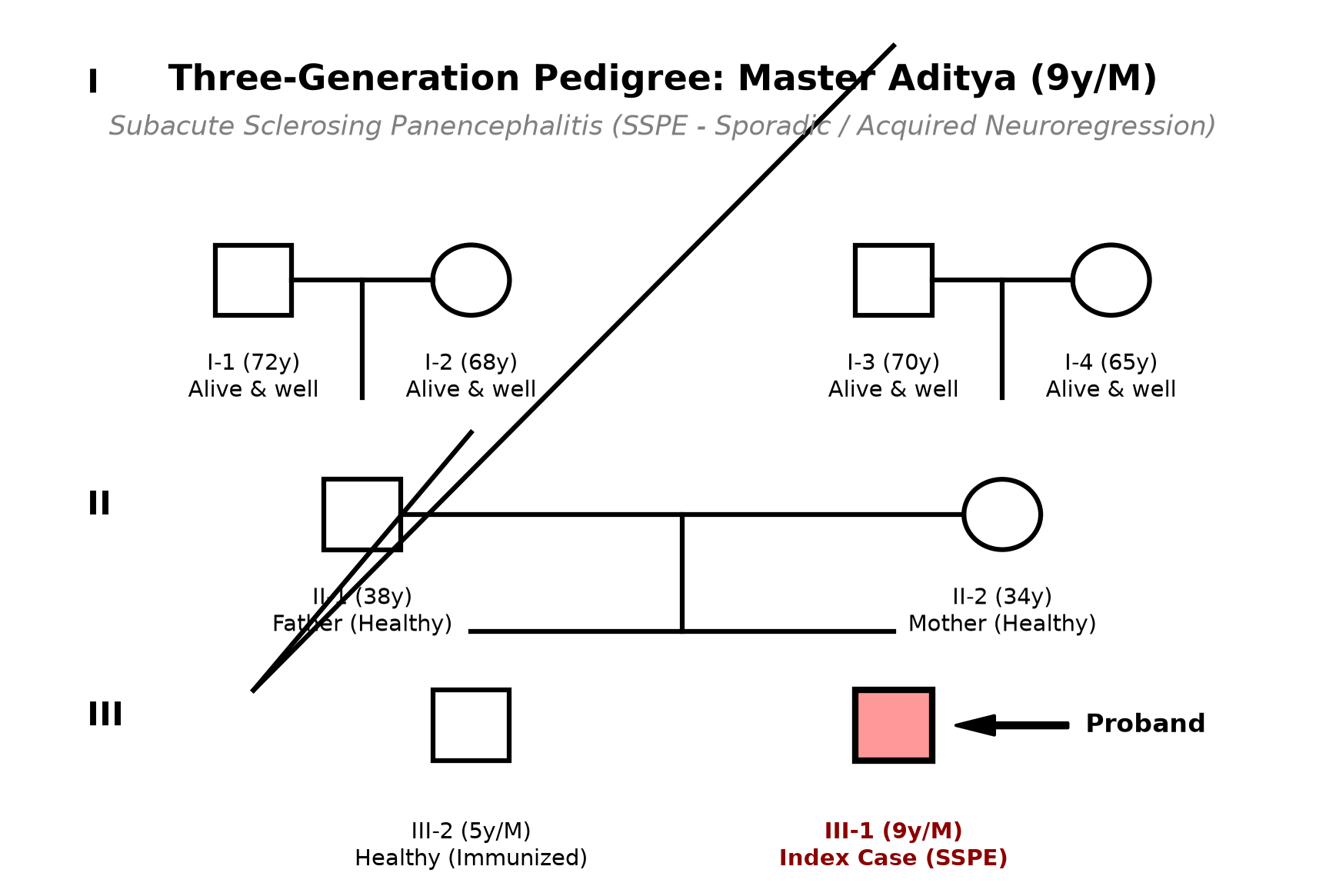
5. Family History & Pedigree
- Parents are non-consanguineous.
- Father (38y) is a daily-wage laborer; Mother (34y) is a homemaker.
- Younger brother (5y) is healthy, thriving, and fully vaccinated with two doses of MR vaccine.
6. General Physical Examination
- Child Behavioral State: Awake, apathetic, intermittently smiling inappropriately, easily startled by tactile stimuli.
- Vitals:
- Heart Rate: 88 beats/min (regular, good volume)
- Respiratory Rate: 20 breaths/min (regular)
- Blood Pressure: $102/66\text{ mmHg}$ ($50^{\text{th}}$ centile)
- Temperature: $98.6^\circ\text{F}$ (Afebrile)
- Capillary Refill Time (CRT): $<2$ seconds
- General Markers: Mild pallor present; no icterus, cyanosis, clubbing, lymphadenopathy, or pedal edema.
- Neurocutaneous / Dysmorphic Markers: Absent. No café-au-lait spots, no telangiectasia, no coarse features.
- Skeletal: Spine normal; no contractures currently, but tight Achilles tendons bilaterally.
Anthropometry
| Metric | Patient Value | Expected (50th Centile WHO) | Z-Score | Nutritional Status |
|---|---|---|---|---|
| **Weight** | 21.0 kg | 28.1 kg | -2.1 SD | Moderate Malnutrition |
| **Height** | 126.0 cm | 133.3 cm | -1.2 SD | Mild Stunting |
| **BMI** | 13.2 kg/m² | 15.8 kg/m² | -2.2 SD | Moderate Thinness (WHO) |
| **Head Circumference**| 51.5 cm | 51.8 cm | -0.2 SD | Normocephalic (No macro/microcephaly)|
7. Central Nervous System (CNS) Examination
A. Higher Mental Functions (HMF)
- Sensorium: Conscious but detached; poor eye contact; fluctuating attention span.
- Cognition & Memory: Profound dementia; unable to count from 1 to 10, does not recognize current month or location.
- Speech: Marked dysarthria, hypophonic, perseverative vocalizations, unable to generate complete sentences.
- Frontal Release Signs: Grasp reflex positive bilaterally, Palmomental reflex positive, Snout reflex positive.
B. Involuntary Movements (Hallmark of Stage 2 SSPE)
| Movement Parameter | Clinical Characteristic Observed |
|---|---|
| **Type of Movement** | **Stereotyped Periodic Myoclonus (Radermecker Jerks)** |
| **Semiology** | Brief, synchronous, bilateral flexion of head and neck with abduction of arms and flexion at knees |
| **Periodicity** | Rhythmic, recurring precisely every **6 to 8 seconds** |
| **Associated Features** | Preserved consciousness during jerks; causes unprovoked drop attacks and loss of postural control |
| **Modulating Factors** | Exaggerated by sudden loud auditory / tactile stimuli; completely ceases during sleep |
C. Cranial Nerves
- CN I: Not testable.
- CN II: Visual tracking present; blinks to threat; Fundoscopy: Normal optic disc margins, normal retinal vasculature; NO macular cherry-red spot, NO retinitis pigmentosa, NO chorioretinitis scars.
- CN III, IV, VI: Full extraocular range; no ptosis; no nystagmus; no vertical supranuclear gaze palsy; pupils 3.5 mm bilaterally equal, reactive to light.
- CN V: Sensation intact; corneal reflex present; Jaw jerk is brisk (hyperreflexic).
- CN VII: Mild bilateral facial hypomimia (masked facies); smile symmetric.
- CN IX, X: Palatal elevation sluggish; exaggerated gag reflex (Pseudobulbar palsy); mild pooling of saliva in pharynx.
- CN XI: Neck tone increased; sternocleidomastoid power Grade 4/5.
- CN XII: Tongue protrudes in midline, spastic, no fasciculations or wasting.
D. Motor System Examination
- Muscle Bulk: Generalized mild muscle wasting secondary to disuse and malnutrition.
- Muscle Tone (Modified Ashworth Scale):
- Upper Limbs: Grade 2 Spasticity (Clasp-knife type) at elbows and wrists bilaterally.
- Lower Limbs: Grade 3 Spasticity (Considerable increase in tone; passive movement difficult) with bilateral adductor hypertonia.
- Power (MRC Scale):
- Upper Limbs (Proximal & Distal): Grade 4/5 bilaterally
- Lower Limbs (Proximal & Distal): Grade 3+/5 bilaterally
- Deep Tendon Reflexes (DTR):
- Biceps ($C_5-C_6$): $3+$ (Brisk) bilaterally
- Triceps ($C_7-C_8$): $3+$ (Brisk) bilaterally
- Supinator ($C_5-C_6$): $3+$ (Brisk) with finger jerk bilaterally
- Knee ($L_3-L_4$): $4+$ (Hyperreflexic with sustained clonus) bilaterally
- Ankle ($S_1$): $4+$ (Hyperreflexic with sustained ankle clonus $>10$ beats) bilaterally
- Superficial Reflexes:
- Abdominal Reflex: Absent in all four quadrants.
- Plantar Response: Bilateral Extensor ($\uparrow / \uparrow$ Babinski Sign Positive).
E. Sensory, Cerebellar & Meningeal Signs
- Sensory System: Responds to pinprick withdrawal in all four extremities; no obvious sensory level.
- Cerebellar System: Formal testing limited by spasticity and myoclonus; prominent kinetic tremors noted during reaching.
- Meningeal Signs: Neck stiffness absent, Kernig negative, Brudzinski negative.
8. Other Systemic Examination
- Cardiovascular System: S1, S2 heard normally, no murmurs.
- Respiratory System: Clear breath sounds; no aspiration crackles.
- Abdomen: Soft, non-tender, no hepatosplenomegaly (Liver span 8 cm, Spleen not palpable).
9. Comprehensive Localization & Staging
A. Anatomical & Pathophysiological Localization
- Panencephalitic Involvement:
- Cerebral Cortex (Grey Matter): Early dementia, scholastic decline, behavioral changes, frontal release signs.
- Subcortical / White Matter Tracts: Bilateral corticospinal tract involvement manifesting as spastic quadriparesis, hyperreflexia, ankle clonus, and extensor plantars.
- Cortico-Subcortical / Thalamic Pacemaker: Generation of stereotyped, periodic, synchronous myoclonic spasms recurring every 6–8 seconds.
B. Jabbour Clinical Staging for SSPE
| Jabbour Stage | Clinical Features | Status in Patient |
|---|---|---|
| **Stage 1 (Behavioral / Cognitive)** | Subtle intellectual decline, emotional lability, lethargy, drop in school grades | Passed (6 to 4 months ago) |
| **Stage 2 (Myoclonus / Motor)** | **Periodic myoclonus, drop attacks, spasticity, dysarthria, apraxia, visual changes** | **CURRENT STAGE (Stage 2)** |
| **Stage 3 (Extrapyramidal / Rigidity)** | Decerebrate / decorticate posturing, severe rigidity, stupor, dysphagia, coma | Not yet reached |
| **Stage 4 (Autonomic / Vegetative)** | Akinetic mutism, flexion contractures, loss of cortical function, autonomic failure | End-stage |
C. Differential Diagnosis Matrix
| Differential Diagnosis | Points in Favor | Points Against / Differentiating Features |
|---|---|---|
| **Subacute Sclerosing Panencephalitis (SSPE)** | • 9y boy with natural measles at 11m<br>• Subacute neuroregression<br>• Stereotyped periodic myoclonus every 6-8s<br>• Spastic quadriparesis + dementia | **Definitive Diagnosis** (Meets Dyken's Criteria) |
| **Neuronal Ceroid Lipofuscinosis (NCL / Batten Disease)** | • Neuroregression, myoclonus, seizures, cognitive decline | • Usually associated with progressive visual loss, retinal degeneration, bull's eye maculopathy (absent here)<br>• Jerks are non-periodic / polymorphic<br>• Granular osmiophilic deposits (GRODs) on biopsy |
| **Progressive Myoclonic Epilepsy (Lafora / Unverricht-Lundborg)** | • Myoclonus, ataxia, cognitive decline | • Action myoclonus provoked by movement/light rather than stereotyped periodic slow myoclonus<br>• Intractable tonic-clonic seizures predominate<br>• Lafora bodies on skin/axillary biopsy |
| **Metachromatic Leukodystrophy (MLD)** | • Progressive motor loss, spasticity, regression | • Typically presents earlier (1-2y)<br>• Absent/diminished DTRs due to peripheral neuropathy<br>• No periodic slow-wave myoclonus |
| **Juvenile Huntington Disease (Westphal Variant)** | • Cognitive decline, rigidity, behavioral changes | • Autosomal dominant family history (CAG repeat expansion)<br>• Prominent akinesia, rigidity, and chorea rather than periodic myoclonic drop attacks |
| **Wilson Disease** | • Scholastic decline, tremors, dysarthria, behavioral change | • KF ring absent on slit lamp<br>• Normal liver enzymes, no dystonia/parkinsonism<br>• Periodic myoclonus is not a feature |
10. Diagnostic Confirmation (Dyken's Criteria)
flowchart TD
    A["Master Aditya (9y/M) with Suspected SSPE"] --> B["Diagnostic Evaluation as per Dyken's Criteria"]

    B --> C["1. Video-EEG Recording"]
    B --> D["2. CSF & Serum Measles Antibody Titers"]
    B --> E["3. MRI Brain with Contrast"]

    C --> F["Bilateral, synchronous, symmetrical, high-voltage (300-500 µV) periodic slow-wave complexes (Radermecker complexes) every 4-8s"]
    D --> G["Markedly elevated anti-measles IgG in CSF (>1:4 ratio with serum), confirming intrathecal synthesis"]
    E --> H["Subcortical & periventricular T2/FLAIR hyperintensities with mild cortical atrophy"]

    F & G & H --> I["Definitive Confirmation of SSPE (Jabbour Stage 2)"]
Dyken's Criteria Evaluation for Aditya:
- Major Criteria:
- Clinical Presentation: Subacute progressive cognitive decline and stereotyped periodic myoclonus ($\checkmark$ Present).
- Elevated CSF Measles Antibodies: Intrathecal measles antibody ratio $>1:4$ ($\checkmark$ Confirmed).
- Minor Criteria:
- EEG: Periodic high-voltage slow-wave complexes (Radermecker complexes) ($\checkmark$ Confirmed).
- CSF IgG Index: Elevated ($>0.7$) with oligoclonal bands ($\checkmark$ Confirmed).
- Neuroimaging: Periventricular white matter T2/FLAIR hyperintensities ($\checkmark$ Confirmed).
11. Comprehensive Management Plan
A. Specific Disease-Modifying Pharmacotherapy
While SSPE is notoriously progressive, combined immunomodulatory and antiviral therapy can stabilize or slow progression in Jabbour Stage 1 and 2:
$$\text{Oral Inosiplex (Isoprinosine): } 100\text{ mg/kg/day orally in 3 to 4 divided doses}$$$$\mathbf{PLUS}$$$$\text{Intraventricular / Intrathecal Interferon-alpha (IFN-}\alpha\text{): } 1-3\text{ million IU/m}^2\text{ weekly via Ommaya reservoir}$$$$\text{Alternative: Oral Ribavirin / Favipiravir in clinical trial protocols}$$B. Symptomatic Control of Periodic Myoclonus
- First-Line: Clonazepam $0.05-0.1\text{ mg/kg/day}$ divided BID/TID (effective for suppressing subcortical myoclonic discharge).
- Add-on Antiepileptics: Sodium Valproate ($20-40\text{ mg/kg/day}$) or Levetiracetam ($30-50\text{ mg/kg/day}$).
C. Supportive & Palliative Care
- Airway & Bulbar Care: Suctioning for pharyngeal secretions; semi-upright feeding position; transition to Nasogastric (NG) tube / Percutaneous Endoscopic Gastrostomy (PEG) to prevent aspiration pneumonia.
- Nutritional Rehabilitation: High-calorie, high-protein formula ($1700\text{ kcal/day}$, $30\text{ g protein/day}$) via enteral tube.
- Physical Therapy: Passive stretching, anti-spasticity positioning, ankle-foot orthoses (AFOs) to prevent fixed equinus contractures.
- Family Counseling & Prognostication: Empathetic counseling regarding progressive nature of the disease, long-term palliative care goals, and emphasizing that SSPE is $100\%$ preventable with timely Measles-Rubella (MR) immunization.
12. Final Spoken Diagnosis
"Master Aditya, a 9-year-old right-handed male child, with a history of natural measles at 11 months of age, presenting with progressive cognitive decline, stereotyped periodic myoclonus, drop attacks, and spastic quadriparesis over 6 months, has a definitive diagnosis of Subacute Sclerosing Panencephalitis (SSPE), currently in Jabbour Stage 2, with secondary pseudobulbar palsy and moderate malnutrition."