
Miss Diya, a 4 year old girl, 2nd order child born of a non-consanguineous marriage from Bhopal, Madhya Pradesh presented with complaints of sudden appearance of pinpoint red-purple spots and bruises over the body for 3 days, and one episode of spontaneous nosebleed (epistaxis) yesterday.
- Sudden eruption of pinpoint, non-blanching petechiae and purpura in a previously healthy child
- Spontaneous bruises and ecchymoses over pressure points and extremities
- Epistaxis (nosebleeds) or gum bleeding during teeth brushing
- Mucosal "wet purpura" (blood blisters on buccal mucosa, subconjunctival hemorrhages)
- Absence of constitutional symptoms (fever, weight loss, bone pain)
HOPI
The history is dated back to 3 days ago when the mother first noticed tiny reddish-purple spots over both legs while bathing the child.
The quintessential clinical hallmark of childhood ITP is the "well-looking child with severe bleeding signs". Systematically verify:
- Isolated Bleeding Signs: Petechiae, purpura, ecchymoses, epistaxis.
- Antecedent Viral Trigger: History of a mild respiratory illness, exanthem, or MMR immunization 1 to 4 weeks prior (molecular mimicry producing autoantibodies against platelet GPIIb/IIIa).
- Absence of Malignancy / Bone Marrow Failure Red Flags: No bone pain, limping, fever, weight loss, night sweats, or prior cytopenias.
- Danger Signs (Wet Purpura): Buccal mucosal blisters, epistaxis, hematuria, GI bleeding, and severe headache/vomiting (intracranial hemorrhage risk, occurring in $<0.5\%$ of cases).
- Cutaneous Bleeding Manifestations:
- Appeared abruptly 3 days ago without trauma.
- Initial lesions were tiny, pinpoint, reddish-purple spots (petechiae) over both legs.
- Over the next 48 hours, similar spots appeared over the abdomen, back, and arms, along with larger purplish patches (ecchymoses) over both shins Reflects failure of primary hemostatic plug formation due to profound antibody-mediated peripheral platelet destruction.
- Lesions did not itch, did not hurt, and did not blanch when pressed with a glass tumbler.
- Mucosal Bleeding (Wet Purpura):
- Yesterday morning, the child experienced spontaneous bleeding from the right nostril (epistaxis) lasting ~10 minutes, which resolved with firm manual pressure.
- Mother noticed slight pinkish blood staining on the toothbrush after cleaning teeth.
- Child has two tiny blood blisters on the inner cheek mucosa Presence of mucosal bleeding ("wet purpura") elevates the clinical bleeding score (Buchanan score Grade 3), necessitating consideration of active medical therapy over observation alone.
- Antecedent Viral Illness:
- Two weeks prior to the onset of the rash, the child had a mild upper respiratory illness with low-grade fever, runny nose, and dry cough lasting 3 days, which resolved spontaneously without antibiotics Classic 1-to-3 week latent period following viral infection triggering anti-platelet autoantibody generation.
- Negative History:
- No history of bone pain, refusal to bear weight, joint swelling, or limping Critical negative: rules out Acute Lymphoblastic Leukemia (ALL) and neuroblastoma bone metastasis.
- No history of persistent fever, drenching night sweats, or significant weight loss Rules out lymphoproliferative malignancy and tuberculosis.
- No history of severe headache, vomiting, altered consciousness, or seizures Critical negative: rules out life-threatening intracranial hemorrhage.
- No history of dark red urine (hematuria), vomiting of blood (hematemesis), or black stools (melena).
- No history of bloody diarrhea followed by decreased urine output Rules out Hemolytic Uremic Syndrome (HUS).
- No history of malar rash, photosensitivity, oral ulcers, or alopecia Rules out Systemic Lupus Erythematosus.
- No history of medications (quinine, anticonvulsants, heparin, cotrimoxazole) or recent MMR vaccination within the past 6 weeks.
Past History
- First episode of bleeding in life; no prior history of bruising, epistaxis, or bleeding after trauma.
- No history of chronic illness or prior hospitalizations.
Family history
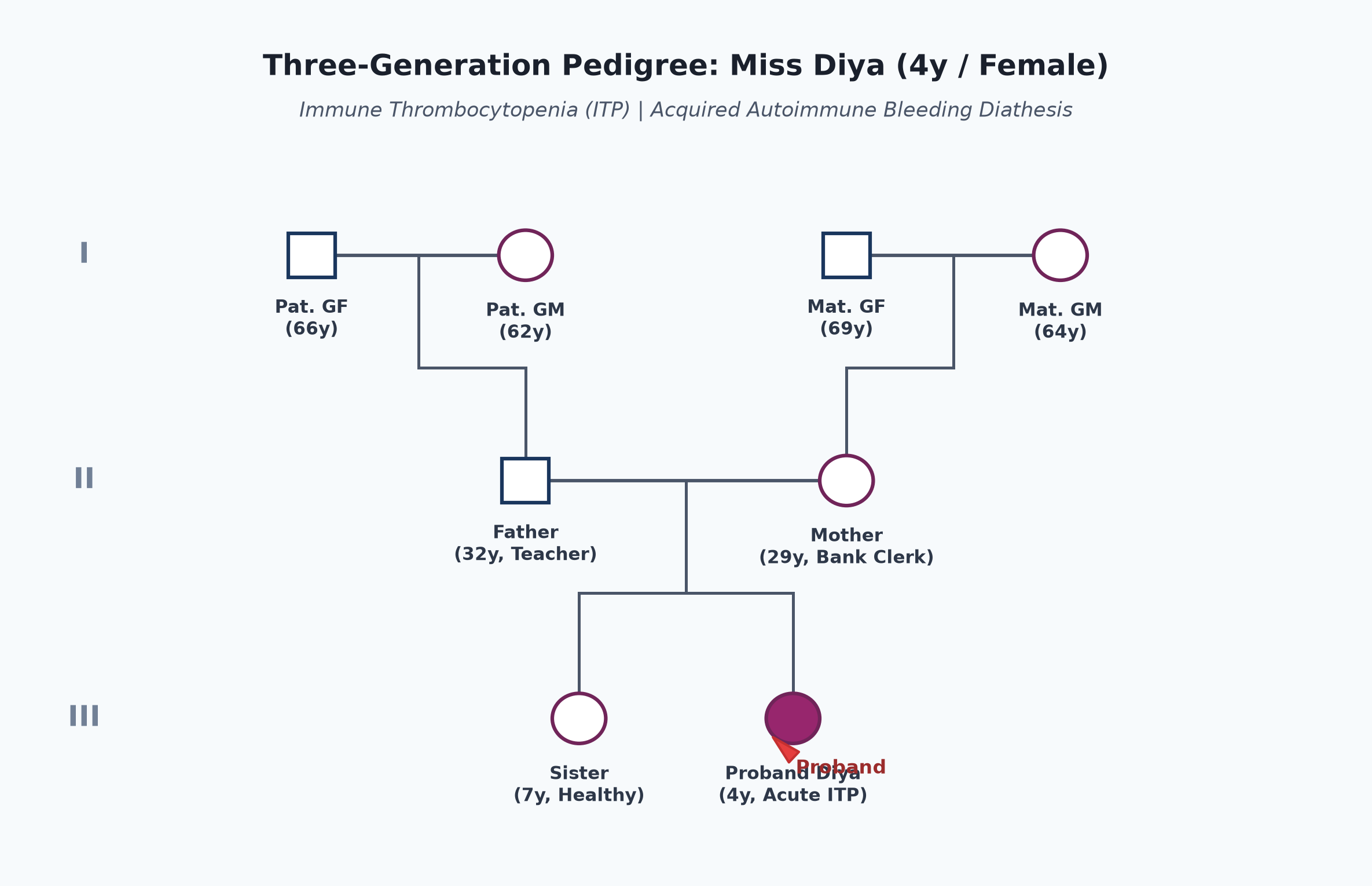
- Born of a non-consanguineous marriage.
- Father 32 years, school teacher; mother 29 years, bank clerk; both healthy.
- Elder sister (7 years old) is completely healthy with no bleeding tendencies.
- No family history of thrombocytopenia, autoimmune disorders, bleeding diathesis, or early childhood deaths.
Immunization history
- Up to date as per the National Immunization Schedule (UIP); received MMR at 9 months and MR at 16-24 months. No vaccines administered in the last 3 months.
Dietary history
- Consumes a normal balanced home diet.
| Food Item | Quantity | Calories (kcal) | Protein (g) |
|---|---|---|---|
| Cow's Milk | 300 mL | 180 | 9.6 |
| Chapati (2) | 50 g flour | 170 | 5.8 |
| Rice & Dal | 1 bowl | 160 | 5.2 |
| Vegetable Sabzi & Fruit | 1 serving | 95 | 1.8 |
| Total Observed Daily Intake | — | 605 kcal | 22.4 g |
24-Hour Recall Deficit Analysis
$$ \text{Ideal Body Weight (IBW for 4 years, 50th centile WHO)} = 16.2\text{ kg} $$| Nutrient | Expected Intake (ICMR-NIN 2024 for IBW 16.2 kg) | Observed Intake | Deficit | Percentage Deficit |
|---|---|---|---|---|
| Energy (kcal) | $16.2\text{ kg} \times 80\text{ kcal/kg} = 1296\text{ kcal}$ | 605 kcal | 691 kcal | 53.3% Deficit |
| Protein (g) | $16.2\text{ kg} \times 1.0\text{ g/kg} = 16.2\text{ g}$ | 22.4 g | Nil (Adequate) | 0% Deficit |
The expected calories and proteins should be calculated from the ideal body weight, not from current weight.
Socioeconomic and KAP
- Belongs to Modified BG Prasad Socioeconomic Class II (Upper Middle Class).
- Lives in an urban pucca house in Bhopal.
- Parents were terrified when blood spots appeared suddenly; seeking reassurance and prompt treatment.
Summary of History
Miss Diya, a 4-year-old girl, 2nd order child born of non-consanguineous parents from Bhopal, presented with abrupt onset of generalized petechiae, ecchymoses, and mild epistaxis for 3 days following a viral illness 2 weeks prior, without fever, bone pain, constitutional symptoms, lymphadenopathy, or gross organ bleeding.
I would like to think of an acquired isolated bleeding disorder secondary to Newly Diagnosed Immune Thrombocytopenia (Acute ITP), presenting with moderate mucocutaneous bleeding (Buchanan Grade 3), without evidence of intracranial hemorrhage or secondary bone marrow failure.
General head to toe examination
- Child Behavioral State: Child is active, playful, sitting comfortably, alert, cooperative, cheerful, and entirely non-toxic.
- Vitals:
- Pulse Rate: 94 beats/minute, regular, normal volume.
- Respiratory Rate: 20 breaths/minute, regular, unlabored.
- Blood Pressure: $92/58\text{ mmHg}$ ($50^{\text{th}}$ centile for height and age).
- Temperature: $36.8^\circ\text{C}$ (afebrile).
- Anthropometry:
| Parameter | Observed | Expected (50th WHO) | Z-score / Centile | Inference |
|---|---|---|---|---|
| Weight | 16.0 kg | 16.2 kg | $50^{\text{th}}\text{ centile}$ | Normal nutritional status |
| Height | 102 cm | 102.7 cm | $50^{\text{th}}\text{ centile}$ | Normal stature |
- Bleeding Manifestations (General Examination):
- Petechiae: Extensive, multiple pinpoint non-blanching red-purple spots (1-2 mm) distributed over both lower limbs, forearms, chest, and face.
- Purpura & Ecchymoses: Multiple violaceous patches measuring $1.0-3.5\text{ cm}$ over bilateral pretibial areas and right forearm; flat, non-palpable, non-tender.
- Oral Cavity (Wet Purpura):
- Two small hemorrhagic bullae (blood blisters, ~3-4 mm) visible on the left buccal mucosa.
- Clotted blood visible in the right anterior naris; no active trickling.
- Subconjunctival hemorrhage: None.
- Paramount Negative Physical Findings:
- Pallor: Absent; conjunctiva and mucosal surfaces are pink.
- Lymphadenopathy: Completely absent (cervical, axillary, epitrochlear, and inguinal nodes are non-palpable).
- Skeletal / Bony Tenderness: No tenderness over sternum, ribs, spine, or long bones.
- Icterus, Cyanosis, Clubbing, Edema: Absent.
Systemic Examination
Abdomen
- Inspection: Flat, symmetrical, moves with respiration; umbilicus normal.
- Palpation:
- Soft, non-tender throughout; no guarding.
- Liver: Not palpable (liver dullness spans 7.5 cm, normal).
- Spleen: NOT PALPABLE (absence of splenomegaly is a paramount physical finding; palpable spleen strongly challenges the diagnosis of ITP and warrants bone marrow evaluation!).
- Kidneys: Not ballotable.
- Percussion & Auscultation: Resonant note throughout; normal bowel sounds; no bruits.
Central Nervous System (CNS)
- Completely conscious, alert, oriented, active, cheerful.
- Cranial nerves I-XII intact; pupils equal and briskly reactive to light.
- Motor System: Normal bulk, tone, and power (5/5) in all limbs; DTRs $2+$; plantars flexor.
- Meningeal Signs: Absent.
- Fundoscopy: Optic discs clear, sharp margins, normal vessels; NO retinal hemorrhages (rules out impending intracranial bleed).
Cardiovascular & Respiratory Systems
- Normal heart sounds ($S_1, S_2$), no murmurs.
- Normal vesicular breath sounds bilaterally; no crackles or wheeze.
other systems
- Musculoskeletal: Full range of joint movements; no hemarthrosis.
Summary
Miss Diya, a 4-year-old girl, born of non-consanguineous parents from Bhopal, presented with abrupt onset of extensive petechiae, ecchymoses, and mild epistaxis for 3 days following an antecedent viral illness 2 weeks prior. Physical examination reveals an active, well-appearing child with extensive non-palpable cutaneo-mucosal bleeding and buccal blood blisters, but with completely normal hemoglobin, absence of pallor, absence of lymphadenopathy, absence of bony tenderness, and crucially, absence of splenomegaly or hepatomegaly.
The clinical presentation is classic for Newly Diagnosed Immune Thrombocytopenia (Acute ITP), presenting with moderate mucosal bleeding (Buchanan Bleeding Score Grade 3), without red flags of bone marrow failure or intracranial hemorrhage.
Differential Diagnosis
| Disease | Points IN FAVOR | Points AGAINST |
|---|---|---|
| Immune Thrombocytopenia (Acute ITP) | Previously healthy child, antecedent viral illness, abrupt onset of isolated petechiae/purpura, normal Hb/WBC, no organomegaly | Primary Diagnosis |
| Acute Lymphoblastic Leukemia (ALL) | Acute bleeding manifestations, bruising in a 4-year-old | Absence of fever, bone pain, limping, pallor, generalized lymphadenopathy, or splenomegaly; normal peripheral smear with no blasts |
| Aplastic Anemia / Bone Marrow Failure | Cutaneous bleeding, thrombocytopenia | Only platelets are affected; hemoglobin and leukocyte count are completely normal; no antecedent toxin/drug exposure |
| Henoch-Schönlein Purpura (IgA Vasculitis) | Acute onset purpura in a 4-year-old following viral infection | HSP purpura is characteristically palpable and localized to buttocks/extensor limbs; platelet count is normal in HSP (thrombocytopenic in ITP) |
| Hemolytic Uremic Syndrome (HUS) / TTP | Acute thrombocytopenia, bruising | Absence of prodromal bloody diarrhea, no microangiopathic hemolytic anemia (schistocytes), no oliguria or renal dysfunction |
| Inherited Thrombocytopenia (e.g., Wiskott-Aldrich, TAR) | Severe thrombocytopenia, bleeding | First bleeding episode at 4 years, no chronic eczema, no recurrent infections, normal radii |
Investigation Protocol & Diagnostic Workup
flowchart TD
    A["Well Child with Acute Onset Purpura & Petechiae"] --> B["CBC & Thorough Peripheral Blood Smear Examination"]
    B --> C{"Isolated Thrombocytopenia with Normal Hb, WBC & Normal Smear?"}
    C -->|Yes| D["Assess for Red Flags: Bone Pain, Hepatosplenomegaly, Lymphadenopathy"]
    C -->|No / Multiple Cytopenias / Blasts| E["Mandatory Bone Marrow Aspiration: Rule out ALL / Aplastic Anemia"]
    D -->|No Red Flags| F["Confirm Newly Diagnosed ITP; Bone Marrow Biopsy NOT Indicated (ASH 2019)"]
    F --> G["Stratify Bleeding Severity (Buchanan Bleeding Scale Grade 1-4)"]
    G -->|Grade 1-2 (Cutaneous Only)| H["Watchful Waiting / Observation Alone"]
    G -->|Grade 3-4 (Active Mucosal / Wet Purpura)| I["Initiate First-Line Medical Therapy: Oral Prednisolone or IVIG"]
1. Complete Blood Count (CBC)
- Platelet Count: Markedly depressed at $14,000/\mu\text{L}$ (severe isolated thrombocytopenia $<20,000/\mu\text{L}$).
- Hemoglobin: $11.8\text{ g/dL}$ (normal; no anemia).
- RBC Indices: MCV $82\text{ fL}$, MCH $28\text{ pg}$ (normal).
- Total Leukocyte Count (TLC): $7,400/\mu\text{L}$; differential normal (Neutrophils $52\%$, Lymphocytes $42\%$, Monocytes $4\%$, Eosinophils $2\%$).
- Absolute Neutrophil Count (ANC): $3,848/\mu\text{L}$ (normal; excludes neutropenia).
2. Peripheral Blood Smear Examination (Mandatory Diagnostic Step)
- Platelet Morphology: Severe thrombocytopenia confirmed; presence of occasional large / giant platelets (megathrombocytes) reflecting active, accelerated compensatory bone marrow thrombopoiesis.
- RBC & WBC Morphology: Completely normal.
- Critical Negatives: NO blast cells, no dysplastic myeloid cells, no atypical lymphocytes, and no fragmented RBCs / schistocytes (rules out microangiopathic hemolysis).
3. Blood Group & Secondary Workup
- Blood Group & Rh Typing: A Positive (important if IV Anti-D is ever considered).
- Direct Antiglobulin Test (Coombs Test): Negative (rules out Evans syndrome — combined autoimmune hemolytic anemia and ITP).
- Coagulation Profile (PT, aPTT): Normal (rules out consumptive coagulopathy / DIC).
4. Is Bone Marrow Aspiration Indicated? (VIVA High-Yield)
- NO! Bone marrow examination is NOT indicated in a child with typical acute ITP presenting with isolated thrombocytopenia, normal Hb and WBC count, normal peripheral smear, and absence of organomegaly, lymphadenopathy, or bone pain (ASH 2019 / IAP Guidelines).
- Mandatory Indications for Bone Marrow:
- Presence of atypical features (fever, unexplained bone pain, joint swelling, lymphadenopathy, splenomegaly).
- Abnormalities on CBC other than thrombocytopenia (unexplained anemia, leukopenia, neutropenia).
- Before starting systemic corticosteroids IF the examiner/clinician has any suspicion of occult leukemia (steroids can mask leukemia and cause tumor lysis).
- Failure to respond to first-line therapies.
Management Plan
1. Management Strategy Based on Bleeding Severity (ASH 2019 / IAP Guidelines)
- The Core Rule: "Treat the bleeding child, NOT the platelet number."
- Grade 1–2 Bleeding (Minor cutaneous petechiae/bruises only): Observation and watchful waiting alone, irrespective of platelet count ($<10,000$ or $>10,000$). Over $75-80\%$ of children experience spontaneous complete remission within 3 to 6 months.
- Grade 3 Bleeding (Active mucosal bleeding / wet purpura — Current Patient): Pharmacotherapy is indicated to rapidly halt mucosal hemorrhage.
2. First-Line Pharmacotherapy
- Option A: Oral Corticosteroids (Cost-Effective & First-Line in India):
- Short-Course Prednisolone: Administer oral Prednisolone at $4.0\text{ mg/kg/day}$ for 3 to 4 days, OR $2.0\text{ mg/kg/day}$ for 7 to 14 days, followed by rapid cessation.
- Rationale: Short courses minimize steroid toxicity (hypertension, weight gain, behavioral changes) while rapidly inhibiting splenic macrophage Fc-receptor clearance of platelets.
- Option B: Intravenous Immunoglobulin (IVIG) (If Rapid Rise Needed):
- Indicated for severe/uncontrolled mucosal bleeding or planned emergency surgery.
- Dose: $0.8-1.0\text{ g/kg}$ as a single intravenous infusion over 4–6 hours (platelets typically rise $>50,000/\mu\text{L}$ within 24–48 hours).
- Option C: Intravenous Anti-D Immunoglobulin:
- Reserved for Rh(D)-positive, Coombs-negative, non-splenectomized patients ($50-75\text{ mcg/kg}$ IV). (Precaution: risk of acute intravascular hemolysis).
3. Emergency Management of Life-Threatening Hemorrhage (e.g., Intracranial Hemorrhage)
- If intracranial or life-threatening hemorrhage occurs:
- Immediate Platelet Transfusions (given in high doses / continuous infusion, despite rapid destruction, to achieve immediate hemostatic plugging).
- Concurrent IVIG ($1.0\text{ g/kg}$) + IV Methylprednisolone ($30\text{ mg/kg}$ pulse therapy).
- Urgent neurosurgical decompression if indicated; recombinant Factor VIIa as rescue.
4. General Supportive & Activity Precautions
- Activity Restriction: Strictly restrict contact sports, rough physical play, cycling, and gymnastics while platelet count is $<30,000/\mu\text{L}$.
- Medication Avoidance: Strictly avoid all medications that interfere with platelet function: Aspirin, Ibuprofen, and other NSAIDs. Use oral Paracetamol for pain or fever.
- Avoid Injections: Prohibit all intramuscular (IM) injections and arterial punctures.