
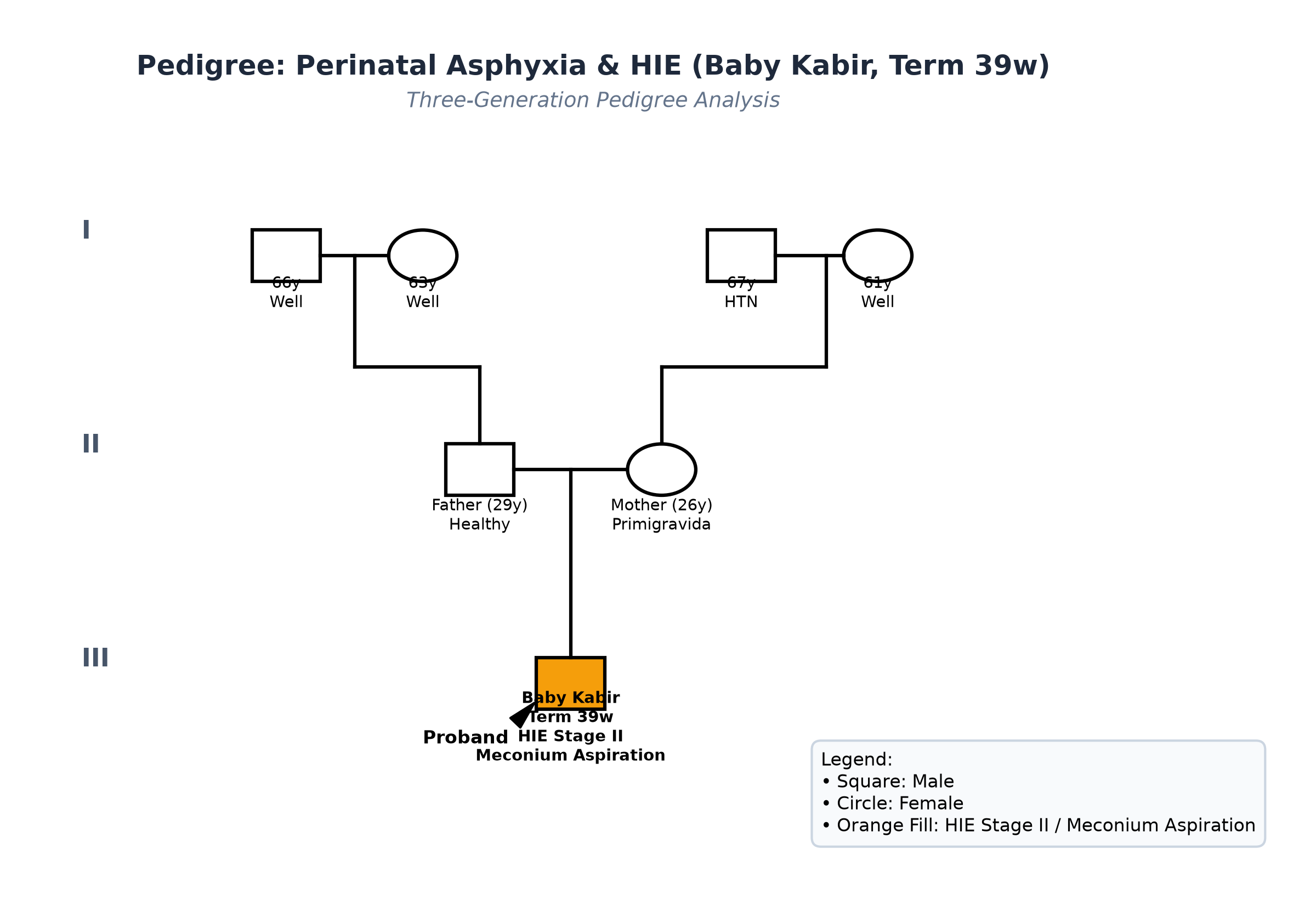
Baby of Priya, a 3-day-old male neonate, 1st order child born of a non-consanguineous marriage to a 26-year-old primigravida from Indore, Madhya Pradesh, born at 39 completed weeks of gestation by emergency vacuum-assisted vaginal delivery indicated for prolonged second stage of labor and fetal bradycardia with thick meconium-stained amniotic fluid (MSAF), birth weight 2950 grams (AGA, 50th percentile), who had severe perinatal depression with delayed cry, required positive pressure ventilation and chest compressions at birth (Apgar scores of 2, 4, and 6 at 1, 5, and 10 minutes; cord arterial blood pH 6.95 with base deficit $18.2\text{ mmol/L}$), and developed lethargy, generalized hypotonia, absent primitive reflexes, and clinical subtle and clonic seizures at 4 hours of life, classified as Moderate Hypoxic Ischemic Encephalopathy (Modified Sarnat Stage II), successfully managed with 72 hours of Therapeutic Hypothermia (Total Body Cooling to $33.5^\circ\text{C}$) and antiseizure therapy with Phenobarbital.
When presenting an asphyxiated neonate, examiners look for precision across five pillars:
- Diagnostic Validation: Do not loosely use 'birth asphyxia'. Demonstrate that the infant fulfills the AAP/ACOG Criteria for Perinatal Hypoxic-Ischemic Event:
- Metabolic acidemia in fetal umbilical cord arterial blood: $\text{pH} < 7.00$ or Base Deficit $\ge 12-16\text{ mmol/L}$.
- Apgar score $\le 5$ at 5 and 10 minutes.
- Neurological manifestations: neonatal encephalopathy (Sarnat Stage II or III).
- Multisystem organ dysfunction (acute kidney injury, myocardial dysfunction, elevated hepatic transaminases, or DIC).
- Sarnat Staging Precision: Accurately classify Mild (Stage I: hyperalert, jittery, sympathetic tone, no seizures), Moderate (Stage II: lethargic, hypotonic, parasympathetic tone, seizures present), or Severe (Stage III: stupor/coma, flaccid, brainstem signs, refractory seizures).
- The 6-Hour Cooling Window: Emphasize that neuroprotection via Therapeutic Hypothermia MUST be initiated within 6 hours of birth to interrupt the secondary energy failure cascade.
- Rewarming Protocol: Explain the controlled rewarming process ($0.5^\circ\text{C}$ every 2 hours) and highlight why rapid rewarming is dangerous (hypotension, rebound seizures).
Chief Complaints & NICU Admission
Referred to Level III NICU at 2 hours of life with:
- Delayed cry at birth (cried after 12 minutes of active bag and mask resuscitation and chest compressions).
- Respiratory depression and lethargy since birth.
- Onset of abnormal body movements (lip smacking, cycling movements of lower limbs, and focal right upper limb clonic jerks) starting at 4 hours of life.
- Total body cooling initiated at 5 hours of life for moderate HIE.
HOPI
Baby of Priya was delivered at 39 weeks gestation following an uneventful antenatal course until labor onset. Labor was induced at 39 weeks; during the second stage, labor became obstructed and protracted ($>2.5\text{ hours}$ in second stage). Cardiotocography (CTG) demonstrated recurrent late decelerations with baseline fetal bradycardia ($90-100\text{ bpm}$). Membranes ruptured 1 hour prior to delivery, draining thick, pea-soup meconium-stained amniotic fluid. Emergency vacuum extraction was executed.
- Resuscitation Course at Birth:
- At birth, the infant was limp, apneic, cyanotic, and had a heart rate of $60\text{ beats/minute}$.
- Under radiant warmer, gentle drying, positioning, and suctioning were performed.
- Positive Pressure Ventilation (PPV) initiated with T-piece resuscitator delivering $21\%\text{ O}_2$ at $20-25\text{ cm }\text{H}_2\text{O}$ PIP and $5\text{ cm }\text{H}_2\text{O}$ PEEP.
- At 1 minute: Heart rate remained $<60\text{ bpm}$; chest compressions (3:1 ratio) initiated and $\text{FiO}_2$ increased to $100\%$.
- Responded at 4 minutes: Heart rate rose to $>100\text{ bpm}$; spontaneous irregular gasps appeared.
- Apgar scores recorded were: 2 at 1 minute (0 for color, 0 for tone, 1 for HR $<100$, 0 for reflex, 1 for respiratory effort), 4 at 5 minutes, and 6 at 10 minutes.
- Umbilical arterial cord blood gas: $\text{pH } 6.95$, $\text{PCO}_2\text{ }68\text{ mmHg}$, $\text{PO}_2\text{ }24\text{ mmHg}$, $\text{HCO}_3^-\text{ }14.2\text{ mEq/L}$, Base Deficit $18.2\text{ mmol/L}$ (Severe mixed metabolic and respiratory acidemia).
- Evolution of Encephalopathy:
- In NICU, the baby remained lethargic, stuporous, with generalized hypotonia and constricted pupils ($2\text{ mm}$, sluggishly reactive).
- Primitive reflexes (Moro, sucking, rooting) were completely absent.
- At 4 hours of life, the infant exhibited paroxysmal lip smacking, repeated chewing motions, cycling/pedaling movements of the legs, and rhythmic clonic jerking of the right upper limb lasting 45-60 seconds (Subtle & Clonic Seizures).
- Modified Sarnat Staging: Classified as Stage II (Moderate HIE) based on lethargy, hypotonia, miosis, suppressed primitive reflexes, and clinical seizures.
- Therapeutic Hypothermia (Total Body Cooling):
- Assessed for cooling eligibility: Gestation $\ge 35\text{ wks}$, severe metabolic acidosis (cord pH $<7.00$, BD $>16$), and moderate encephalopathy.
- Initiated on servo-controlled total body cooling blanket at 5 hours of life (within the mandatory 6-hour therapeutic window).
- Target core rectal temperature maintained strictly at $33.5^\circ\text{C} \pm 0.5^\circ\text{C}$ for 72 hours.
- Amplitude-integrated EEG (aEEG) monitoring showed discontinuous low-voltage background with electrographic seizure discharges.
- Antiseizure loading with Inj. Phenobarbital $20\text{ mg/kg IV}$ infused over 20 minutes; clinical seizures controlled; aEEG background converted to continuous normal voltage by 36 hours of cooling.
- Rewarming Phase (72 to 84 Hours):
- At 72 hours of cooling, controlled rewarming was conducted at $0.5^\circ\text{C}\text{ every 2 hours}$ over 12 hours until rectal temperature reached $36.5^\circ\text{C}$.
- Hemodynamically stable during rewarming; no rebound seizures; blood pressure remained within normal limits.
Past & Antenatal History
- Antenatal:
- Primigravida mother, 26 years old, regular antenatal visits; normotensive; normal OGTT; normal anomaly scan at 20 weeks.
- No maternal fever, rash, foul-smelling vaginal discharge, or antepartum hemorrhage.
- Natal:
- Term 39 weeks; vacuum extraction after prolonged 2nd stage; clear amniotic fluid until late labor when thick meconium passed due to intrapartum fetal hypoxia.
- Delayed cord clamping could not be performed due to urgent resuscitation requirement.
Family History
- Non-consanguineous marriage. No history of early neonatal deaths, seizure disorders, or metabolic conditions.
Nutritional & Fluid Management
During the acute encephalopathic and cooling phase, renal and cerebral autoregulation are impaired, necessitating strict fluid restriction to prevent hyponatremic cerebral edema:
- Days 1 to 3 (During Therapeutic Hypothermia):
- Kept Nil per Os (NPO) with central venous catheter / umbilical venous catheter.
- Restricted fluid intake at $40-50\text{ mL/kg/day}$ with 10% Dextrose (delivering Glucose Infusion Rate - GIR of $4-6\text{ mg/kg/min}$).
- Serum electrolytes and blood glucose monitored every 6-8 hours; strict urine output monitoring via urinary catheter ($>1\text{ mL/kg/hr}$).
- Rewarming & Recovery Phase (Day 4 onwards):
- Total fluids liberalized to $70-80\text{ mL/kg/day}$.
- Trophic enteral feeds (Minimal Enteral Nutrition) initiated on Day 4 with mother's expressed colostrum at $10-15\text{ mL/kg/day}$ via orogastric tube.
- Feeds advanced daily as bowel sounds and abdominal girth remained stable; currently taking $80\text{ mL/kg/day}$ of EBM via orogastric tube.
The expected calories and proteins should be calculated from the target weight and gestation.
Socioeconomic & KAP
- Modified BG Prasad Socioeconomic Class II. Parents counseled in detail regarding perinatal asphyxia, cooling therapy rationale, antiseizure medications, and long-term neurodevelopmental follow-up.
Summary of History
Baby of Priya, a 3-day-old term male infant born at 39 weeks gestation by emergency vacuum delivery for prolonged second stage and fetal bradycardia with thick meconium-stained liquor, birth weight 2950g, had severe perinatal depression requiring CPR and positive pressure ventilation (cord pH 6.95, base deficit 18.2, Apgar 2, 4, 6), developed clinical seizures and moderate encephalopathy (Modified Sarnat Stage II) at 4 hours of life, received 72 hours of servo-controlled therapeutic hypothermia ($33.5^\circ\text{C}$) and phenobarbital seizure control, now successfully rewarmed and initiating enteral trophic feeds.
Provisional Clinical Diagnosis: Term Male Neonate (Day 3 of Life, Gestational Age 39 Weeks), Appropriate for Gestational Age, with Hypoxic Ischemic Encephalopathy (Modified Sarnat Stage II - Moderate), recovering post-completion of Therapeutic Hypothermia (Total Body Cooling for 72 Hours) and Phenobarbital Antiseizure Therapy, currently in the Post-Cooling Stabilization Phase.
General Examination (Post-Rewarming at 78 Hours of Life)
- General Appearance: Lying supine in radiant warmer, eyes closed, awakens upon tactile stimulation with a weak cry, currently afebrile ($36.8^\circ\text{C}$), pink, mild facial bruising from vacuum cup application, no jaundice, cyanosis, or peripheral edema.
- Vitals:
- Heart Rate: 124 beats/minute, regular, normal volume, peripheral pulses easily palpable.
- Respiratory Rate: 38 breaths/minute, spontaneous, unlabored, no grunting, retractions, or stridor.
- Blood Pressure: $68/42\text{ mmHg}$ (Mean Arterial Pressure: $50\text{ mmHg}$, normal for term neonate).
- Temperature: $36.8^\circ\text{C}$ (Axillary).
- Capillary Refill Time: $<2$ seconds.
- $\text{SpO}_2$: 98% in room air.
- Anthropometry:
- Weight: 2910 g (Birth weight 2950 g; physiological weight loss of 1.3%).
- Length: 49.5 cm (50th percentile WHO).
- Head Circumference: 34.0 cm (50th percentile WHO).
Head to Toe Examination
- Head: Vacuum chignon over occipito-parietal region, soft, non-tender, crosses suture lines, resolving; anterior fontanelle is $2.0 \times 2.0\text{ cm}$, soft, flat, normotensive (no bulging or excessive pulsation, confirming resolution of acute cerebral edema); sutures normally approximated; no subgaleal hematoma.
- Eyes: Pupils equal ($3\text{ mm}$), briskly reactive to light; normal red reflex bilaterally; fundus examination shows no retinal hemorrhages.
- Ears: Normal placement and recoil; bilateral ear canals patent.
- Skin: Resolving erythema over back from cooling blanket; no subcutaneous fat necrosis (a recognized complication of therapeutic hypothermia).
Detailed Central Nervous System Examination
Sarnat Staging Comparison (At Presentation vs Post-Cooling)
| Clinical Parameter | At Presentation (Hour 4 of Life) | Post-Cooling (Hour 78 of Life) | Inference / Evolution |
|---|---|---|---|
| Level of Consciousness | Lethargic, stuporous, dull response to voice | Drowsy, awakens to touch, cries feebly | Significant improvement |
| Spontaneous Motor Activity | Severely decreased, sluggish limb movements | Moderate spontaneous movement of all limbs | Improving motor drive |
| Muscle Tone | Generalized hypotonia, marked head lag | Mild axial hypotonia, appendicular tone fair | Tone recovering |
| Pupils & Eye Movements | Constricted ($2\text{ mm}$), sluggish; roving eyes | Normal caliber ($3\text{ mm}$), brisk light reflex | Intact pupillary pathway |
| Primitive Reflexes: | |||
| • Sucking & Rooting | Completely absent | Weak, incomplete suck present | Brainstem recovery in progress |
| • Moro Reflex | Absent | Sluggish abduction, incomplete adduction | Improving primitive reflex arch |
| • Palmar & Plantar Grasp | Weak | Present, symmetrical | Intact spinal reflex arcs |
| • Tonic Neck Reflex | Absent | Moderately present | Maturing brainstem-spinal tract |
| Clinical Seizures | Subtle (lip smacking, cycling) & clonic | ZERO seizures for $>48\text{ hours}$ | Controlled on Phenobarbital |
| Sarnat Classification | Stage II (Moderate HIE) | Stage I / Resolving Encephalopathy | Positive neuroprotective response |
Multisystem Examination (Targeted for Asphyxial Organ Injury)
Cardiovascular System
- Precordium quiet; apex in 4th intercostal space at midclavicular line.
- S1, S2 heard normally; no murmur (transient tricuspid regurgitation or papillary muscle ischemia excluded); capillary refill time $<2\text{ s}$; pulses normal.
Respiratory System
- Symmetrical chest expansion; respiratory rate 38/min; bilateral air entry vesicular, clear; no crepitations or wheezing; infant extubated and maintaining saturations in room air.
Abdomen & Renal System
- Abdomen soft, non-distended; bowel sounds active ($3-4/\text{min}$); liver palpable $1.5\text{ cm}$ below right costal margin, soft; spleen not palpable.
- Urine Output: Catheter removed post-rewarming; infant voided clear urine; output maintained at $2.4\text{ mL/kg/hour}$ (no acute kidney injury or oliguria).
Summary
Baby of Priya, a 3-day-old term male infant born with severe perinatal depression and thick meconium aspiration, who developed Sarnat Stage II moderate HIE with clinical seizures, was treated with 72 hours of servo-controlled therapeutic hypothermia and IV phenobarbital, and currently exhibits marked neurological recovery with resolving hypotonia, returning primitive reflexes, normal renal and cardiac function, and zero seizure recurrence.
Final Diagnosis: Term Male Neonate (Day 3 of Life), Appropriate for Gestational Age, with Hypoxic Ischemic Encephalopathy (Modified Sarnat Stage II), Successfully Treated with 72 Hours of Therapeutic Hypothermia and Phenobarbital Antiseizure Therapy, currently in Active Neurological Recovery.
Investigation Protocol & Multi-Organ Asphyxia Panel
flowchart TD
    A["Term Neonate with Severe Perinatal Asphyxia (Cord pH <7.00)"] --> B["Continuous aEEG & Servo-Controlled Therapeutic Hypothermia (33.5°C x 72h)"]
    B --> C["Multisystem Organ Surveillance: Renal, Hepatic, Cardiac, Coagulation"]
    C --> D["Targeted aEEG Monitoring: Detect & Treat Electrographic Seizures (Phenobarbital)"]
    D --> E["Controlled Rewarming (0.5°C / 2 hrs over 12 hrs) at 72 Hours"]
    E --> F["Post-Rewarming Brain MRI (Days 4-7): DWI, T1, T2 (Basal Ganglia vs Watershed)"]
    F --> G["Neurological Examination at Discharge & High-Risk Clinic Follow-up"]
1. Laboratory Surveillance (Serial Workup)
| Investigation | Observed (Admission) | Observed (Post-Cooling) | Biological Reference Range | Clinical Inference |
|---|---|---|---|---|
| Arterial Cord Blood Gas | pH 6.95, BD 18.2 | pH 7.38, BD 2.4 | pH $7.35-7.45$, BD $\pm 3$ | Severe initial asphyxial acidosis $\to$ Resolved |
| Blood Glucose | $44\text{ mg/dL}$ | $82\text{ mg/dL}$ | $50-100\text{ mg/dL}$ | Transient initial hypoglycemia $\to$ Normalized |
| Serum Calcium | $7.4\text{ mg/dL}$ | $8.9\text{ mg/dL}$ | $8.5-10.5\text{ mg/dL}$ | Corrected with 10% Calcium Gluconate infusion |
| Serum Creatinine | $1.1\text{ mg/dL}$ | $0.6\text{ mg/dL}$ | $0.3-0.7\text{ mg/dL}$ | Transient asphyxial renal strain $\to$ Normal renal function |
| Blood Urea Nitrogen | $24\text{ mg/dL}$ | $14\text{ mg/dL}$ | $8-20\text{ mg/dL}$ | Normal |
| Serum Sodium | $133\text{ mEq/L}$ | $139\text{ mEq/L}$ | $135-145\text{ mEq/L}$ | Mild initial hyponatremia (SIADH risk) $\to$ Resolved |
| Serum Potassium | $5.1\text{ mEq/L}$ | $4.3\text{ mEq/L}$ | $3.5-5.5\text{ mEq/L}$ | Normokalemia maintained |
| Serum AST / ALT | 142 / 98 IU/L | 52 / 40 IU/L | AST $<60$, ALT $<45\text{ IU/L}$ | Transient ischemic hepatitis (resolving) |
| Serum Troponin-I | $0.18\text{ ng/mL}$ | $<0.04\text{ ng/mL}$ | $<0.04\text{ ng/mL}$ | Mild myocardial ischemic strain, now normalized |
| Platelet Count | $165,000/\mu\text{L}$ | $210,000/\mu\text{L}$ | $150,000-450,000/\mu\text{L}$ | Normocytic; no cooling-induced thrombocytopenia |
2. Neurodiagnostic Modalities
- Amplitude-Integrated EEG (aEEG):
- Baseline (0-6 hours): Discontinuous low-voltage (DNV) background with electrographic seizure runs.
- At 24-48 hours: Background evolved to continuous normal voltage (CNV) with sleep-wake cycling (SWC).
- Post-rewarming: Continuous normal voltage with clear sleep-wake cycles and absence of epileptiform activity.
- Brain MRI Protocol (Scheduled for Day 5 of Life - Optimal Window Days 4-7):
- Diffusion-Weighted Imaging (DWI) & Apparent Diffusion Coefficient (ADC): Detects cytotoxic edema in the posterior limb of internal capsule (PLIC), ventrolateral thalami, and basal ganglia (putamen).
- T1/T2-weighted imaging: Assesses the 'Loss of PLIC Sign' (normally, myelin in the PLIC shows hyperintensity on T1-weighted images; loss of this high signal indicates severe motor tract injury and predicts spastic cerebral palsy).
Comprehensive Management & Long-Term Prognostication
1. Antiseizure Medication Strategy
- Maintenance Phenobarbital: Continue oral Phenobarbital at $4\text{ mg/kg/day}$ in two divided doses.
- Duration & Weaning Protocol: In infants with acute provoked seizures secondary to HIE whose neurological exam and aEEG normalize before discharge, Phenobarbital should be tapered and stopped prior to hospital discharge or at 2-4 weeks post-discharge. Long-term anticonvulsants are unnecessary unless unprovoked epilepsy develops.
2. Enteral Nutrition Advancement
- Advance expressed breast milk feeds by $20-30\text{ mL/kg/day}$ as tolerated.
- Transition from orogastric tube feeding to direct breastfeeding as suckling reflex and swallow coordination mature over the next 2-4 days.
3. High-Risk Neonatal Neurodevelopmental Follow-up
- Enrol the infant in the High-Risk Infant Follow-up Clinic:
- Hearing screen: Comprehensive Diagnostic Brainstem Evoked Response Audiometry (BERA) at 3 months (pericranial hypoxia carries high risk of sensorineural hearing loss).
- Visual assessment: Visual Evoked Potentials (VEP) and fundus screening.
- Motor and Cognitive Tracking: Neurological examination using Amiel-Tison scale at 1, 3, 6, 9, 12, 18, and 24 months.
- Early Intervention: Early infant stimulation therapy (physiotherapy, occupational therapy) initiated immediately upon discharge to promote neuroplasticity.