
Baby of Kavita, a 4-day-old newborn, 2nd order child born of a second-degree consanguineous marriage (parents are first cousins) from Aurangabad, Maharashtra, delivered at full term (39 weeks) by normal vaginal delivery with a birth weight of 3100 grams, referred on day 4 of life for evaluation of ambiguous external genitalia noticed at birth, presenting with marked virilization consisting of an enlarged, chordee-tethered phallic structure (stretched length $1.8\text{ cm}$), a single common urogenital orifice situated at the base of the phallus, extensive labioscrotal fusion with hyperpigmented, rugated scrotalized labial folds, and non-palpable gonads in the labioscrotal folds or inguinal canals bilaterally, classified as Prader Virilization Stage 3, who developed acute dehydration, vomiting, lethargy, profound hyponatremia ($118\text{ mEq/L}$), severe hyperkalemia ($7.8\text{ mEq/L}$), and metabolic acidosis on day 9 of life, confirmed to have Classical Salt-Wasting Congenital Adrenal Hyperplasia (21-Hydroxylase Deficiency) in a Genetic Female (46,XX DSD), successfully resuscitated with isotonic saline boluses, IV Hydrocortisone, Fludrocortisone, and oral sodium chloride supplementation.
A newborn presenting with ambiguous genitalia represents both an acute medical emergency and a delicate psychosocial emergency:
- The Cardinal Bedside Question: Are gonads palpable?
- Bilateral Non-Palpable Gonads: Presume ovaries until proven otherwise $\to$ 46,XX DSD $\to$ Congenital Adrenal Hyperplasia (CAH) is the most common, lethal etiology!
- Bilateral Palpable Gonads: Presume testes $\to$ 46,XY DSD (Androgen Insensitivity, 5-alpha reductase deficiency, or testosterone biosynthetic defects).
- Unilateral Palpable Gonad: Asymmetric DSD $\to$ Mixed Gonadal Dysgenesis (45,X/46,XY) or Ovotesticular DSD.
- Emergency Red Flag (Adrenal Crisis): Salt-wasting CAH infants typically decompensate between day 5 and day 14 of life when maternal aldosterone and cortisol are cleared. Look for vomiting, weight loss $>10\%$, dehydration, hyperpigmentation, hyponatremia, and hyperkalemia.
- The Communication Mandate: NEVER assign a gender prematurely! Advise the parents: 'The external genitals are incompletely formed. We will perform urgent hormone tests and a chromosome analysis to determine the baby's true sex before registering the birth.'
Chief Complaints & NICU Referral
Referred at 4 days of life with:
- Incompletely differentiated external genitalia noticed at birth by the delivery doctor.
- Inability to assign gender at birth.
- Developed frequent non-projectile vomiting, refusal of feeds, and excessive lethargy starting on day 8 of life.
- Found to have profound dehydration and electrolyte shock on day 9 of life.
HOPI
Baby of Kavita was born at 39 weeks gestation following an uneventful pregnancy. Immediately following delivery, the medical staff noted abnormal external genitalia:
- Genital Examination at Birth:
- Presence of a prominent phallic structure resembling a small penis.
- Absence of a urethral opening at the tip of the glans; a single slit-like opening was identified at the base of the phallic shaft.
- The labioscrotal folds were fused in the midline, creating a pouch-like structure that was deeply hyperpigmented and rugated.
- Careful palpation revealed no gonads (testes) palpable within the labioscrotal folds or along the inguinal canals.
- No birth certificate or gender was assigned; parents were referred to the pediatric tertiary center.
- Onset of Salt-Wasting Crisis (Days 8 to 9):
- Between days 1 and 7, the baby was taking breast feeds, but mother noted the baby was increasingly sleepy and sucked weakly.
- On day 8, the baby began vomiting curdled milk after every feed, accompanied by loose watery stools and weight loss.
- On day 9, the baby became limp, cold, mottled, and unarousable with sunken eyes and depressed fontanelle (Adrenal Crisis).
- Emergency room laboratory workup revealed:
- Serum Sodium: $118\text{ mEq/L}$ (Severe Hyponatremia).
- Serum Potassium: $7.8\text{ mEq/L}$ (Severe Hyperkalemia).
- Blood Urea Nitrogen: $42\text{ mg/dL}$, Serum Creatinine: $1.1\text{ mg/dL}$ (Prerenal Azotemia).
- Blood Glucose: $38\text{ mg/dL}$ (Symptomatic Hypoglycemia).
- Venous Blood Gas: $\text{pH } 7.18$, $\text{HCO}_3^-\text{ }11.4\text{ mEq/L}$, Base Deficit $-14.2\text{ mmol/L}$ (Severe High Anion Gap Metabolic Acidosis).
- Serum 17-Hydroxyprogesterone (17-OHP): $>100\text{ ng/mL}$ (Markedly elevated; normal $<2\text{ ng/mL}$).
- Emergency Resuscitation Protocol Executed:
- Two wide-bore IV lines established; infused Normal Saline (0.9% NaCl) bolus at $20\text{ mL/kg}$ ($60\text{ mL}$) over 20 minutes, repeated once for persisting capillary refill time $>4\text{ seconds}$.
- Administered $2\text{ mL/kg}$ of 10% Dextrose IV push for hypoglycemia.
- Membrane stabilization for hyperkalemia: 10% Calcium Gluconate at $1.0\text{ mL/kg IV}$ under continuous ECG monitoring.
- Glucocorticoid replacement: Inj. Hydrocortisone sodium succinate stress dose of $25\text{ mg IV bolus}$, followed by $25\text{ mg/day}$ continuous infusion / divided Q6H.
- Rehydration and electrolyte normalization achieved over 36 hours; oral Fludrocortisone ($0.15\text{ mg/day}$) and Sodium Chloride ($1.5\text{ g/day}$ oral solution) added once oral feeds resumed.
Past & Maternal History
- Maternal Antenatal History:
- 25-year-old mother, Gravida 2, Para 0, Abortion 1.
- Did not take any androgenic medications, progestins, or herbal drugs during pregnancy.
- Mother experienced no virilizing symptoms during pregnancy (no acne, hirsutism, deepening of voice, or clitoromegaly), which excludes maternal luteoma of pregnancy or aromatase deficiency in the fetus (where the mother virilizes during pregnancy!).
- Natal History:
- Full term, normal spontaneous vaginal delivery; birth weight $3100\text{ grams}$, birth length $50.0\text{ cm}$; cried immediately.
Family History
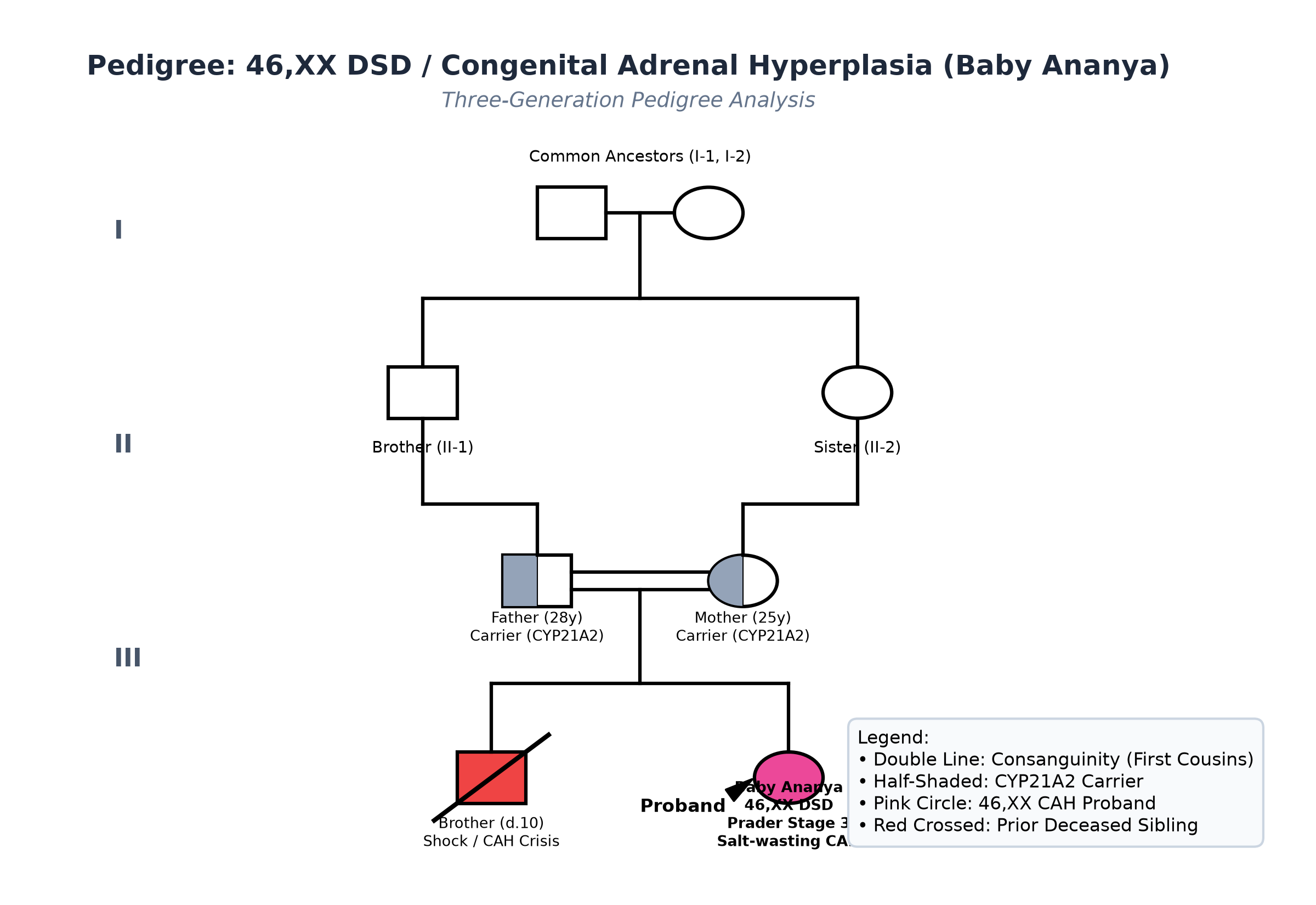
- Second-Degree Consanguinity: Parents are first cousins (Father's sister's daughter married Mother's brother's son).
- Prior Neonatal Death: The first pregnancy resulted in a full-term presumed male baby who developed severe vomiting, dehydration, and died on Day 10 of life in a rural clinic with a presumed diagnosis of 'septic shock' (retrospectively recognized as an undiagnosed fatal salt-wasting CAH crisis in a male sibling!).
Nutritional & Fluid History
- Pre-Crisis: Exclusively breastfed; feed volume was variable due to progressive lethargy.
- Current Post-Crisis Regimen:
- Current weight post-rehydration: $3.02\text{ kg}$.
- Expressed breast milk via paladai: $150\text{ mL/kg/day}$ = $450\text{ mL/day}$ divided into 8 feeds ($55-60\text{ mL}$ every 3 hours).
- Sodium Chloride Supplementation: $1.5\text{ g/day}$ of NaCl (approx. $26\text{ mEq Na}^+/\text{day}$) dissolved in expressed breast milk, given in divided doses to overcome neonatal distal tubular aldosterone insensitivity.
The expected calories and proteins should be calculated from the target weight and gestation.
Socioeconomic & KAP
- Modified BG Prasad Socioeconomic Class III.
- Parents were extremely distressed regarding the ambiguous genitalia and the near-fatal shock event.
- Provided empathetic, structured counseling: explained that the baby is a genetic girl with completely normal internal reproductive organs (uterus, fallopian tubes, ovaries) and normal future reproductive potential, whose adrenal glands produced excess male hormones during fetal life because of a treatable enzyme defect.
Summary of History
Baby of Kavita, a 4-day-old newborn born of a consanguineous marriage with a family history of an early neonatal death, presenting with ambiguous genitalia (Prader Stage 3: $1.8\text{ cm}$ phallus, single urogenital opening, fused hyperpigmented labioscrotal folds, non-palpable gonads bilaterally), who presented on day 9 in acute salt-wasting adrenal crisis (Na 118, K 7.8, hypoglycemia, shock) with 17-OHP $>100\text{ ng/mL}$, successfully resuscitated with IV fluids, hydrocortisone, fludrocortisone, and salt supplementation.
Provisional Clinical Diagnosis: Full-Term Infant (Day 10 of Life), Appropriate for Gestational Age, with 46,XX Differences / Disorders of Sex Development (46,XX DSD), secondary to Classical Salt-Wasting Congenital Adrenal Hyperplasia (21-Hydroxylase Deficiency), Recovered from Acute Salt-Wasting Adrenal Crisis, on Maintenance Hormone Replacement.
Physical Examination (Day 10 Post-Stabilization)
- General Appearance: Infant is calm, awake, alert, well-hydrated, sucking well on finger; afebrile; pink; no jaundice, cyanosis, or peripheral edema.
- Vitals:
- Heart Rate: 134 beats/minute, regular, strong peripheral pulses.
- Respiratory Rate: 36 breaths/minute, unlabored, no retractions.
- Blood Pressure: $72/46\text{ mmHg}$ (Normotensive for newborn).
- Temperature: $36.8^\circ\text{C}$ (Axillary).
- Capillary Refill Time: $<2$ seconds (Skin turgor restored, anterior fontanelle flat).
- Anthropometry:
- Weight: 3020 g (Birth weight 3100 g).
- Length: 50.0 cm (50th centile WHO).
- Head Circumference: 34.5 cm (50th centile WHO).
Detailed External Genital Examination & Prader Staging
- Phallic Structure:
- Stretched Phallic Length (SPL): $1.8\text{ cm}$ (Normal term female clitoral length $<0.6\text{ cm}$; normal term male penile length $3.5 \pm 0.4\text{ cm}$). Represents significant clitoromegaly.
- Phallic diameter: $0.7\text{ cm}$. Mild chordee present pulling phallus downward.
- Glans is well-formed with a prominent prepuce that hooded dorsally.
- Urethral / Vaginal Orifice:
- No meatal opening at the tip of the glans.
- A single urogenital sinus orifice is situated at the base of the phallus on the perineum (common channel confluence of urethra and vagina).
- Labioscrotal Folds:
- Completely fused in the posterior midline creating a deep perineal raphe.
- Marked hyperpigmentation and scrotalized rugosity of the folds (reflects fetal ACTH overproduction driven by cortisol deficiency).
- Gonadal Palpation:
- Bilateral labioscrotal folds: Completely empty; no gonads palpable.
- Bilateral inguinal canals: No palpable masses, hernias, or gonad-like structures.
- Clinical Inference: Absence of palpable gonads strongly supports the presence of intra-abdominal ovaries (46,XX DSD) rather than descended testes.
- Prader Classification: Prader Stage 3 (Marked phallic enlargement, single common urogenital orifice at base, extensive posterior labioscrotal fusion).
Systemic Examination
- Head to Toe: Generalized hyperpigmentation noted over the areolae, axillae, and genital folds. Spine normal; no cleft lip/palate; no dysmorphic facies.
- Cardiovascular: S1 and S2 heard normally; no murmurs; peripheral pulses equal.
- Respiratory: Clear breath sounds bilaterally; normal vesicular breathing.
- Abdomen: Soft, non-tender; liver palpable $1.0\text{ cm}$ below right costal margin, soft; spleen not palpable; no renal masses.
- Central Nervous System: Normal sensorium, alert; normal tone; vigorous rooting and sucking; symmetrical Moro reflex.
Summary
Baby of Kavita, a genetic female infant born of consanguineous parents with a family history of early neonatal death, presenting with ambiguous genitalia (Prader Stage 3: clitoromegaly $1.8\text{ cm}$, single urogenital opening, non-palpable gonads, hyperpigmentation), who suffered a severe salt-wasting adrenal crisis on day 9 (Na 118, K 7.8, hypoglycemia), confirmed to have 46,XX CAH with 17-OHP $>100\text{ ng/mL}$, successfully resuscitated and maintained on steroid replacement.
Final Diagnosis: Full-Term Infant (Day 10 of Life), with Disorders of Sex Development (46,XX DSD), caused by Classical Salt-Wasting Congenital Adrenal Hyperplasia (21-Hydroxylase Deficiency, CYP21A2 Gene Mutation), Post-Adrenal Crisis Resuscitation, on Triple Replacement Therapy (Hydrocortisone, Fludrocortisone, and Sodium Chloride).
Differential Diagnosis of Atypical / Ambiguous Genitalia
| Disorder | Points IN FAVOR | Points AGAINST |
|---|---|---|
| Classical Salt-Wasting CAH (21-OH Deficiency) | Bilateral non-palpable gonads, Prader Stage 3, severe hyponatremia, hyperkalemia, hypoglycemia, 17-OHP $>100\text{ ng/mL}$, consanguinity, prior sibling death | Primary Diagnosis (46,XX DSD) |
| $11\beta$-Hydroxylase Deficiency CAH | Ambiguous genitalia in 46,XX, clitoromegaly, hyperpigmentation | Causes hypertension and hypokalemic alkalosis due to 11-deoxycorticosterone (DOC) accumulation, not salt wasting and shock |
| $3\beta$-Hydroxysteroid Dehydrogenase Deficiency | Salt-wasting crisis, hyponatremia, hyperkalemia, ambiguous genitalia | Extremely rare; causes mild virilization in females and severe undervirilization in males; DHEA is markedly elevated |
| 46,XY DSD (Androgen Insensitivity / $5\alpha$-Reductase) | Under-virilized external genitalia, perineal hypospadias | Gonads (testes) are almost always palpable in the inguinal canal or labia; no salt-wasting crisis; normal electrolytes |
| Mixed Gonadal Dysgenesis (45,X/46,XY) | Ambiguous genitalia | Asymmetric genitalia with unilateral palpable testis and contralateral streak gonad; no adrenal crisis |
Investigation Protocol & Laboratory Workup
flowchart TD
    A["Neonate with Ambiguous Genitalia & Bilateral Non-Palpable Gonads"] --> B["EMERGENCY WORKUP: Serum Electrolytes, Blood Glucose, VBG, Serum 17-OHP"]
    B --> C["Rapid Cytogenetics: Karyotype (G-banding) & SRY Fluorescence In Situ Hybridization (FISH)"]
    C --> D["Pelvic & Abdominal Ultrasound: Identify Uterus, Cervix, Ovaries & Adrenals"]
    D --> E{"Karyotype 46,XX + High 17-OHP + Uterus Present?"}
    E -->|Yes| F["Confirm 46,XX DSD: 21-Hydroxylase Deficiency CAH"]
    F --> G["Initiate Hydrocortisone, Fludrocortisone & Oral NaCl Maintenance"]
    G --> H["Multidisciplinary Team Evaluation: Female Gender Assignment & Future Surgical Planning"]
1. Endocrine & Biochemical Confirmation Panel
| Investigation | Observed Value (Crisis) | Observed Value (Post-Resuscitation) | Biological Reference Range | Inference |
|---|---|---|---|---|
| Serum 17-OHP | $>100\text{ ng/mL}$ | $18.4\text{ ng/mL}$ | $<2.0\text{ ng/mL}$ | Pathognomonic for 21-Hydroxylase deficiency |
| Serum Sodium | $118\text{ mEq/L}$ | $137\text{ mEq/L}$ | $135-145\text{ mEq/L}$ | Severe salt-wasting hyponatremia $\to$ Corrected |
| Serum Potassium | $7.8\text{ mEq/L}$ | $4.6\text{ mEq/L}$ | $3.5-5.5\text{ mEq/L}$ | Severe hyperkalemia (ECG peaked T) $\to$ Normalized |
| Plasma Renin Activity (PRA) | $48\text{ ng/mL/hr}$ | $12\text{ ng/mL/hr}$ | $2.0-8.0\text{ ng/mL/hr}$ | Massive activation from hypovolemia/aldosterone lack |
| Serum Cortisol (Basal) | $3.2\text{ mcg/dL}$ | — | $>15-20\text{ mcg/dL}$ (in stress) | Inappropriately low; confirms adrenal failure |
| Blood Glucose | $38\text{ mg/dL}$ | $86\text{ mg/dL}$ | $50-100\text{ mg/dL}$ | Symptomatic hypoglycemia $\to$ Corrected |
| Serum Testosterone | $160\text{ ng/dL}$ | $42\text{ ng/dL}$ | $<20\text{ ng/dL}$ (female neonate) | Markedly elevated androgen synthesis |
2. Imaging & Cytogenetics
- Pelvic Ultrasonography:
- Clear identification of a normal infantile uterus measuring $3.2 \times 1.1\text{ cm}$ with distinct endometrial stripe.
- Bilateral normal ovaries identified in pelvis; no testes or testicular tissue seen.
- Bilateral adrenal glands are markedly enlarged with classic 'cerebriform' (convoluted brain-like) pattern of congenital adrenal hyperplasia.
- Cytogenetic Analysis (Karyotype):
- High-resolution G-banding: 46,XX (female chromosome complement).
- SRY gene PCR / FISH: Negative for SRY.
- Molecular Genetics: Direct sequencing of CYP21A2 gene revealed homozygous $I2g$ splice-site mutation ($c.293-13C>G$), confirming severe classical salt-wasting CAH phenotype.
Long-Term Multidisciplinary Management Plan
1. Chronic Maintenance Hormone Replacement Therapy
- Oral Hydrocortisone (Glucocorticoid):
- Dose: $10-15\text{ mg/m}^2/\text{day}$ orally divided into 3 doses ($1.5\text{ mg}$ morning, $1.0\text{ mg}$ afternoon, $1.5\text{ mg}$ night). A slightly higher bedtime dose suppresses the nocturnal surge of ACTH.
- Avoid dexamethasone or prednisolone in growing children due to severe growth suppression!
- Oral Fludrocortisone (Mineralocorticoid):
- Dose: $0.1-0.2\text{ mg/day}$ in 1-2 divided doses.
- Sodium Chloride Supplementation:
- Dose: $1-2\text{ grams/day}$ ($17-34\text{ mEq/day}$) of oral NaCl added to breast milk feeds throughout the first year of life.
2. Sick-Day Stress Dosing Protocol (Parental Education)
- In the event of fever ($>38.5^\circ\text{C}$), gastroenteritis, or trauma:
- Double or Triple the oral hydrocortisone dose immediately.
- If the infant is vomiting and cannot tolerate oral medication:
- Administer emergency home Inj. Hydrocortisone ($25\text{ mg IM}$) and immediately transport to the hospital.
- Provide parents with an emergency medical alert card and pre-filled hydrocortisone vials.
3. Multidisciplinary Gender Assignment & Surgical Timing
- Gender Assignment: Confirmed as Female. The child has normal 46,XX karyotype, normal ovaries, uterus, and fallopian tubes, and with proper medical therapy has normal female puberty and reproductive fertility.
- Surgical Staging (Chicago Consensus):
- Cosmetic surgery is not an emergency.
- A retrograde genitogram / cystourethroscopy will delineate the confluence point of the vagina with the common urogenital sinus.
- Low confluence: Single-stage feminizing genitoplasty (neurovascular-sparing clitoroplasty and pull-through exteriorization of the vagina) deferred until 6 to 12 months of age or later, performed by an experienced pediatric urologist.
- Regular psychological counseling for parents and the growing child.