
Baby Pari of Mrs. Sunita, a 3-week-old infant (genetically 46,XX), 2nd order child born of a first-degree consanguineous marriage from Indore, Madhya Pradesh, presented to the pediatric emergency in a state of circulatory shock, with recurrent non-bilious projectile vomiting, poor feeding, profound lethargy, severe weight loss since birth, and genital ambiguity noted since delivery.
- Ambiguous external genitalia in 46,XX female infants (clitoromegaly, labial fusion, urogenital sinus)
- Catastrophic adrenal crisis at 7 to 21 days of life (vomiting, diarrhea, severe weight loss, hypovolemic shock)
- Refractory dehydration and failure to regain birth weight
- Lethargy, somnolence, hypothermia, convulsions (from severe hypoglycemia or hyponatremia)
- Generalized hyperpigmentation of areolae, axillae, scrotum/labia, and genital skin folds
HOPI
The history is dated back to birth when the attending delivery team noted ambiguous external genitalia with an enlarged phallus, prompting confusion regarding sex assignment.
Classic 21-hydroxylase deficiency (21-OHD) presents a fascinating clinical dichotomy: 46,XX female infants are typically recognized at birth due to virilized ambiguous genitalia (Prader stages I-V), whereas 46,XY male infants appear phenotypically normal and are discharged home, only to present in catastrophic adrenal collapse at Day 7 to 21 of life with vomiting (frequently misdiagnosed as pyloric stenosis) and shock. Always probe for sibling deaths in the neonatal period (especially unexplained male infant collapse) and consanguinity.
- Genital Ambiguity Noted at Birth:
- At delivery, external genitalia showed a markedly enlarged clitoris resembling a small penis, fused labia resembling an empty bifid scrotum, and a single perineal opening Points to excessive fetal adrenal androgen exposure beginning at 8-10 weeks of gestation.
- No gonads were palpable within the labioscrotal folds. Sex of rearing was deferred pending specialist evaluation.
- Poor Feeding & Failure to Regain Birth Weight:
- Discharged on Day 3; initially breastfed weakly, but feeding progressively deteriorated.
- Despite feeding attempts every 2 hours, the infant failed to gain weight; cheek pads disappeared and ribs became visible.
- Acute Decompensation & Adrenal Crisis (Past 5 Days):
- At 2 weeks of age (Day 16), the infant developed frequent non-bilious, forceful vomiting occurring 20-30 minutes after every feed Classic presentation of salt-wasting crisis; often mistaken for hypertrophic pyloric stenosis, but CAH features hyponatremia and hyperkalemia, whereas pyloric stenosis features hypochloremic hypokalemic metabolic alkalosis!
- Infant became extremely lethargic, cold, pale, and unresponsive, with weak whimpering cries and loose watery stools.
- Over the past 24 hours, urine output decreased to $<1$ wet diaper/day (severe oliguria), prompting emergency presentation.
- Progressive Skin Hyperpigmentation:
- Mother noticed darkening of skin around the areolae, axillary folds, and genital region Reflects loss of negative cortisol feedback leading to massive pituitary ACTH and POMC hypersecretion with MSH-like melanocyte stimulation.
- Negative History:
- No history of maternal virilization, hirsutism, voice deepening, or acne during pregnancy Rules out maternal androgen-secreting luteoma or aromatase deficiency.
- No history of bilious (green) vomiting or blood in stools Rules out malrotation with midgut volvulus or necrotizing enterocolitis.
- No history of fever or localizing source of infection.
Past History
- Full-term female infant born by normal vaginal delivery; birth weight 3.1 kg.
- Current weight at 3 weeks: 2.55 kg ($550\text{ g}$ weight loss = $17.7\%$ body weight loss since birth; severe pathological weight loss).
Family history
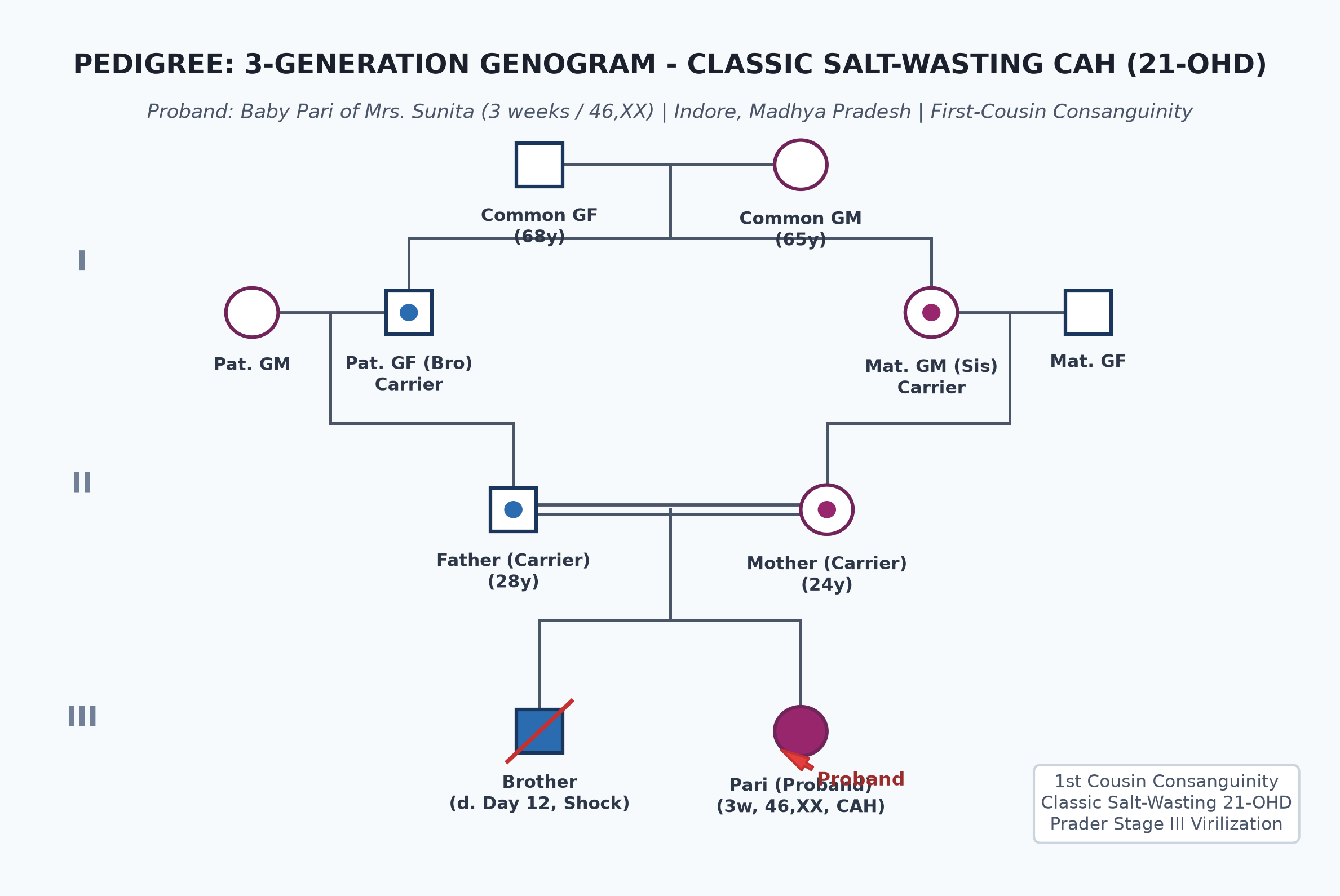
- Born of a first-degree consanguineous marriage (parents are first cousins).
- Father 28 years, laborer; Mother 24 years, homemaker.
- Previous Sibling Death: First-born male child died on Day 12 of life following acute onset of recurrent vomiting, severe dehydration, and sudden circulatory collapse; labeled as "neonatal septic shock" without endocrine autopsy.
- Pedigree confirms an Autosomal Recessive inheritance pattern of Classic Salt-Wasting 21-Hydroxylase Deficiency (CYP21A2 mutation).
Immunization history
- Received BCG and OPV-0 at birth.
Dietary history
- Exclusively breastfed; however, due to lethargy and vomiting, effective milk intake over the last 5 days has been negligible ($<30\text{ mL/feed}$).
Socioeconomic and KAP
- Modified BG Prasad Class IV (Lower Class).
- Parents bewildered by ambiguous genitalia and terrified by the sudden collapse mirroring their first child's death.
Summary of History
Baby Pari, a 3-week-old 46,XX infant born of first-cousin consanguineous parents with a family history of unexplained early male infant death, presents with Prader stage III ambiguous genitalia, failure to regain birth weight ($17.7\%$ weight loss), recurrent non-bilious vomiting, hyperpigmentation, severe dehydration, and circulatory shock at Day 21 of life.
I would like to think of Classic Congenital Adrenal Hyperplasia (21-Hydroxylase Deficiency, Salt-Wasting form) presenting in acute life-threatening Adrenal Crisis with severe hypovolemic shock, hyponatremic dehydration, and hyperkalemia.
General head to toe examination
- Behavioral State: Obtunded, barely rousable, weak whimpering cry, severely dehydrated.
- Vitals:
- Heart Rate: 178 beats/minute, rapid, thready, feeble peripheral pulses.
- Respiratory Rate: 36 breaths/minute, regular, shallow.
- Blood Pressure: $54/32\text{ mmHg}$ (Severe Hypotension / Circulatory Shock).
- Temperature: $35.5^\circ\text{C}$ (Axillary) -> Hypothermia.
- Capillary Refill Time (CRT): 4.5 seconds; peripheral extremities cold, mottled, cyanotic.
- Anthropometry:
| Parameter | Observed | Expected (50th WHO) | Z-score / Centile | Inference |
|---|---|---|---|---|
| Current Weight | 2.55 kg | 3.6 kg | $< -3\text{ SD}$ | Severe Wasting ($17.7\%$ loss from birth) |
| Birth Weight | 3.1 kg | 3.1 kg | $50^{\text{th}}\text{ centile}$ | Normal birth weight |
| Length | 50.0 cm | 51.5 cm | $50^{\text{th}}\text{ centile}$ | Normal Length |
| Head Circumference | 35.0 cm | 35.5 cm | Normal | Normal HC |
- General Physical Findings:
- Dehydration: Sunken eyes, depressed anterior fontanelle, dry oral mucosa, skin pinch retracts $>3$ seconds (Severe $>10\%$ dehydration).
- Hyperpigmentation: Striking diffuse hyperpigmentation, accentuated over both areolae, axillary vaults, umbilical ring, and the corrugated labioscrotal folds.
- Pallor, Icterus, Edema: Absent.
Detailed Genital Examination (Prader Staging)
- External Genital Staging (Prader Stage III):
- Phallus / Clitoris: Markedly hypertrophied clitoris measuring $1.8\text{ cm}$ in length and $0.9\text{ cm}$ in width (Clitoral Index $= 18 \times 9 = 162\text{ mm}^2$; normal full-term female clitoral length is $<6\text{ mm}$, clitoral index $<35\text{ mm}^2$). Prepuce is hooded; no chordee.
- Labioscrotal Folds: Fused posteriorly covering the introitus; corrugated, thickened, and heavily hyperpigmented, resembling an empty scrotum.
- Urogenital Orifice: A single perineal opening (urogenital sinus) located at the base of the enlarged clitoris, through which both urine and vaginal secretions drain.
- Gonadal Palpation: Gonads (testes) are NOT palpable in the labioscrotal folds or in the inguinal canals bilaterally!
- Golden Rule: Ambiguous genitalia with non-palpable gonads is Classic 21-OHD CAH in a 46,XX female until proven otherwise!
Systemic Examination
- Cardiovascular System: Marked tachycardia (178 bpm), heart sounds rapid and faint, no murmurs.
- Abdomen: Soft, scaphoid, non-tender, no masses or organomegaly; liver 1.5 cm below costal margin (normal).
- Central Nervous System: Lethargic, generalized hypotonia, normal cranial nerves, sluggish Moro reflex.
Summary
Baby Pari, a 3-week-old genetically 46,XX infant born of first-degree consanguineous marriage, presents with Prader stage III virilized external genitalia without palpable gonads, hyperpigmentation, severe weight loss ($17.7\%$), recurrent vomiting, hypothermia ($35.5^\circ\text{C}$), and decompensated hypovolemic shock (BP $54/32\text{ mmHg}$, CRT $4.5\text{ sec}$, HR $178\text{ bpm}$), with a history of unexplained neonatal death in a prior male sibling.
Final Clinical Diagnosis: Classic Congenital Adrenal Hyperplasia due to 21-Hydroxylase Deficiency (Salt-Wasting form), presenting in acute life-threatening Adrenal Crisis with severe shock, severe hyponatremia, and hyperkalemia.
Differential Diagnosis
| Condition | Points IN FAVOR | Points AGAINST |
|---|---|---|
| Classic CAH (21-Hydroxylase Deficiency, Salt-Wasting) | 46,XX virilization (Prader III), non-palpable gonads, hyperpigmentation, Day 21 shock, vomiting, AR sibling death | Primary Clinical Diagnosis |
| Congenital Hypertrophic Pyloric Stenosis (CHPS) | Day 14-21 projectile non-bilious vomiting, severe dehydration, weight loss | CHPS features hypokalemic hypochloremic metabolic alkalosis, palpable olive mass, and normal female genitalia; CAH features hyperkalemic hyponatremic acidosis |
| Neonatal Sepsis with Septic Shock | Lethargy, vomiting, hypothermia, delayed CRT, shock | Does not account for virilized external genitalia, hyperpigmentation, or dramatic hyperkalemia |
| 11-Beta-Hydroxylase Deficiency CAH | Ambiguous genitalia in 46,XX, virilization | Features hypertension (due to 11-deoxycorticosterone accumulation) and hypokalemia, NOT salt-wasting shock |
| Complete Androgen Insensitivity Syndrome (CAIS) | Phenotypic ambiguity / female presentation | 46,XY karyotype, normal female external genitalia (no virilization), testes present in inguinal canal/abdomen |
Investigation Protocol & Diagnostic Workup
flowchart TD
    A["Infant in Shock with Ambiguous Genitalia & Non-Palpable Gonads"] --> B["Stat Blood Glucose, Electrolytes, Blood Gas & ECG"]
    B --> C{"Biochemical Pattern: Na < 125, K > 6.5, Glucose < 54?"}
    C -->|Yes: Adrenal Crisis| D["Draw Pre-Treatment 17-OHP, Cortisol, ACTH, Renin"]
    D --> E["Immediately Resuscitate with Normal Saline Bolus (20 mL/kg) + 10% Dextrose"]
    E --> F["Administer IV Hydrocortisone Sodium Succinate (25 mg Stat)"]
    F --> G["Perform Urgent Pelvic Ultrasound: Uterus & Ovaries Present?"]
    G -->|Uterus Present & 46,XX| H["Confirm 21-OHD CAH (Markedly Elevated 17-OHP > 1000 ng/dL)"]
1. Emergency Biochemical Panel
- Serum Electrolytes:
- Serum Sodium ($Na^+$): $116\text{ mEq/L}$ (Severe renal salt wasting; normal $135-145\text{ mEq/L}$).
- Serum Potassium ($K^+$): $7.8\text{ mEq/L}$ (Life-threatening hyperkalemia; normal $3.5-5.5\text{ mEq/L}$).
- Serum Chloride ($Cl^-$): $84\text{ mEq/L}$.
- Serum Bicarbonate ($HCO_3^-$): $12.0\text{ mEq/L}$ (Metabolic acidosis).
- Bedside Blood Glucose: $42\text{ mg/dL}$ (Severe hypoglycemia; $<54\text{ mg/dL}$ due to cortisol deficiency).
- Electrocardiogram (ECG): Peaked, tall, symmetrical "tented" T waves; prolonged PR interval ($0.18\text{ sec}$); slight widening of QRS complex (hyperkalemic myocardial conduction toxicity).
2. Endocrine Biomarkers (Drawn Before Steroid Bolus)
- Serum 17-Hydroxyprogesterone (17-OHP): Markedly elevated ($78.0\text{ ng/mL}$ = $7800\text{ ng/dL}$, normal newborn $<2\text{ ng/mL}$; diagnostic $>1000\text{ ng/dL}$).
- Plasma ACTH: Markedly elevated ($340\text{ pg/mL}$, normal $10-60\text{ pg/mL}$).
- Serum Cortisol: Inappropriately low ($2.4\text{ mcg/dL}$ despite severe shock stress; expected $>20\text{ mcg/dL}$).
- Plasma Renin Activity (PRA): Markedly elevated ($> 45\text{ ng/mL/hr}$, normal $2-8\text{ ng/mL/hr}$).
- Serum Testosterone & Androstenedione: Markedly elevated prepubertal levels.
3. Pelvic Ultrasonography & Karyotyping
- Pelvic USG: Identifies a normal midline infantile uterus ($2.6\text{ cm}$) and bilateral normal ovaries; absence of testes in inguinal canals; adrenal glands are bilaterally enlarged with a characteristic cerebriform pattern.
- Cytogenetic Karyotype: 46,XX (confirms female genetic sex).
Therapeutic Management Protocol
1. Emergency Resuscitation of Adrenal Crisis (First 24 Hours)
- Airway, Breathing, and Vascular Access: High-flow oxygen; secure two large-bore IV cannulae (or intraosseous access).
- Volume Expansion (Fluid Bolus):
- 0.9% Normal Saline (0.9% NaCl): $20\text{ mL/kg}$ IV over 20-30 minutes ($50\text{ mL}$ bolus). Repeat $10\text{ mL/kg}$ bolus if perfusion remains poor.
- Strict Rule: Never use potassium-containing fluids (e.g., Ringer's Lactate is strictly contraindicated).
- Hypoglycemia Correction:
- Administer 10% Dextrose: $2\text{ to } 5\text{ mL/kg}$ IV push ($5-10\text{ mL}$ stat), followed by $10\%\text{ Dextrose with } 0.9\%\text{ Saline}$ infusion.
- Immediate Glucocorticoid Replacement:
- Hydrocortisone Sodium Succinate: Stat IV bolus of $25\text{ mg}$ (or $50-100\text{ mg/m}^2$), followed by $50\text{ to } 100\text{ mg/m}^2/\text{day}$ divided every 6 hours IV ($6-8\text{ mg}$ IV Q6H).
- Hyperkalemia Management:
- 10% Calcium Gluconate: $0.5\text{ mL/kg}$ ($1.3\text{ mL}$) IV over 5-10 minutes with continuous ECG monitoring to stabilize myocardial membranes.
- Nebulized Salbutamol ($2.5\text{ mg}$) to drive potassium intracellularly.
2. Maintenance Therapy (Once Clinically Stabilized)
- Oral Hydrocortisone (Glucocorticoid Replacement):
- Dose: $10\text{ to } 15\text{ mg/m}^2/\text{day}$ orally divided TID (e.g., $2.5\text{ mg}$ morning, $1.25\text{ mg}$ afternoon, $1.25\text{ mg}$ evening).
- Monitoring Target: Maintain 17-OHP between $400\text{ and } 1000\text{ ng/dL}$. Never try to normalize 17-OHP into the normal reference range ($<100\text{ ng/dL}$), as overtreatment will cause severe growth failure and Cushingoid features!
- Fludrocortisone (Mineralocorticoid Replacement):
- Dose: $0.05\text{ to } 0.2\text{ mg/day}$ orally (usually $0.1\text{ mg}$ OD).
- Normalizes electrolytes, blood pressure, and suppresses plasma renin activity.
- Sodium Chloride ($NaCl$) Supplementation:
- Neonates consume breast milk which contains only $7\text{ mEq/L}$ of sodium.
- Supplement $1\text{ to } 2\text{ grams/day}$ ($17-34\text{ mEq/day}$) of table salt added to feeds during the first year of life.
3. Long-Term Multidisciplinary Care & Surgery
- Provide written Sick Day Rules: Triple the hydrocortisone dose during febrile illnesses; emergency IM Solu-Cortef ($25\text{ mg}$) for vomiting.
- Reconstructive feminizing genitoplasty (clitoroplasty and vaginoplasty) planned at an experienced multidisciplinary center.