
Master Reyansh, a 9-year-old male child, 1st order offspring born of a non-consanguineous marriage from Pune, Maharashtra, presented with complaints of progressive proportional growth failure and severe short stature noticed since 4 years of age, progressive chalky pallor resistant to multiple courses of oral iron for 1 year, excessive thirst (polydipsia) and waking up 4 to 5 times every night to pass urine (nocturia) for 8 months, progressive inward bending of both knees (knock-knees / genu valgum) causing an abnormal waddling gait for 6 months, and persistent loss of appetite, sallow complexion, and exertional fatigue for 3 months.
- Severe linear growth failure / stunting (Height Z-score <-3 SD due to uremia, acidosis, and GH resistance)
- Refractory normocytic normochromic anemia unresponsive to oral hematinics (Erythropoietin deficiency)
- Polyuria, polydipsia, and nocturia (Loss of medullary concentrating ability and vasopressin resistance)
- Progressive bony deformities: Genu Valgum ('knock-knees'), rachitic rosary, widened wrists, and bone pain
- Sallow, earthy-brown complexion and pruritus (Urochrome pigment retention and hyperparathyroidism)
- Morning nausea, anorexia, and vomiting (Uremic gastropathy and retention of nitrogenous waste)
- Morning periorbital puffiness and headache (Volume-overload and renin-mediated hypertension)
HOPI
The child's parents report that he had a history of recurrent febrile urinary tract infections in early infancy and underwent an endoscopic surgical procedure at 8 months of age for urinary obstruction. Over the past 5 years, he has lagged progressively behind his peers in height and physical stamina.
Chronic Kidney Disease in pediatrics is dominated by Congenital Anomalies of the Kidney and Urinary Tract (CAKUT, >50% of cases), unlike adult CKD which is dominated by diabetes and hypertension. Always trace the antenatal history (oligohydramnios, hydronephrosis) and infantile voiding pattern (poor urinary stream, dribbling). Renal Osteodystrophy is a cardinal clinical feature of long-standing pediatric CKD: secondary hyperparathyroidism and calcitriol deficiency cause severe rachitic deformities and 'renal rickets', classically manifesting as Bilateral Genu Valgum in older children. Inquire strictly about polyuria, nocturia, dietary protein tolerance, and prior blood transfusions.
- Proportional Growth Failure & Stunting:
- Parents noticed that the child has not outgrown his school uniform clothes for the past 3 years.
- Height has persistently tracked below the 3rd percentile on WHO growth charts.
- Refractory Pallor & Fatigue:
- Insidious onset over 1 year; received 3 full courses of oral iron syrup without any improvement in energy or hemoglobin.
- Exertional breathlessness on playing with classmates; sits quietly during physical education classes.
- Polyuria, Polydipsia & Nocturia:
- Began 8 months ago; child drinks 3 to 4 liters of water daily, carrying large water bottles to school.
- Wakes up 4 to 5 times every night to void large volumes of clear, pale urine (Nocturia).
- History of secondary nocturnal enuresis Reflects early loss of tubular concentrating capacity (isosthenuria) characteristic of tubulointerstitial and reflux nephropathy.
- Skeletal Deformities (Genu Valgum / Renal Rickets):
- Over the past 6 months, parents noticed inward deviation of both knees; the knees knock against each other while running, forcing an awkward waddling gait.
- Intermittent dull aching pain in both lower thighs and shins, worse in the evening after walking.
- Gastrointestinal & Uremic Symptoms:
- Anorexia, altered metallic taste in mouth, morning nausea, and sallow, dry skin with mild itching (uremic pruritus).
- Negative Inquiries:
- No gross hematuria, oliguria, puffiness of eyes, or facial edema (excludes active nephritic flare).
- No history of frothy urine or generalized anasarca (excludes untreated nephrotic syndrome).
- No history of recurrent convulsions, chest pain, or palpitations.
Past history
- At 6 months of age, presented with high fever, vomiting, and straining on micturition with poor dribbling stream. Diagnosed with Posterior Urethral Valves (Type 1 PUV) with bilateral high-grade hydroureteronephrosis and underwent endoscopic transurethral valve ablation at 8 months of age.
- Nadir serum creatinine at 1 year post-ablation was $0.9\text{ mg/dL}$ (elevated; indicated permanent residual renal dysplasia / hypoplasia).
Antenatal, natal and postnatal history
- Mother was a 26-year-old registered primigravida; routine ultrasound at 32 weeks reported mild oligohydramnios and bilateral fetal hydronephrosis with a distended fetal urinary bladder.
- Full-term elective Cesarean delivery (for fetal distress/oligohydramnios); birth weight 2.8 kg; cried immediately.
- Neonatal period uneventful; discharged on Day 4.
Development history
- Gross motor milestones were mildly delayed: walked at 16 months. Fine motor, language, and social development age-appropriate.
- Currently in Class 4; academic performance has deteriorated over the past year due to fatigue and poor concentration.
Family history
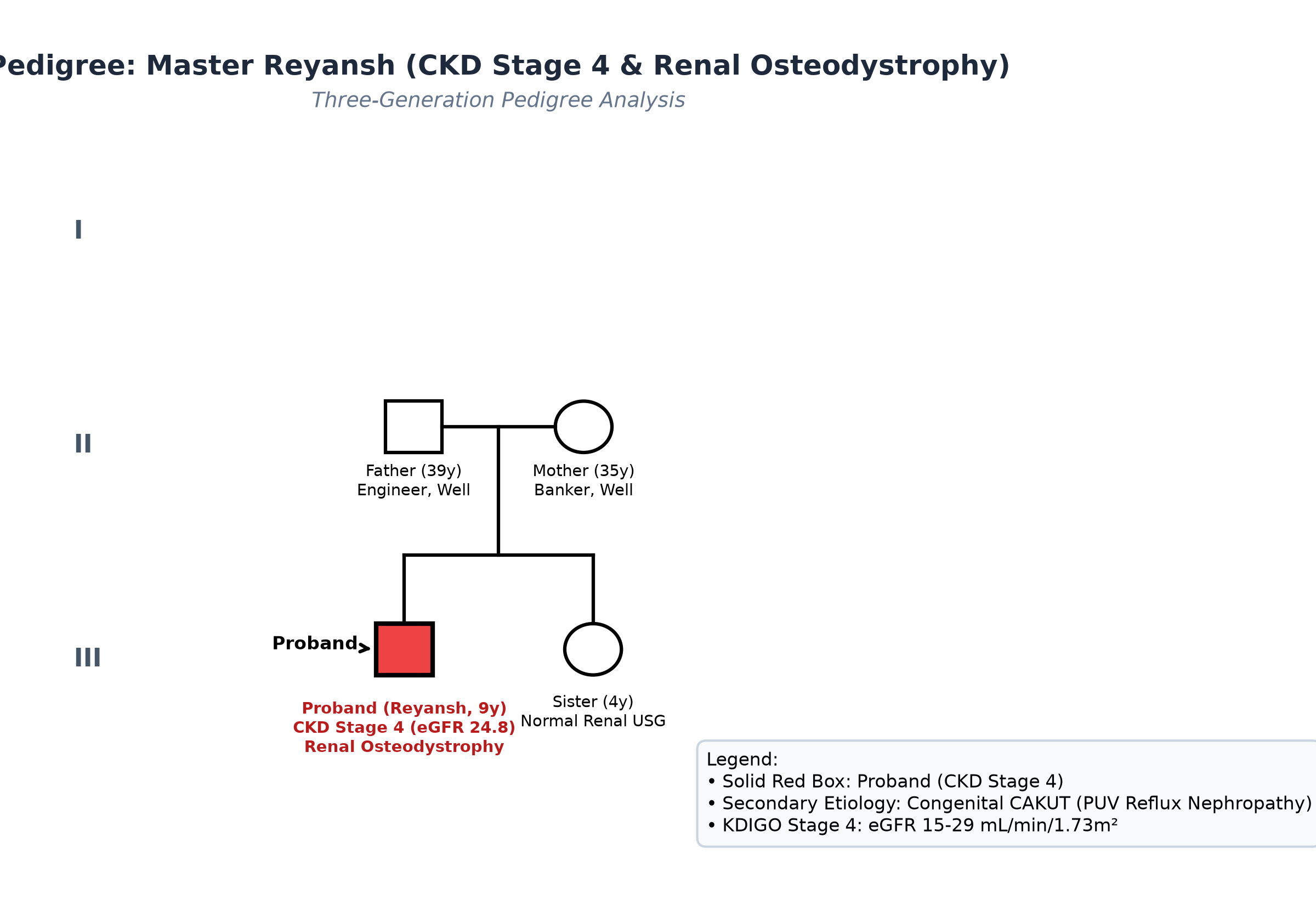
- Non-consanguineous Hindu parentage.
- Father 39 years, engineer, healthy; Mother 35 years, bank officer, healthy.
- Younger sister (4 years old) is healthy; screening renal ultrasound was normal.
- No family history of early renal failure, cystic kidney diseases, or early dialysis.
Immunization history
- Received all routine vaccines per the National Immunization Schedule; received Pneumococcal conjugate vaccine and annual Influenza vaccine.
- Hepatitis B vaccine series completed; anti-HBs titer documented $>100\text{ mIU/mL}$ (mandatory for potential dialysis/transplant candidates).
Dietary history
- Vegetarian diet; parents restricted protein intake on community advice, causing significant caloric deficit.
| Food Item | Quantity | Calories (kcal) | Protein (g) |
|---|---|---|---|
| Cow's Milk (toned) | 250 mL | 150 | 8.0 |
| Roti (whole wheat, 2) | 60 g flour | 204 | 7.0 |
| Boiled Rice | 150 g cooked | 195 | 3.9 |
| Moong Dal (watery, 1 katori) | 25 g raw | 85 | 5.5 |
| Potato / Gourd Sabzi | 1 bowl | 95 | 1.8 |
| Poha with vegetables | 1 small plate | 180 | 3.2 |
| Apple | 1 small (80 g) | 48 | 0.3 |
| Puffed Rice (snack) | 30 g | 120 | 2.1 |
| Total Observed Daily Intake | — | 1077 kcal | 31.8 g |
24-Hour Recall Deficit Analysis
$$ \text{Ideal Body Weight (IBW for 9 years, 50th centile WHO)} = 28.5\text{ kg} $$| Nutrient | Expected Intake (ICMR-NIN 2024 for IBW 28.5 kg) | Observed Intake | Deficit | Percentage Deficit |
|---|---|---|---|---|
| Energy (kcal) | $28.5\text{ kg} \times 58\text{ kcal/kg} = 1653\text{ kcal}$ | 1077 kcal | 576 kcal | 34.8% Deficit |
| Protein (g) | $28.5\text{ kg} \times 0.95\text{ g/kg} = 27.1\text{ g}$ | 31.8 g | Nil (Adequate) | 0% Deficit |
The expected calories and proteins should be calculated from the ideal body weight, not from current weight.
Socioeconomic and KAP
- Modified BG Prasad Socioeconomic Class II (Upper Middle Class).
- Urban apartment with municipal supply; family motivated for renal replacement therapy.
Summary of History
Master Reyansh, a 9-year-old male child with a history of posterior urethral valve ablation in infancy, presents with chronic progressive failure to thrive, severe linear stunting, refractory normocytic anemia, polyuria, nocturia, polydipsia, bilateral genu valgum deformities, and uremic symptoms, without gross edema or hematuria.
I would like to consider a provisional diagnosis of Chronic Kidney Disease (CKD) Stage 4 secondary to Congenital Reflux Nephropathy / Post-Obstructive Renal Dysplasia, complicated by Renal Osteodystrophy (Renal Rickets), Anemia of CKD, and Volume-Dependent Hypertension.
General head to toe examination
- General Appearance: Alert, conscious, cooperative, short and frail for age, sallow earthy-brown skin complexion, pale conjunctiva, visible inward bowing of knees.
- Vitals:
- Heart Rate: 94 beats/minute, regular, normal volume.
- Respiratory Rate: 20 breaths/minute, regular, no acidotic Kussmaul breathing.
- Blood Pressure: $124/82\text{ mmHg}$ ($>95^{\text{th}}\text{ percentile} + 12\text{ mmHg}$ for age, sex, and height centile $\to$ Stage 2 Systemic Hypertension).
- Temperature: $36.8^\circ\text{C}$ ($98.2^\circ\text{F}$) axillary.
- Capillary Refill Time: $<2$ seconds.
- Anthropometry:
| Parameter | Observed | Expected (50th WHO) | Z-score / Centile | Inference |
|---|---|---|---|---|
| Weight | 19.5 kg | 28.5 kg | $<-3.0\text{ SD}$ | Severe Underweight |
| Pre-morbid Weight | 20.0 kg | 28.5 kg | $<-3.0\text{ SD}$ | Chronic growth arrest |
| Height | 115.0 cm | 133.5 cm | $<-3.0\text{ SD}$ | Severe Stunting (Linear Growth Failure) |
| Height Age | ~6.0 years | 9.0 years | — | Severe linear lag of 3 years |
| Weight-for-Height | 19.5 kg for 115 cm | 20.5 kg | $-0.5\text{ SD}$ | Normal weight for stunted height |
| Head Circumference | 51.0 cm | 52.0 cm | Normal | Normal head growth |
| BMI | $14.7\text{ kg/m}^2$ | $16.0\text{ kg/m}^2$ | $-1.0\text{ SD}$ | Mild thinness |
- Dermatological & General Signs:
- Complexion: Typical sallow, earthy-yellowish-brown complexion (retention of urochromes and carotenes combined with chronic anemia).
- Pallor: Marked pallor visible on palpebral conjunctiva, tongue, nail beds, and palmar creases.
- Skin: Dry, scaly (xerosis), with linear excoriation marks over the arms and legs (uremic pruritus).
- Edema: Mild non-pitting periorbital puffiness; no pedal edema.
- Icterus, Cyanosis, Clubbing, Lymphadenopathy: Absent.
- Skeletal & Renal Osteodystrophy Examination:
- Knees: Bilateral symmetrical Genu Valgum (Knock-Knees):
- Intermalleolar Distance (IMD): $8.5\text{ cm}$ with medial femoral condyles touching (Abnormal; normal $<5\text{ cm}$).
- Wrists: Symmetrical widening and thickening of distal radial and ulnar metaphyses bilaterally.
- Thorax: Palpable beading at costochondral junctions (Rachitic Rosary).
- Spine: No kyphoscoliosis; gait is antalgic and waddling.
- Knees: Bilateral symmetrical Genu Valgum (Knock-Knees):
Systemic Examination
Abdomen
- Inspection: Symmetrically flat, soft, non-tender, no dilated veins, no visible pulsations.
- Palpation:
- Kidneys: Neither kidney is ballotable or palpable; renal angles are non-tender (shrunken dysplastic kidneys).
- Bladder: Urinary bladder is not palpable; suprapubic region soft, no mass.
- Liver & Spleen: Liver span 8.0 cm, not palpable below costal margin; spleen not palpable.
- Percussion & Auscultation: Resonant note throughout; bowel sounds normal; no renal artery bruits.
Cardiovascular System
- Precordium: Apical impulse in 5th intercostal space, 1 cm lateral to midclavicular line (mild left ventricular hypertrophy).
- Auscultation: $S_1$ normal, $S_2$ loud ($A_2$ accentuated due to systemic hypertension); no murmur, no pericardial friction rub (excludes uremic pericarditis).
Respiratory System
- Normal vesicular breath sounds bilaterally; lung bases clear, no crackles or wheezes.
Central Nervous System
- Alert, oriented, GCS 15/15; speech normal, cranial nerves intact.
- Motor tone normal, power 5/5, deep tendon reflexes $2+$ symmetrical, plantars flexor.
- Fundus examination: Grade I Hypertensive Retinopathy (mild arteriolar narrowing), no papilledema or hemorrhages.
Summary
Master Reyansh, a 9-year-old male child with a history of posterior urethral valve ablation in infancy, presents with severe proportional linear stunting (height $<-3\text{ SD}$), refractory pallor, polyuria, nocturia, Stage 2 hypertension, and marked skeletal manifestations of renal osteodystrophy (bilateral genu valgum with IMD 8.5 cm, rachitic rosary, widened wrists), in the absence of congestive heart failure, gross edema, or uremic encephalopathy.
Final Clinical Diagnosis: Chronic Kidney Disease (CKD) Stage 4 (eGFR approximately $20-25\text{ mL/min/1.73 m}^2$) secondary to Congenital Reflux Nephropathy / Post-PUV Renal Dysplasia, complicated by High-Turnover Renal Osteodystrophy (Renal Rickets / Secondary Hyperparathyroidism), Anemia of CKD, and Volume-Overload Systemic Hypertension.
Differential Diagnosis
| Disorder | Points IN FAVOR | Points AGAINST |
|---|---|---|
| CKD Stage 4 with Renal Osteodystrophy | Stunting, refractory anemia, polyuria/nocturia, genu valgum, rachitic rosary, sallow skin, hypertension, prior PUV | Primary Diagnosis |
| Nutritional Rickets | Genu valgum, widened wrists, rachitic rosary | Nutritional rickets occurs in infants $<2$ years, responds rapidly to vitamin D, and does NOT cause severe anemia, polyuria, or hypertension |
| Distal Renal Tubular Acidosis (dRTA) | Stunting, polyuria, rickets/genu valgum | dRTA has normal GFR and normal serum creatinine; does not cause severe uremic anemia, Stage 2 hypertension, or high serum phosphorus |
| Steroid-Resistant Nephrotic Syndrome | Chronic renal progression, stunting | Characterized by massive persistent nephrotic-range proteinuria, hypoalbuminemia, and generalized anasarca, absent here |
Investigation Protocol & Mathematical Staging
flowchart TD
    A["Child with Stunting, Refractory Anemia, Genu Valgum & Hypertension"] --> B["Serum Creatinine, Urea, Electrolytes, Blood Gases & Urinalysis"]
    B --> C["Calculate Bedside Schwartz eGFR: 0.413 x Height / Creatinine"]
    C --> D["KDIGO CKD Staging: Classify Stage 1 to 5"]
    D --> E["CKD-MBD Mineral Panel: Calcium, Phosphorus, Alk Phos, iPTH, 25-OH Vit D"]
    E --> F["Anemia Workup: CBC, Ferritin, Transferrin Saturation (TSAT)"]
    F --> G["Imaging: Bilateral Skeletal Survey & Renal Ultrasonography"]
    G --> H["Cardiovascular: Echocardiography (Left Ventricular Mass Index - LVMI)"]
    H --> I["Formulate Multimodal Management: Diet, EPO, Calcitriol, Binders, RRT Preparation"]
1. Renal Function & Mathematical Staging (Bedside Schwartz Equation)
- Height: $115.0\text{ cm}$; Serum Creatinine: $2.1\text{ mg/dL}$; Blood Urea: $68\text{ mg/dL}$.
- Bedside Schwartz Equation (2009 Update): $$ \text{eGFR} = \frac{0.413 \times \text{Height (cm)}}{\text{Serum Creatinine (mg/dL)}} = \frac{0.413 \times 115.0}{2.1} = \frac{47.495}{2.1} = \mathbf{22.62\text{ mL/min/1.73 m}^2} $$
- KDIGO CKD Staging:
- $\text{eGFR } 22.6\text{ mL/min/1.73 m}^2$ places the child squarely in CKD Stage 4 (Severe reduction in GFR, $15\text{ to } 29\text{ mL/min/1.73 m}^2$).
2. CKD-Mineral and Bone Disorder (CKD-MBD) Panel
- Serum Calcium: $8.2\text{ mg/dL}$ (Mild hypocalcemia; normal $8.8-10.2\text{ mg/dL}$).
- Serum Phosphorus: $6.4\text{ mg/dL}$ (Marked hyperphosphatemia; normal $3.5-5.5\text{ mg/dL}$).
- Calcium-Phosphate Product ($\text{Ca} \times \text{P}$): $$ \text{Ca} \times \text{P} = 8.2 \times 6.4 = \mathbf{52.48\text{ mg}^2/\text{dL}^2} $$ (Target $<55\text{ mg}^2/\text{dL}^2$ to prevent metastatic vascular and cardiac valve calcification!)
- Serum Alkaline Phosphatase (ALP): $680\text{ IU/L}$ (Markedly elevated high-turnover bone marker; normal $<250\text{ IU/L}$).
- Intact Parathyroid Hormone (iPTH): $385\text{ pg/mL}$ (Markedly elevated; confirms Secondary Hyperparathyroidism; target in CKD Stage 4 is $70-110\text{ pg/mL}$, roughly $2-3\times$ normal).
- Serum $25\text{-OH Vitamin D}$: $18\text{ ng/mL}$ (Deficiency).
3. Acid-Base & Electrolyte Profile
- Venous Blood Gas: pH $7.28$, Serum Bicarbonate ($HCO_3^-$): $15.2\text{ mEq/L}$ (Moderate metabolic acidosis).
- Serum Sodium: $138\text{ mEq/L}$; Serum Potassium: $4.8\text{ mEq/L}$ (Normal).
4. Anemia of CKD Panel
- Hemoglobin: $7.2\text{ g/dL}$; MCV $86\text{ fL}$ (Normocytic normochromic anemia).
- Serum Ferritin: $142\text{ ng/mL}$ (Normal $>100\text{ ng/mL}$).
- Transferrin Saturation (TSAT): $24\%$ (Adequate $>20\%$).
- Inference: Adequate iron stores $\to$ Eligible for immediate Erythropoietin therapy!
5. Imaging & Cardiovascular Evaluation
- Bilateral Knee & Wrist Radiographs:
- Widening, cupping, and fraying of distal metaphyseal zones.
- Cortical tunneling and subperiosteal bone resorption along the radial border of middle phalanges (Osteitis Fibrosa Cystica).
- Femoro-tibial angle $18^\circ$ valgus deformity.
- Renal Ultrasonography:
- Bilateral small, shrunken, hyperechoic kidneys (Right kidney $6.2\text{ cm}$, Left kidney $5.8\text{ cm}$; expected $8.5\text{ cm}$) with loss of corticomedullary differentiation and multiple small cortical cysts (End-stage dysplastic reflux nephropathy).
- Echocardiography:
- Concentric Left Ventricular Hypertrophy (LVMI $48\text{ g/m}^{2.7} > 95^{\text{th}}$ percentile); ejection fraction $62\%$; no pericardial effusion.
Comprehensive Multimodal Management Plan
flowchart LR
    A["Stage 4 CKD Management"] --> B["Diet & Caloric Optimization"]
    A --> C["CKD-MBD & Bone Protocol"]
    A --> D["Anemia & EPO Protocol"]
    A --> E["Blood Pressure Control"]
    A --> F["Renal Replacement Planning"]
1. Dietary Management & Growth Optimization
- Caloric Intake: High caloric density providing $100\%$ of RDA for chronological age ($58\text{ kcal/kg} \approx 1650\text{ kcal/day}$).
- Protein Intake: Maintain at $100\%$ DRI ($0.95\text{ g/kg/day} \approx 19-20\text{ g/day}$) of high biological value protein (eggs, dairy, poultry). Strictly avoid severe protein malnutrition!
- Fluid & Salt: Low-salt diet ($1.5-2.0\text{ g/day}$); fluid intake should equal insensible losses plus daily urine volume.
2. CKD-MBD & Renal Osteodystrophy Therapy
- Dietary Phosphate Restriction: Eliminate high-phosphate processed foods and dark colas.
- Phosphate Binders (WITH MEALS):
- Calcium Carbonate: $50\text{ to } 100\text{ mg/kg/day}$ of elemental calcium divided with each meal. Binds dietary phosphate in gut lumen.
- Active Vitamin D Analog:
- Oral Calcitriol: Start at $0.25\text{ mcg}$ orally on alternate days; titrate to maintain iPTH in the target range of $70-110\text{ pg/mL}$ while monitoring serum calcium to prevent hypercalcemia.
- Acidosis Correction:
- Oral Sodium Bicarbonate: $1.0\text{ to } 2.0\text{ mEq/kg/day}$ (Titrate to maintain serum bicarbonate $\ge 22\text{ mEq/L}$; essential to prevent ongoing bone dissolution and muscle catabolism).
3. Management of Anemia of CKD
- Target Hemoglobin: $10.5\text{ to } 11.5\text{ g/dL}$.
- Erythropoiesis-Stimulating Agent (ESA):
- Recombinant Human Erythropoietin (rHuEPO): $50\text{ to } 75\text{ Units/kg/dose}$ SC twice weekly.
- Continue maintenance oral iron (Elemental iron $2-3\text{ mg/kg/day}$) to sustain $\text{TSAT} > 20\%$ and $\text{Ferritin} > 100\text{ ng/mL}$.
4. Blood Pressure Control & Renoprotection
- Target Blood Pressure: $<50^{\text{th}}$ percentile for age, sex, and height ($<108/70\text{ mmHg}$).
- First-Line Agent: Oral Amlodipine ($0.1-0.2\text{ mg/kg/day}$). Add Enalapril ($0.1-0.2\text{ mg/kg/day}$) with biweekly monitoring of serum potassium and creatinine to retard proteinuria.
5. Renal Replacement Therapy (RRT) Preparation
- Vascular Access Preservation: Strictly label the left non-dominant upper limb: "NO VENIPUNCTURE / NO IV CANNULA" to preserve veins for future arteriovenous fistula (AVF).
- RRT Counseling: Prepare family for Automated Peritoneal Dialysis (APD) using a cuffed Tenckhoff catheter vs Pre-emptive Living Donor Renal Transplantation (Father evaluated as prospective donor).
- Orthopedic Plan: Defer surgical corrective osteotomy for genu valgum until metabolic bone disease (iPTH, calcium, phosphate) is stabilized!