
🧠 Cerebral Palsy (Spastic Quadriparesis) - Case Presentation
1. Patient Bio-Demographic Profile
- Name: Master Vikram
- Age / Sex: 1.5 Years (18 Months) / Male
- Informant: Mother & Father (Reliable)
- Address: Rural district, Rajasthan (referred to tertiary pediatric neurology clinic)
- Socioeconomic Status: Modified BG Prasad Class IV (Lower Socioeconomic Class)
- Handedness: Hand preference not established (<2 years); shows early pathological left-hand reaching
- Date of Examination: 19th September 2024
2. Chief Complaints
1. Inability to attain neck holding, sitting, or standing since birth (Delayed Milestones)
2. Excessive stiffness in all four limbs and scissoring of legs since 6 months of age
3. Recurrent abnormal body movements (infantile spasms / seizures) since 4 months of age
4. Difficulty in feeding with choking and drooling of saliva since birth
3. History of Present Illness (HPI)
"Master Vikram, an 18-month-old male child, second in birth order born of a non-consanguineous marriage, delivered at term by normal vaginal delivery with a history of severe birth asphyxia and 12-day NICU stay, presented with global developmental delay, generalized spasticity with lower limb scissoring, secondary structural epilepsy, and pseudobulbar feeding difficulties, with no loss of previously attained milestones."
A. Chronological Elaboration of Illness
1. Perinatal Insult & Initial Evolution
- Delivered at 39 weeks gestation at a primary health centre; did not cry immediately at birth (delayed cry >10 minutes).
- Required bag-and-mask resuscitation and urgent transfer to SNCU/NICU where he was mechanically ventilated for 6 days.
- Manifested neonatal seizures on Day 2 of life, managed with intravenous phenobarbitone.
- Discharged on Day 12 on oral maintenance phenobarbitone. Neonatal jaundice was absent.
2. Milestone Evolution & Motor Delay
- Parents noticed generalized floppiness in early infancy, which gradually transformed into hypertonia and limb stiffness from 5–6 months of age.
- Mother experienced significant resistance while changing diapers due to tight adductor spasm and leg scissoring.
- When held upright, the child stands on toes (equinus posturing) with crossed thighs.
- Hands remain persistently fisted with cortical thumb posturing (fisting beyond 3 months).
3. Associated Seizure Disorder
- At 4 months of age, developed brief, repetitive clusters of sudden flexion jerks (head nodding with arm abduction and leg flexion) occurring in clusters upon awakening (infantile spasms / West syndrome).
- Treated with oral antiepileptics (Sodium Valproate and Clobazam) with partial seizure control.
4. Bulbar & Feeding Difficulties
- Feeding takes prolonged time (>45 minutes per feed); frequently coughs and chokes during feeds, with continuous saliva drooling and food pooling (pseudobulbar palsy).
B. Negative History (3C 1D Framework)
Checklist for Cerebral Palsy vs. Progressive Neurodegeneration:
- [x] Non-Progressive Static Insult: Developmental delay was present from birth; NO history of loss of previously acquired milestones (rules out Neuroregression / Storage disorders).
- [ ] No history of vision loss, cherry-red spot, or hearing deterioration.
- [ ] No history of diurnal variation or fluctuations in stiffness (rules out Dopa-Responsive Dystonia).
- [ ] No history of unprovoked acute episodic decompensations with catabolism (rules out Organic Acidemias, MSUD).
- [ ] No family history of early sibling deaths, consanguinity, or hereditary spastic paraplegia.
4. Birth, Developmental & Dietary History
A. Antenatal, Natal & Postnatal History
- Antenatal: Booked pregnancy; regular checkups; mother aged 28 years; no maternal hypertension, diabetes, fever with rash, or teratogen exposure.
- Natal: Term 39 weeks NVD; prolonged second stage of labor; Birth weight: 2.8 kg; Apgar 2 at 1 min, 5 at 5 min. Severe Hypoxic-Ischemic Encephalopathy (HIE Stage II / Sarnat & Sarnat).
- Postnatal: SNCU admission for 12 days; mechanical ventilation for 6 days; neonatal seizures.
B. Developmental Quotient (DQ) Assessment
$$\text{Developmental Quotient (DQ)} = \frac{\text{Developmental Age (DA)}}{\text{Chronological Age (CA)}} \times 100$$| Domain | Attained Milestone | Developmental Age (DA) | Chronological Age (CA) | Domain DQ (%) |
|---|---|:---:|:---:|:---:|
| **Gross Motor** | Partial neck control (head lag present) | 2 Months | 18 Months | **11.1%** |
| **Fine Motor** | Bidextrous swiping; persistent fisting | 3 Months | 18 Months | **16.6%** |
| **Language** | Monosyllabic babbling ('ba', 'da') | 6 Months | 18 Months | **33.3%** |
| **Social / Cognitive** | Recognizes mother, responsive social smile | 4 Months | 18 Months | **22.2%** |
| **Overall DQ** | | **3.75 Months** | **18 Months** | **20.8% (Severe Delay)** |
C. Dietary History & 24-Hour Recall
| Meal Time | Food Item & Composition | Quantity | Energy (kcal) | Protein (g) |
|---|---|---|---|---|
| Morning (8:00 AM) | Cow's milk with sugar + mashed banana | 120 ml + 1/2 banana | 95 + 45 | 3.8 + 0.6 |
| Mid-Morning (11:00 AM) | Suji kheer (Semolina in milk) | 1 small katori (80 g) | 110 | 2.8 |
| Lunch (1:30 PM) | Mashed Khichdi (Rice + Moong dal + ghee) | 1 katori (120 g) | 160 | 4.2 |
| Evening (5:30 PM) | Boiled mashed potato with milk | 1/2 katori (60 g) | 70 | 1.8 |
| Dinner (8:30 PM) | Mashed dalia (broken wheat) with milk | 1 katori (100 g) | 120 | 3.6 |
| Night (11:00 PM) | Cow's milk | 100 ml | 65 | 3.2 |
| **Total Daily Intake** | | | **665 kcal** | **20.0 g** |
| **RDA (ICMR-NIN 2024 for 18m)** | | | **1050 kcal** | **12.5 g** |
| **Deficit / Excess** | | | **-385 kcal (-36.7%)** | **+7.5 g (Adequate)** |
Daily energy deficit of $385\text{ kcal/day}$ ($36.7\%$) secondary to pseudobulbar dysphagia and prolonged feeding times, leading to severe undernutrition.
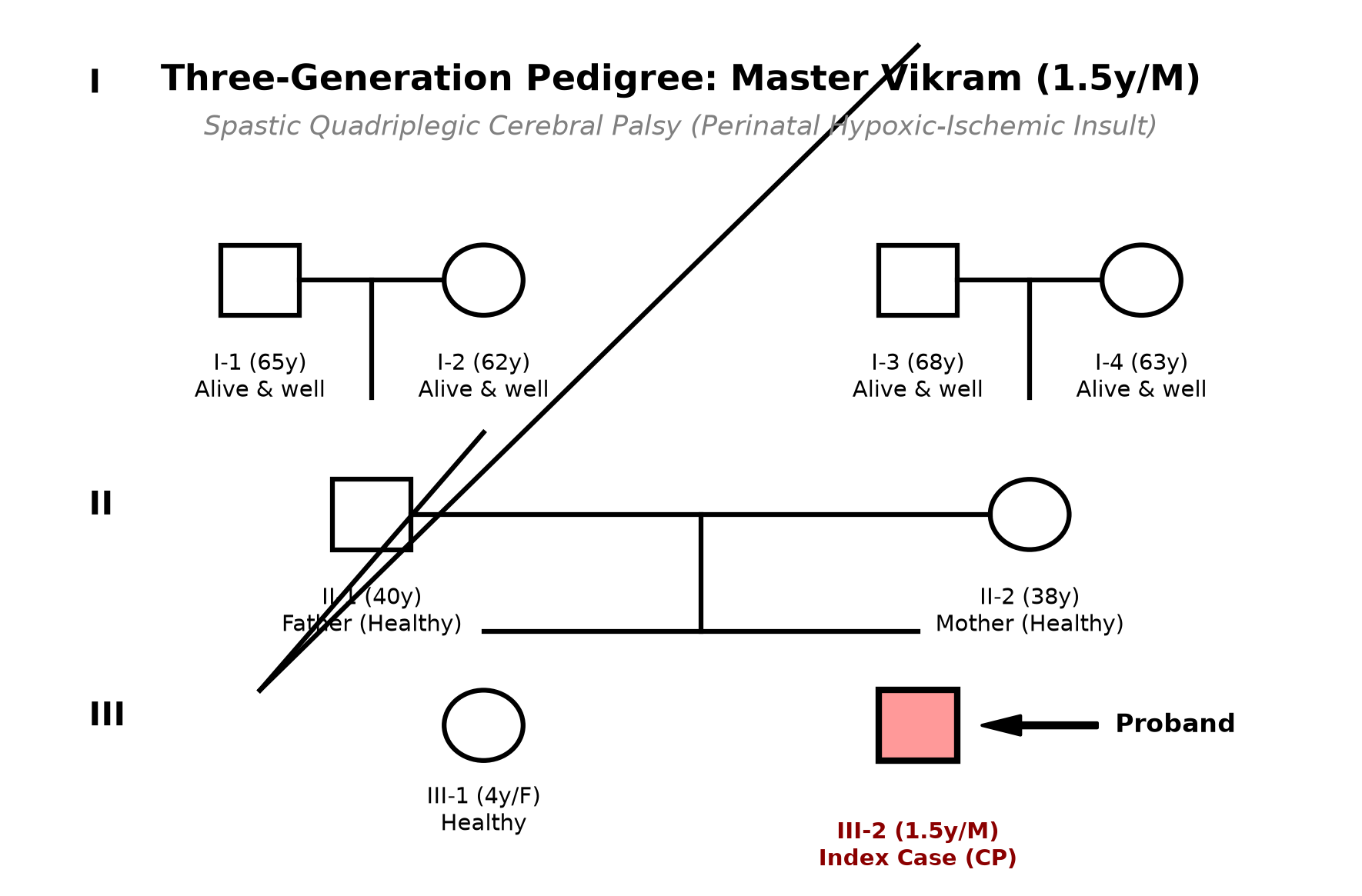
5. Family History & Pedigree
- Parents non-consanguineous.
- Father (40y) laborer; Mother (38y) homemaker.
- Elder sister (4y/F) healthy with normal development.
6. General Physical Examination
- Child Behavioral State: Prechtl State 3 (Awake, calm, in mother's lap).
- Vitals: Heart Rate: 104 bpm, Respiratory Rate: 26 cpm, BP: $88/56\text{ mmHg}$ ($50^{\text{th}}$ centile), Afebrile.
- Anthropometry:
- Weight: 7.8 kg ($Z$-score: $-3.2\text{ SD}$, Severe Underweight / SAM)
- Length: 75.0 cm ($Z$-score: $-2.5\text{ SD}$, Stunted)
- Head Circumference: 43.0 cm ($Z$-score: $-3.1\text{ SD}$, Secondary Microcephaly)
- MUAC: 11.2 cm ($<11.5\text{ cm}$, Severe Acute Malnutrition)
- Neurocutaneous / Dysmorphic Markers: Absent. No café-au-lait spots, no Ash-leaf macules.
7. Central Nervous System (CNS) Examination
A. Higher Mental Functions & Primitive Reflexes
- Sensorium: Alert, visual tracking present up to $180^\circ$, turns head to loud sounds.
- Speech: Coos, monosyllabic babbling.
- Persistent Primitive Reflexes:
- Asymmetrical Tonic Neck Reflex (ATNR): Obligatory & Persistent (Fencer's posture persists $>30$ seconds).
- Symmetrical Tonic Neck Reflex (STNR): Persistent.
- Tonic Labyrinthine Reflex (TLR): Extensor hypertonia in supine, flexor in prone.
- Parachute Reaction: Absent (delayed protective responses).
B. Cranial Nerves
- CN II: Blinks to threat; Fundoscopy: Normal disc, no chorioretinitis, no optic atrophy.
- CN III, IV, VI: Full ocular range; transient esotropia (strabismus).
- CN VII: Mild bilateral upper motor neuron facial weakness; drooling of saliva.
- CN IX, X: Pseudobulbar palsy (exaggerated gag reflex, pooling of pharyngeal secretions, impaired swallowing coordination).
- CN XII: Spastic tongue with difficulty in lateral movement; no fasciculations.
C. Motor System Examination & Spasticity Grading
| Muscle Group | Tone (Modified Ashworth Scale) | Modified Tardieu Scale (R1 vs R2) | Contracture Status |
|---|:---:|:---:|---|
| **Biceps / Elbow Flexors** | Grade 2 (Marked increase throughout ROM) | $R1 = 45^\circ, R2 = 135^\circ$ | Dynamic Spasticity |
| **Wrist Flexors / Pronators** | Grade 2 (Cortical thumb) | $R1 = 30^\circ, R2 = 80^\circ$ | Dynamic Spasticity |
| **Hip Adductors** | Grade 3 (Considerable increase; scissoring) | $R1 = 20^\circ, R2 = 45^\circ$ | High Dynamic Component |
| **Hamstrings (Popliteal Angle)** | Grade 3 (Popliteal angle $140^\circ$) | $R1 = 110^\circ, R2 = 145^\circ$ | Spastic + Mild Contracture |
| **Gastrocnemius / Soleus** | Grade 3 (Equinus posturing) | $R1 = -15^\circ, R2 = +5^\circ$ | Tight Achilles Tendon |
- Power (MRC Scale): Grade 3+/5 in upper limbs, Grade 3/5 in lower limbs (compromised by spasticity).
- Deep Tendon Reflexes (DTR):
- Biceps, Triceps, Supinator: $3+$ (Hyperreflexic) bilaterally.
- Knee Jerks: $4+$ (Hyperreflexic with sustained clonus) bilaterally.
- Ankle Jerks: $4+$ (Sustained ankle clonus $>10$ beats) bilaterally.
- Superficial Reflexes: Plantar response: Bilateral Extensor ($\uparrow / \uparrow$ Babinski Positive).
8. Functional Classifications of Cerebral Palsy
| Classification System | Staging / Level Assigned | Clinical Description |
|---|:---:|---|
| **SCPE Classification** | **Spastic Quadriplegic CP** | Bilateral spasticity involving all four limbs (Lower limbs $\ge$ Upper limbs) |
| **GMFCS (Gross Motor)** | **Level V** | Completely dependent for all mobility; lacks head/trunk control |
| **MACS (Manual Ability)** | **Level V** | Severely limited ability to handle objects; requires total assistance |
| **EDACS (Eating & Drinking)** | **Level IV** | Significant limitations; high risk of aspiration; requires pureed feeds |
| **VSS (Visual Status)** | **Level II** | Mild visual impairment with intermittent strabismus |
9. Differential Diagnosis Matrix
| Differential Diagnosis | Points in Favor | Points Against / Differentiating Features |
|---|---|---|
| **Cerebral Palsy (Spastic Quadriplegia)** | • Term birth asphyxia (HIE II)<br>• Non-progressive motor delay<br>• Persistent primitive reflexes<br>• Spastic quadriparesis + clonus | **Definitive Diagnosis** (Static encephalopathy) |
| **Neurodegenerative / Storage Disorder** | • Global developmental delay<br>• Spasticity, microcephaly | • No loss of previously attained milestones<br>• No cherry-red spot or organomegaly<br>• Perinatal insult explains onset |
| **Hereditary Spastic Paraplegia (HSP)** | • Progressive lower limb spasticity | • Upper limb and bulbar involvement<br>• Negative family history<br>• Perinatal asphyxia history |
| **Dopa-Responsive Dystonia (Segawa)** | • Lower limb hypertonia | • No diurnal variation (not worse in evening)<br>• True spasticity with clonus rather than pure dystonia |
10. Comprehensive Multi-Disciplinary Management Plan
flowchart TD
    A["Master Vikram (18m/M) Spastic Quadriplegic CP (GMFCS Level V)"] --> B["Multi-Disciplinary Rehabilitation Protocol"]

    B --> C["1. Neuro-Rehabilitation & Physical Therapy"]
    B --> D["2. Spasticity Management"]
    B --> E["3. Seizure Control (Structural Epilepsy)"]
    B --> F["4. Nutritional & Bulbar Support"]

    C --> G["Passive stretching, positional seating, Ankle-Foot Orthoses (AFOs), standing frame"]
    D --> H["Oral Baclofen (0.5-1.5 mg/kg/day) + Focal Botulinum Toxin A (Botox) for adductors/gastroc"]
    E --> I["Sodium Valproate (20-30 mg/kg/day) + Clobazam (0.5 mg/kg/day)"]
    F --> J["Calorie-dense pureed feeds + Upright feeding posture; assess for PEG tube"]
A. Pharmacotherapy
- Anti-Spasticity Therapy: $$\text{Oral Baclofen: } 0.5\text{ mg/kg/day divided TID, titrated up to } 1.5\text{ mg/kg/day}$$ $$\mathbf{OR}\text{ Oral Tizanidine: } 0.1-0.2\text{ mg/kg/day}$$ $$\text{Focal Spasticity: Intramuscular Botulinum Toxin A (Botox) } 3-6\text{ units/kg per muscle group}$$
- Antiepileptic Therapy: Optimize Sodium Valproate ($20-30\text{ mg/kg/day}$) + Clobazam for structural epilepsy.
B. Assistive Devices & Physical Therapy
- Rigid solid Ankle-Foot Orthoses (AFOs) to maintain neutral ankle dorsiflexion ($90^\circ$) and prevent equinus contractures.
- Adapted seating system with head rest and pelvic harness for trunk support.
11. Final Spoken Diagnosis
"Master Vikram, an 18-month-old male child, presenting with static developmental delay following term birth asphyxia (HIE Stage II), has a clinical diagnosis of Spastic Quadriplegic Cerebral Palsy, classified functionally as GMFCS Level V, MACS Level V, and EDACS Level IV, complicated by secondary structural epilepsy (controlled on AEDs), pseudobulbar palsy, secondary microcephaly, and Severe Acute Malnutrition (SAM)."