
Master Vignesh, a 7-year-old boy, 2nd order child of non-consanguineous marriage from Coimbatore, Tamil Nadu presented with complaints of rapidly progressive weakness of both lower limbs progressing to both upper limbs over 4 days, inability to walk, and difficulty in closing both eyes noticed 2 days prior to presentation.
- Rapidly progressive, symmetrical, ascending limb weakness (legs $\rightarrow$ arms $\rightarrow$ bulbar)
- Inability to walk or bear weight, with frequent falls
- Pain, paresthesias, or calf/back tenderness preceding the weakness
- Facial diplegia (sleeping with eyes half-open) or swallowing difficulty
- Respiratory distress / weak cough (impending respiratory paralysis)
HOPI
- Antecedent Illness:
- The child had an episode of acute febrile watery diarrhea with abdominal cramps approximately 2 weeks prior to the onset of weakness (characteristic antecedent Campylobacter jejuni enteritis), which resolved completely in 3 days with oral rehydration therapy.
- Onset & Ascending Progression of Weakness:
- 4 days ago, the child complained of pain and tingling sensation in both feet and calves, followed by difficulty getting up from a sitting position and unsteady gait.
- By Day 2 of illness, weakness progressed rapidly; the child became completely unable to walk, stand, or climb stairs, and was confined to bed.
- By Day 3 of illness, weakness ascended to involve both upper limbs; the child had difficulty lifting his arms to feed himself, raising hands above the shoulder level, and holding a pencil or cup.
- Cranial Nerve Symptoms (Facial Diplegia):
- 2 days ago, the mother noticed that the child was unable to close both eyes completely while sleeping (lagophthalmos) and had difficulty blowing his cheeks, drinking through a straw, or holding water in his mouth.
- Mild slurring of speech was observed; no frank choking or nasal regurgitation of fluids.
- Respiratory & Autonomic Symptoms:
- Child has mild breathlessness on talking; his single breath count (SBC) has decreased from normal ($>25$) to 12.
- Mother noted intermittent excessive sweating of palms and flushing of face.
Pertinent Negatives in HOPI:
- No history of fever at the onset of weakness (rules out acute poliomyelitis and acute transverse myelitis).
- No history of back trauma, falls, or localized vertebral spine tenderness (rules out spinal cord compression/hematoma).
- No history of a definitive sensory level on the trunk (rules out acute transverse myelitis).
- No history of acute urinary retention requiring catheterization (rules out transverse myelitis; bladder is typically preserved or only transiently affected in GBS).
- No history of dog bite (rules out paralytic rabies).
- No history of canned food or honey ingestion (rules out botulism).
- No history of tick bites or intramuscular gluteal injections (rules out tick paralysis and traumatic sciatic neuritis).
- No history of diurnal fluctuation of weakness or fatiguability (rules out Myasthenia Gravis).
- No history of similar episodic weakness in the past (rules out hypokalemic periodic paralysis).
Past History
- No history of previous episodes of acute flaccid paralysis or chronic neurological illnesses.
- No history of recent vaccinations (rabies, OPV) in the preceding 6 weeks.
- No history of drug allergies or surgical procedures.
Family history
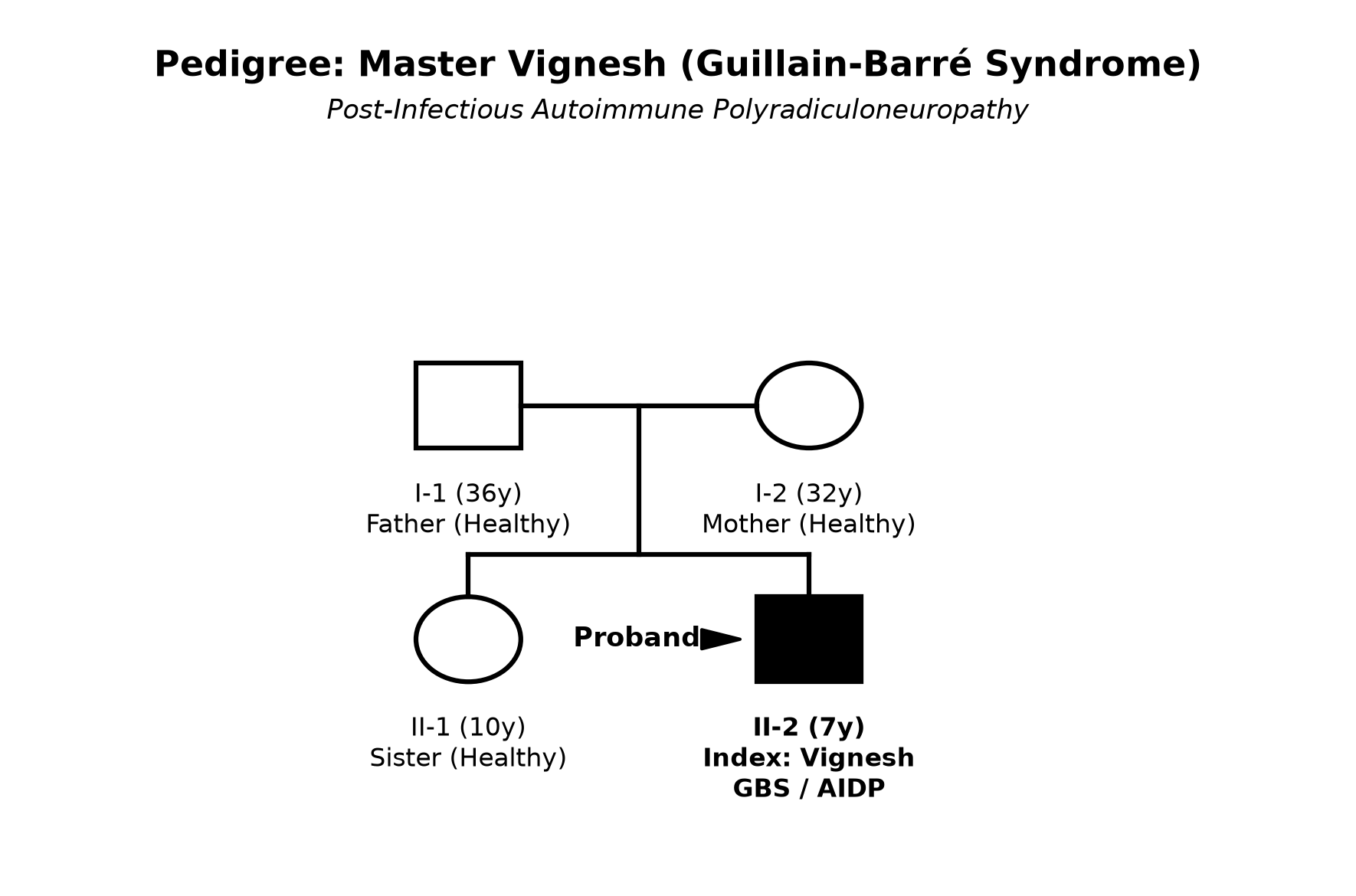
- 2nd-order male child born to non-consanguineously married parents.
- Elder sister (10 years old) is healthy and asymptomatic.
- No family history of hereditary motor sensory neuropathies (Charcot-Marie-Tooth) or periodic paralyses.
Immunization history
- Completely immunized for age per National Immunization Schedule (BCG, OPV 0-3, Pentavalent 1-3, fIPV, MR 1-2, DPT booster).
- BCG scar is present on left deltoid.
Dietary history
- Regular family diet; independent feeder prior to illness; currently fed semi-solids in bed due to arm weakness.
| Food Item | Quantity | Calories (kcal) | Protein (g) |
|---|---|---|---|
| Idli with Sambar | 3 pieces (~120 g) | 195 | 5.5 |
| Curd Rice | 1 bowl (~150 g) | 210 | 4.5 |
| Boiled Egg (Whole) | 1 egg (~50 g) | 75 | 6.0 |
| Cow's Milk | 350 mL | 240 | 11.0 |
| Total Daily Intake | 720 | 27.0 |
| 24-Hour Recall | Expected (for Ideal Body Weight ~22 kg) | Observed | Deficit / Surplus |
|---|---|---|---|
| Calories | 1750 kcal (~80 kcal/kg) | 720 kcal | 1030 kcal (58.8% deficit) |
| Protein | 22.0 g (1.0 g/kg) | 27.0 g | +5.0 g (Adequate) |
The expected calories and proteins should be calculated from the ideal body weight, not from current weight.
Socioeconomic and KAP
- Family resides in a pucca house with sanitary latrine and piped drinking water in Coimbatore.
- Father is an industrial supervisor; Mother is a graduate homemaker.
- Socioeconomic Status: Upper-middle class (Modified Kuppuswamy Score: 19).
- Parents brought the child promptly recognizing the rapid ascending nature of the paralysis.
Summary of History
"Master Vignesh, a 7-year-old male child, with a history of acute diarrheal illness 2 weeks ago, presented with acute-onset, rapidly progressive, symmetrical, ascending flaccid quadriparesis over 4 days, progressing from the lower extremities to the upper extremities and trunk, associated with bilateral facial weakness and mild breathlessness.
The paralysis is associated with distal paresthesias, absence of fever at onset, preserved bowel and bladder functions, and absence of a spinal sensory level.
In view of the post-infectious acute onset, symmetrical ascending lower motor neuron quadriparesis, bilateral LMN facial palsy, and impending respiratory compromise, I would like to consider a clinical diagnosis of Acute Flaccid Paralysis, clinically consistent with Guillain-Barré Syndrome (Acute Inflammatory Demyelinating Polyradiculoneuropathy - AIDP), currently in the Progressive Phase (Hughes Disability Grade 4), with Impending Respiratory Muscle Compromise (Single Breath Count 12)."
General head to toe examination
Pre-Examination Child Behavioral State
- Child State: Alert, anxious, cooperative, breathing comfortably at rest (Prechtl State 3: quiet wakefulness).
- Glasgow Coma Scale (GCS): E4 V5 M6 = 15/15.
Vitals & Autonomic Monitoring
- Pulse Rate: 108 bpm (resting sinus tachycardia, reflecting mild autonomic dysfunction), regular.
- Blood Pressure: 116/78 mmHg (supine) $\rightarrow$ 102/66 mmHg (seated) — mild orthostatic drop without syncope.
- Respiratory Rate: 24/min, shallow abdominothoracic pattern.
- Single Breath Count (SBC): 12 (Normal $\ge 25$; $<15$ signifies significant respiratory muscle weakness).
- Neck Flexor Power: Grade 3/5 (unable to lift head against resistance, an important marker of impending diaphragmatic weakness).
Anthropometry
| Parameter | Observed | Expected (50th percentile WHO) | Z-Score / Interpretation |
|---|---|---|---|
| Weight | 21.5 kg | 22.9 kg | Normal (-0.5 SD) |
| Height | 121 cm | 122 cm | Normal |
| BMI | 14.7 kg/m² | 15.4 kg/m² | Normal |
Head-to-Toe Markers
- Facies: Expressionless facies with bilateral incomplete eye closure (lagophthalmos) and sagging mouth angles.
- Spine: Normal alignment; no vertebral tenderness or paraspinal muscle spasm.
- Extremities: No skin rashes, tick marks, trauma scars, or calf pseudo-hypertrophy.
Systemic Examination
CNS Examination
1. Cranial Nerves
- CN VII (Facial Nerve): Bilateral Lower Motor Neuron (LMN) Facial Palsy (Bifacial Weakness):
- Inability to close both eyes tightly (sclera exposed / Bell's phenomenon visible bilaterally).
- Flattening of forehead wrinkles bilaterally; inability to puff cheeks or whistle; droop of both mouth angles.
- CN IX, X (Bulbar Nerves): Gag reflex present; uvula central; no pooling of secretions or nasal regurgitation.
- CN III, IV, VI, XI, XII: Normal extraocular movements, normal sternocleidomastoid power, tongue protrudes in midline without wasting or fasciculations.
2. Motor System (Granular Power Charting)
| Motor Parameter | Right Upper Limb | Left Upper Limb | Right Lower Limb | Left Lower Limb |
|---|---|---|---|---|
| Muscle Bulk | Normal, no wasting | Normal, no wasting | Normal, no wasting | Normal, no wasting |
| Tone | Hypotonia (Flaccid) | Hypotonia (Flaccid) | Hypotonia (Flaccid) | Hypotonia (Flaccid) |
| Power: Shoulder / Hip (Proximal) | Grade 3/5 | Grade 3/5 | Grade 2/5 | Grade 2/5 |
| Power: Elbow / Knee | Grade 3/5 | Grade 3/5 | Grade 2/5 | Grade 2/5 |
| Power: Wrist / Ankle (Distal) | Grade 4/5 | Grade 4/5 | Grade 3/5 | Grade 3/5 |
| Biceps Jerk | Absent (0) | Absent (0) | - | - |
| Triceps Jerk | Absent (0) | Absent (0) | - | - |
| Supinator Jerk | Absent (0) | Absent (0) | - | - |
| Knee Jerk | - | - | Absent (0) | Absent (0) |
| Ankle Jerk | - | - | Absent (0) | Absent (0) |
| Plantar Reflex | Flexor | Flexor | Mute / No response | Mute / No response |
| Abdominal Reflex | Present | Present | Present | Present |
3. Sensory & Cerebellar System
- Sensory Examination: Subjective complaints of stocking-and-glove paresthesias; objective pinprick, light touch, vibration, and joint position sensations are intact without a spinal sensory level.
- Cerebellar System: No nystagmus, intention tremor, or dysmetria.
other systems
- Respiratory System: Bilateral chest expansion slightly decreased (2.0 cm); vesicular breath sounds; no adventitious sounds.
- Cardiovascular System: Resting sinus tachycardia (108 bpm); normal heart sounds; no murmurs.
- Abdomen: Soft, non-tender; no urinary bladder distension; bowel sounds present.
Summary
"Master Vignesh, a 7-year-old male child, with a history of acute gastroenteritis 2 weeks ago, presented with acute, symmetrical, ascending lower motor neuron quadriparesis over 4 days, with bilateral LMN facial palsy and reduced respiratory reserve (Single Breath Count 12).
Physical examination reveals a conscious child with resting sinus tachycardia, bilateral LMN facial weakness, generalized flaccidity, symmetrical proximal > distal weakness (lower limb power 2/5, upper limb power 3/5), generalized universal areflexia (absent deep tendon reflexes in all 4 limbs), mute plantars, intact objective sensation without a sensory level, and normal sphincter control.
Final Diagnosis: I formulate my diagnosis as Acute Flaccid Paralysis (AFP), clinically consistent with Guillain-Barré Syndrome (Acute Inflammatory Demyelinating Polyradiculoneuropathy - AIDP), currently in the Progressive Stage (Hughes Disability Scale Grade 4 - Bedbound), with Bilateral Facial Nerve Involvement and Impending Respiratory Muscle Weakness, with No fixed autonomic instability."
Differential Diagnosis
| Disease Entity | Points in Favor in this Case | Points Against / Differentiating Features |
|---|---|---|
| Guillain-Barré Syndrome (AIDP) | Post-infectious onset (2 weeks post-GE), ascending symmetrical flaccid quadriparesis, universal areflexia, bilateral facial palsy, absent sensory level, preserved bladder. | Classical presentation; confirmed on CSF (cytoalbuminologic dissociation) and Nerve Conduction Velocity (NCV) demyelinating pattern. |
| Acute Transverse Myelitis (ATM) | Acute flaccid weakness of lower limbs, areflexia during spinal shock. | ATM presents with severe fever and back pain at onset, a distinct trunk sensory level, and early persistent acute urinary retention / neurogenic bladder, with hyperreflexia emerging later. |
| Poliomyelitis / Vaccine-Associated Paralytic Polio | Acute flaccid paralysis, areflexia, post-infectious presentation. | Polio is characterized by high fever at onset, marked asymmetry (often patchy, single limb), prominent muscle pain/spasm, and absence of sensory symptoms; confirmed by stool viral cultures. |
| Hypokalemic Periodic Paralysis | Acute flaccid symmetrical weakness, universal areflexia, normal sensation. | Weakness develops rapidly over hours (often waking up from sleep after high-carbohydrate meal), facial and respiratory muscles are spared, and serum potassium is $<2.5\text{ mEq/L}$ with immediate recovery on $K^+$ infusion. |
| Tick Paralysis / Botulism | Acute flaccid paralysis, areflexia. | Botulism presents with descending paralysis starting with prominent extraocular/bulbar weakness, unreactive dilated pupils, and autonomic dry mouth; Tick paralysis resolves within 24 hours of tick removal. |
Investigation Protocol & Diagnostic Workup
flowchart TD
    A["Suspected Guillain-Barré Syndrome"] --> B["1. Urgent Bedside Evaluation: Vital Capacity, Single Breath Count, ECG, Serum Electrolytes"]
    B --> C["2. Mandatory Stool Surveillance: 2 Stool Samples 24h apart for Poliovirus Isolation"]
    A --> D["3. Cerebrospinal Fluid (CSF) Analysis (after Day 7 of illness)"]
    D --> E["Cytoalbuminologic Dissociation: Elevated Protein (>100–300 mg/dL) with Normal Cells (<5–10 lymphocytes)"]
    A --> F["4. Nerve Conduction Velocity (NCV) Studies"]
    F -->|Demyelinating: Prolonged F-latencies, Conduction Block, Slow NCV| G["AIDP Variant Confirmed"]
    F -->|Axonal: Reduced CMAP amplitudes with normal velocities| H["AMAN / AMSAN Variant Confirmed"]
1. Bedside & Triage Investigations
- Single Breath Count (SBC) & Forced Vital Capacity (FVC):
- SBC $<15$ or FVC $<20\text{ mL/kg}$ indicates severe diaphragmatic weakness requiring ICU admission and preparation for elective intubation.
- Serum Electrolytes (Na⁺, K⁺): Normal potassium ($4.2\text{ mEq/L}$) immediately excludes hypokalemic periodic paralysis.
- Continuous 12-Lead ECG Monitoring: Screen for dysautonomia (sinus tachycardia, bradyarrhythmias, heart blocks, fluctuating blood pressure).
2. Mandatory Poliovirus Surveillance Protocol
- Stool Samples for AFP Surveillance:
- Two adequate stool samples collected at least 24 hours apart within 14 days of paralysis onset must be sent in reverse cold chain ($<4^\circ\text{C}$) to an accredited WHO laboratory for viral culture.
3. Cerebrospinal Fluid (CSF) Analysis
- Classic Cytoalbuminologic Dissociation:
- Markedly elevated CSF Protein ($100\text{ to }400+\text{ mg/dL}$) with a normal CSF white cell count ($<5\text{ to }10\text{ cells/}\mu\text{L}$, all lymphocytes).
- Timing Pearl: CSF protein may be normal during the first 3–7 days of illness; the peak protein elevation occurs in the 2nd to 3rd week.
4. Electrophysiological Nerve Conduction Studies (NCV / EMG)
- AIDP (Demyelinating Pattern): Prolonged distal motor latencies, markedly reduced conduction velocities ($<70\%$ of normal), conduction blocks, temporal dispersion, and prolonged or absent F-waves (earliest sign of proximal radiculopathy).
- AMAN (Axonal Pattern): Markedly reduced distal Compound Muscle Action Potential (CMAP) amplitudes with preserved conduction velocities.
Management Plan
flowchart LR
    A["Comprehensive GBS Care"] --> B["1. Specific Immunotherapy (IVIG / Plasmapheresis)"]
    A --> C["2. ICU Monitoring & Airway Protection"]
    A --> D["3. Dysautonomia & Pain Control"]
    A --> E["4. Physical Therapy & DVT Prophylaxis"]
1. Specific Immunotherapy (Gold Standard)
- Indications: Hughes Disability Grade $\ge 3$ (unable to walk $10\text{ meters}$ unaided), rapidly ascending weakness, bulbar palsy, or declining vital capacity.
- Option A (Intravenous Immunoglobulin - IVIG) (Preferred in Children):
- Total Dose: $2.0\text{ g/kg}$ IV infusion:
- Regimen: $0.4\text{ g/kg/day}$ infused over 4–6 hours daily for 5 consecutive days, OR $1.0\text{ g/kg/day}$ for 2 consecutive days.
- Pre-medicate with IV paracetamol and chlorpheniramine; monitor for anaphylactoid reactions.
- Total Dose: $2.0\text{ g/kg}$ IV infusion:
- Option B (Plasma Exchange / Plasmapheresis):
- $200\text{–}250\text{ mL/kg}$ total exchange over 4–5 sessions every other day using 5% albumin as replacement fluid.
- Note: Corticosteroids are NOT effective in GBS and should not be administered.
2. Respiratory Monitoring & Intubation Criteria ("Rule of 20/30/40")
- Elective Intubation & Mechanical Ventilation Criteria:
- Forced Vital Capacity $<20\text{ mL/kg}$ (or SBC $<10$).
- Maximum Inspiratory Pressure (MIP) $<30\text{ cm H}_2\text{O}$.
- Maximum Expiratory Pressure (MEP) $<40\text{ cm H}_2\text{O}$.
- Inability to lift head off the bed (severe neck flexor weakness), severe bulbar palsy with aspiration risk, or paradoxical abdominal breathing.
3. Autonomic Instability & Supportive Care
- Cardiovascular Support: Short-acting beta-blockers (Esmolol) for severe hypertension/tachycardia; Atropine or temporary pacing for profound bradycardia; cautious isotonic fluid boluses for hypotension.
- Neuropathic Pain Management: Gabapentin ($10\text{–}30\text{ mg/kg/day}$) or Pregabalin for severe paraspinal and radicular limb aching.
- Nursing & Physical Therapy: Frequent 2-hourly turning, air-mattress, passive range-of-motion exercises, and Ankle-Foot Orthoses to prevent foot drop contractures.