
Master Subhash, a 6 year old boy, 1st order child born of a first-degree consanguineous marriage from Cuttack, Odisha presented with complaints of massive, progressive swelling of the abdomen since 2 years of age, progressive paleness and easy fatigability for 1 year, recurrent episodes of severe agonizing pain in both thighs and knees ("bone crises") for 6 months, and frequent spontaneous nosebleeds for 3 months.
- Massive abdominal distension (dragging sensation, early satiety, left hypochondrial fullness)
- Chronic fatigue, lethargy, and severe pallor (hypersplenism and marrow infiltration)
- Bone pain, bone crises, and pathological fractures (bone marrow expansion and osteopenia)
- Easy bruising, petechiae, and epistaxis (severe hypersplenism-induced thrombocytopenia)
- Failure to thrive, short stature, and delayed somatic growth
HOPI
The history is dated back to 2 years of age when the mother first noticed that the child's abdomen was becoming unusually prominent, particularly on the left side.
In any child presenting with massive splenomegaly extending across the midline or into the right iliac fossa, systematically evaluate four major pathological categories:
- Lysosomal Storage Disorders: Gaucher disease Type 1, Niemann-Pick Type B (massive spleen > liver, bone crises, absence of neuroregression).
- Chronic Hematologic / Hemolytic: Thalassemia Major, Sickle cell anemia, Pyruvate kinase deficiency.
- Infections: Visceral Leishmaniasis (Kala-azar: prolonged fever, dark skin, hypergammaglobulinemia), Chronic malaria, Schistosomiasis.
- Malignancy / Myeloproliferative: Juvenile Myelomonocytic Leukemia (JMML), Chronic Myeloid Leukemia (CML), Lymphoma. In Gaucher disease, specifically ask about bone crises (intense skeletal pain with fever mimicking osteomyelitis), pathological fractures, early satiety from splenic compression of the stomach, and ocular saccadic movements (to differentiate non-neuropathic Type 1 from neuropathic Types 2 and 3).
- Massive Abdominal Enlargement (Hepatosplenomegaly):
- Noticed since 2 years of age, progressive and painless.
- Distension began under the left ribs (splenomegaly) and subsequently involved the right upper abdomen.
- Causes a heavy "dragging" sensation; child is unable to run or play actively.
- Early Satiety: Child eats only 2-3 bites of food and complains of fullness Massive spleen directly compresses the greater curvature of the stomach, drastically reducing gastric reservoir capacity.
- Skeletal Symptoms & Severe "Bone Crises":
- Over the past 6 months, the child experienced 3 distinct episodes of excruciating, deep-seated, agonizing pain in the distal thighs and knees (bone crises).
- Each episode was accompanied by low-grade fever, localized warmth, and complete inability to bear weight or walk, lasting 4–7 days.
- History of a trivial fall at home 4 months ago resulting in a fracture of the distal third of the right femur, managed with cast immobilization Accumulation of glucocerebroside-laden Gaucher cells in bone marrow causes marrow expansion, osteonecrosis, osteopenia, cortical thinning, and high vulnerability to pathological fractures.
- Pallor & Easy Fatigability:
- Progressive pallor noticed over the past year. Child tires quickly, prefers sitting, and breathes rapidly on mild exertion.
- Bleeding Manifestations (Epistaxis & Bruising):
- Recurrent spontaneous episodes of epistaxis over the past 3 months (3-4 episodes/month, controlled with pinching).
- Mother noted multiple bluish-purple spots (ecchymoses) over the legs following minimal bumps Direct consequence of severe hypersplenism sequestering platelets, often compounded by abnormal platelet aggregation.
- Negative History:
- Normal developmental milestones; speech, cognition, and scholastic readiness are completely age-appropriate Excludes neurodegenerative storage disorders (Tay-Sachs, Niemann-Pick Type A, Metachromatic Leukodystrophy).
- No history of abnormal rapid eye movements, inability to look up/down or side-to-side (no supranuclear gaze palsy) Crucial clinical marker: excludes Type 2 (acute neuropathic) and Type 3 (chronic neuropathic) Gaucher disease, confirming Type 1 (Non-neuropathic).
- No history of prolonged undulating fever with drenching night sweats or travel to endemic areas (Bihar/Bengal) Rules out Visceral Leishmaniasis (Kala-azar).
- No history of lymph node swellings in the neck, armpits, or groins.
- No history of jaundice, high-colored urine, or facial bone deformities (chipmunk facies) Rules out Thalassemia Major.
- No history of morning stiffness, joint swelling, or salmon-colored rash Rules out Systemic Juvenile Idiopathic Arthritis (sJIA).
Past History
- History of right distal femur fracture 4 months ago following a trivial stumble from a bed.
- No past history of blood transfusions, native herbal intake, or chronic diarrhea.
Family history
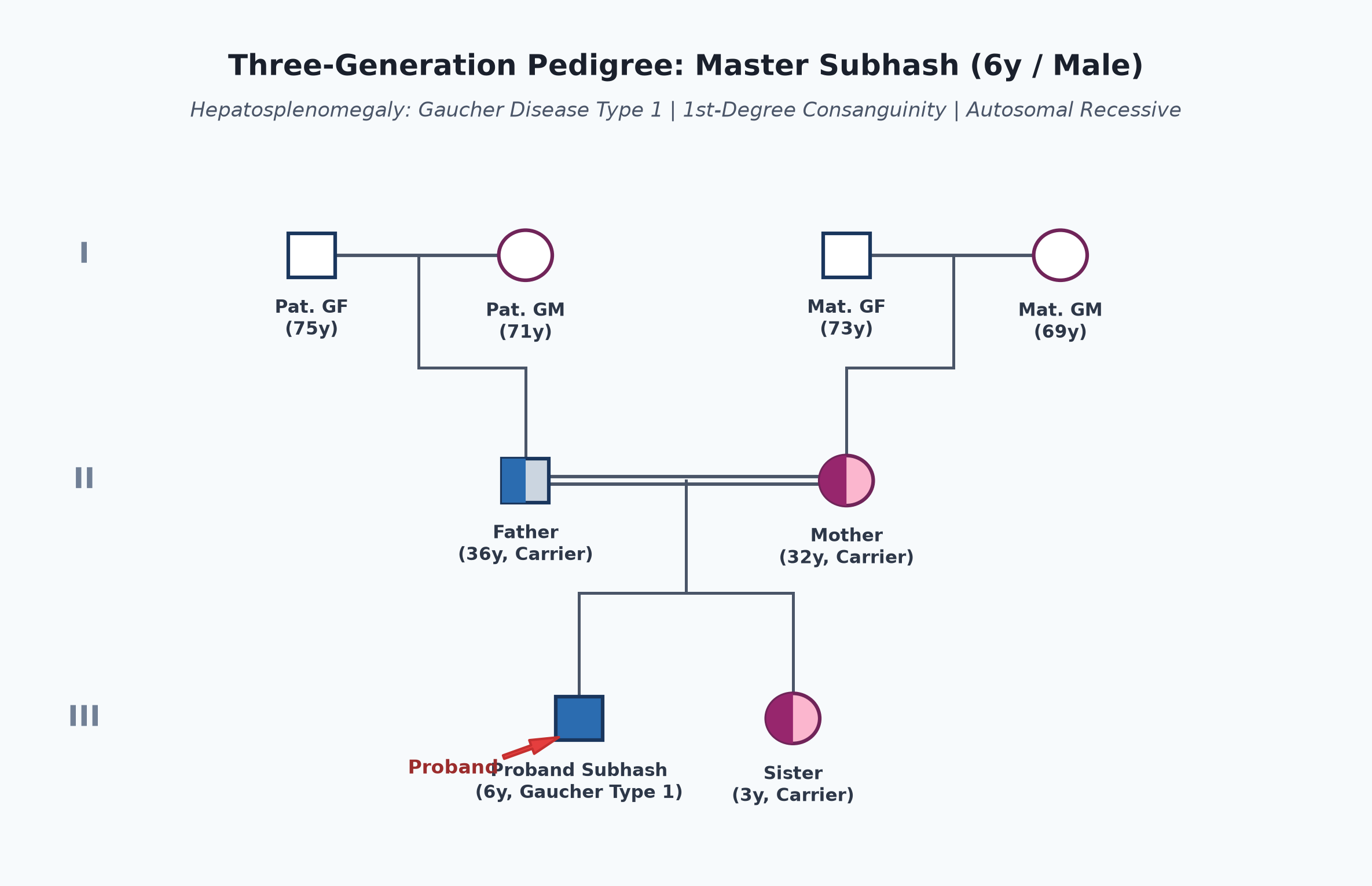
- Born of a first-degree consanguineous marriage (parents are first cousins).
- Father 36 years, shopkeeper; mother 32 years, homemaker; both healthy.
- Younger sister (3 years old) is currently asymptomatic with normal growth.
- No family history of splenomegaly, bleeding disorders, bone fractures in childhood, or early infant deaths.
Immunization history
- Received all vaccines up to age as per the UIP schedule (BCG, OPV, Pentavalent, PCV, Rotavirus, fIPV, MR, and DPT booster).
- Pneumococcal polysaccharide and meningococcal vaccines not yet administered.
Dietary history
- Severe caloric deficit due to early satiety and mechanical gastric compression by the massive spleen.
| Food Item | Quantity | Calories (kcal) | Protein (g) |
|---|---|---|---|
| Boiled Rice (with Dal) | 150 g | 195 | 4.8 |
| Cow's Milk | 200 mL | 120 | 6.4 |
| Pakhala (Fermented rice water) | 1 bowl | 80 | 1.2 |
| Suji Halwa | 1 small cup | 110 | 2.0 |
| Total Observed Daily Intake | — | 505 kcal | 14.4 g |
24-Hour Recall Deficit Analysis
$$ \text{Ideal Body Weight (IBW for 6 years, 50th centile WHO)} = 20.5\text{ kg} $$| Nutrient | Expected Intake (ICMR-NIN 2024 for IBW 20.5 kg) | Observed Intake | Deficit | Percentage Deficit |
|---|---|---|---|---|
| Energy (kcal) | $20.5\text{ kg} \times 70\text{ kcal/kg} = 1435\text{ kcal}$ | 505 kcal | 930 kcal | 64.8% Deficit |
| Protein (g) | $20.5\text{ kg} \times 1.0\text{ g/kg} = 20.5\text{ g}$ | 14.4 g | 6.1 g | 29.8% Deficit |
The expected calories and proteins should be calculated from the ideal body weight, not from current weight.
Socioeconomic and KAP
- Belongs to Modified BG Prasad Socioeconomic Class III (Middle Class).
- Lives in an urban pucca house in Cuttack.
- Parents were anxious that the child had blood cancer due to the massive spleen and bleeding; relieved that diagnosis is metabolic, seeking Enzyme Replacement Therapy.
Summary of History
Master Subhash, a 6-year-old boy, 1st order child born of first-degree consanguineous parents from Cuttack, presented with massive progressive abdominal distension since 2 years of age, progressive pallor, recurrent severe episodic thigh bone crises with a pathological femoral fracture, epistaxis, and early satiety, with completely normal neurocognitive development and absence of abnormal ocular movements, chronic fever, or lymphadenopathy.
I would like to think of a Lysosomal Storage Disorder, most likely Gaucher Disease Type 1 (Non-neuropathic), complicated by massive splenomegaly, hypersplenism (bicytopenia), Gaucher bone disease with pathological fracture, and severe failure to thrive.
General head to toe examination
- Child Behavioral State: Examined in quiet wakefulness (Prechtl State 3), cooperative, walking with an antalgic limp favoring the right lower limb.
- Vitals:
- Pulse Rate: 102 beats/minute, regular, normal volume.
- Respiratory Rate: 22 breaths/minute, regular, abdominothoracic.
- Blood Pressure: $90/58\text{ mmHg}$ ($50^{\text{th}}$ centile for height and age).
- Temperature: $36.8^\circ\text{C}$ (afebrile).
- Anthropometry:
| Parameter | Observed | Expected (50th WHO) | Z-score / Centile | Inference |
|---|---|---|---|---|
| Weight | 14.5 kg | 20.5 kg | $< -3\text{ SD}$ | Severe Underweight (Wasting) |
| Height | 101 cm | 115.5 cm | $< -3\text{ SD}$ | Severe Stunting (Chronic Growth Failure) |
| Head Circumference | 50.0 cm | 50.8 cm | Normal | Spared brain growth |
- General Physical Findings:
- Pallor: Severe pallor visible in lower palpebral conjunctiva, tongue, buccal mucosa, palmar creases, and nail beds.
- Cutaneous Pigmentation: Mild diffuse yellowish-brown ("muddy") pigmentation over the malar areas and extensor surfaces of both legs.
- Purpuric Lesions: Multiple resolving ecchymotic patches over both shins and forearm; a few scattered non-palpable petechiae over the ankles.
- Eyes: Sclera non-icteric; Pingueculae (small, wedge-shaped brownish-yellow deposits in the nasal and temporal bulbar conjunctiva bilaterally).
- Lymphadenopathy: Generalized lymphadenopathy is distinctly absent (cervical, axillary, epitrochlear, and inguinal lymph nodes are non-palpable).
- Edema / Cyanosis / Clubbing: Absent.
Systemic Examination
Abdomen
- Inspection:
- Massive, asymmetric abdominal distension with marked prominence of the left hypochondrium and left flank.
- Umbilicus pushed downward and to the right; skin stretched and shiny.
- Dilated, non-tortuous superficial veins visible over the flank; no caput medusae; no visible peristalsis.
- Palpation:
- Non-tender throughout; no guarding or rigidity.
- Spleen:
- Massive Splenomegaly: Enlarged 10.0 cm below the left costal margin along its long axis, crossing the midline and extending into the right iliac fossa.
- Consistency is firm to hard, surface smooth, medial border demonstrates a distinct, sharp splenic notch, non-tender, no splenic friction rub.
- Liver:
- Marked Hepatomegaly: Palpable 5.5 cm below the right costal margin in the midclavicular line.
- Firm consistency, smooth surface, regular sharp margin, non-tender.
- Total Liver Span is 13.5 cm (significantly enlarged for a 6-year-old; normal $\approx 8-9\text{ cm}$).
- Kidneys: Both kidneys cannot be balloted due to the overlying liver and massive spleen.
- Percussion: Dullness over the left abdomen and right upper quadrant; resonant over the right upper flank; no shifting dullness, no fluid thrill (no ascites).
- Auscultation: Normal bowel sounds; no bruits over the spleen or liver.
Musculoskeletal & Skeletal System
- Femoral Examination:
- Tenderness elicited on deep palpation over the distal third of both femurs.
- Bony thickening / widening palpable over the distal right femoral metaphysis (healed fracture site with callus formation).
- Active and passive range of motion of bilateral hip and knee joints is preserved, but right knee flexion is mildly restricted due to tightness.
- Spine: Normal curvature, no kyphoscoliosis, no vertebral tenderness.
Central Nervous System (CNS)
- Completely conscious, alert, cooperative, age-appropriate vocabulary.
- Cranial Nerve Assessment (High-Yield):
- Extraocular Movements: Full horizontal and vertical saccades and smooth pursuit intact. NO horizontal or vertical supranuclear gaze palsy (excludes Gaucher Type 2 and Type 3).
- No facial asymmetry; gag reflex normal; tongue normal without fasciculations.
- Motor Examination: Normal muscle bulk for wasted habitus; tone normal; power 5/5 in all four limbs; deep tendon reflexes $2+$ throughout; plantars flexor bilaterally.
- Fundoscopy: Clear optic discs; NO cherry-red spot at the macula (excludes Niemann-Pick Type A and Tay-Sachs disease).
Cardiovascular & Respiratory Systems
- Precordium hyperdynamic with Grade 2/6 hemic ejection systolic murmur at the pulmonary area; lungs clear to auscultation bilaterally.
other systems
- Genitalia: Normal male genitalia, testes descended bilaterally.
Summary
Master Subhash, a 6-year-old boy, 1st order child born of first-degree consanguineous parents from Cuttack, presented with massive progressive abdominal distension since 2 years of age, severe pallor, recurrent episodic bone crises in both femurs with a pathological fracture, epistaxis, and severe failure to thrive. Physical examination confirms severe pallor, pingueculae, massive splenomegaly (10 cm, crossing midline), marked firm hepatomegaly (liver span 13.5 cm), distal femoral tenderness, and bicytopenia, with completely normal neurocognitive development, normal extraocular saccades, and absence of lymphadenopathy or cherry-red macula.
The clinical findings are definitive for a Lysosomal Storage Disorder, specifically Gaucher Disease Type 1 (Non-neuropathic), complicated by massive splenomegaly, severe hypersplenism (bicytopenia), osteopenic bone disease with pathological fracture, and severe failure to thrive.
Differential Diagnosis
| Disease | Points IN FAVOR | Points AGAINST |
|---|---|---|
| Gaucher Disease Type 1 (Non-neuropathic) | Consanguinity, massive splenomegaly > hepatomegaly, bone crises, Erlenmeyer flask deformity, pathological fracture, hypersplenism, normal cognition, no gaze palsy | Primary Diagnosis |
| Niemann-Pick Disease Type B (Visceral) | Massive hepatosplenomegaly, absence of neurological involvement, normal intelligence | Bone crises and pathological fractures are uncommon; interstitial lung disease (reticulonodular infiltrates) is frequent in NP-B; confirmed by acid sphingomyelinase deficiency |
| Visceral Leishmaniasis (Kala-azar) | Massive splenomegaly, hepatomegaly, pancytopenia, hyperpigmentation | No prolonged undulating fever, no travel to endemic belt, bone crises/fractures do not occur; rK39 strip test negative |
| Chronic Myeloid Leukemia (CML / JMML) | Massive splenomegaly, hepatomegaly, anemia, bruising | Lacks characteristic leukocytosis ($>50,000-100,000/\mu\text{L}$) with myelocyte bulge; no Philadelphia chromosome ($t[9;22]$ / BCR-ABL1) |
| Thalassemia Major | Massive splenomegaly, hepatomegaly, severe pallor, consanguinity | Absence of thalassemic chipmunk facies, no transfusion dependence, bone crises in Gaucher are acute and severe unlike chronic expansion in thalassemia |
| Glycogen Storage Disease Type I (von Gierke) | Massive hepatomegaly, growth failure, doll-like facies | Massive splenomegaly does NOT occur in GSD-I; hypoglycemia, hyperuricemia, and lactic acidosis absent |
Investigation Protocol & Diagnostic Workup
flowchart TD
    A["Child with Massive Hepatosplenomegaly & Bone Crises"] --> B["CBC & Peripheral Blood Smear: Bicytopenia / Pancytopenia"]
    B --> C["Skeletal Radiographs: X-ray Pelvis & Both Femurs"]
    C --> D["Identify Classical Erlenmeyer Flask Deformity & Osteopenia"]
    D --> E["Beta-Glucosidase (Glucocerebrosidase) Enzyme Activity Assay (Leukocytes / DBS)"]
    E --> F{"Enzyme Activity Markedly Deficient (< 15% of Normal)?"}
    F -->|Yes| G["Confirm Gaucher Disease: Measure Biomarkers (Lyso-Gb1 & Chitotriosidase)"]
    F -->|No| H["Workup for Acid Sphingomyelinase (Niemann-Pick) or Bone Marrow Biopsy"]
    G --> I["GBA1 Molecular Genetic Mutation Analysis (e.g., N370S, L444P)"]
    I --> J["Initiate Enzyme Replacement Therapy (ERT - Imiglucerase / Velaglucerase alfa)"]
1. Confirmatory Enzymatic Assay (Gold Standard)
- Beta-Glucosidase (Acid Glucocerebrosidase) Enzyme Activity:
- Measured in peripheral blood leukocytes or dried blood spot (DBS).
- Result: Markedly deficient at $<10\%$ of normal control mean (confirmatory gold standard for Gaucher disease).
- Molecular Genetic Testing:
- Sequencing of the GBA1 gene on chromosome $1q21$ identifies causative pathogenic variants (e.g., homozygous or compound heterozygous mutations such as N370S, L444P).
2. Specialized Gaucher Disease Biomarkers
- Serum Glucosylsphingosine (Lyso-Gb1): Markedly elevated ($>250\text{ ng/mL}$, normal $<1.5\text{ ng/mL}$) — the most sensitive and specific biomarker for diagnosing and monitoring Gaucher disease activity.
- Serum Chitotriosidase: Elevated $>100$-fold above normal (secreted by lipid-laden Gaucher macrophages; used to monitor response to ERT).
- Serum Ferritin: Elevated ($>800\text{ ng/mL}$).
- Serum Tartrate-Resistant Acid Phosphatase (TRAP): Markedly elevated.
3. Complete Blood Count & Smear (Hypersplenism)
- Hemoglobin: $6.8\text{ g/dL}$ (normocytic normochromic anemia).
- Platelet Count: $42,000/\mu\text{L}$ (severe thrombocytopenia due to splenic pooling).
- Total Leukocyte Count: $3,200/\mu\text{L}$ (leukopenia); ANC $1,600/\mu\text{L}$ (bicytopenia / pancytopenia).
- Peripheral Smear: Shows no blast cells, no fragmented RBCs, no Leishmania donovani (LD) bodies.
4. Skeletal Radiography & Bone Mineral Density
- X-Ray Bilateral Femurs & Pelvis:
- Classical "Erlenmeyer Flask Deformity": Flaring and loss of the normal inward concavity of the distal femoral metaphyses due to intramedullary accumulation of Gaucher cells.
- Generalized osteopenia, cortical thinning, patchy lytic lesions, and a healing transverse fracture line in the right distal third femur.
- DEXA Scan: Severe osteoporosis ($Z\text{-score} < -3.0$).
5. Bone Marrow Aspiration (VIVA Pearl)
- Note: Bone marrow aspiration is NOT required if the enzyme assay is available.
- If performed, demonstrates pathognomonic Gaucher Cells: large ($20-100\,\mu\text{m}$) histiocytic cells with an eccentric nucleus and characteristic pale, fibrillary cytoplasm resembling "wrinkled tissue paper" or "crumpled tissue", staining strongly positive with Periodic Acid-Schiff (PAS).
Management Plan
1. Specific Disease-Modifying Therapy: Enzyme Replacement Therapy (ERT)
- First-Line Standard of Care: Imiglucerase (Cerezyme) or Velaglucerase alfa (VPRIV) (recombinant human acid $\beta$-glucosidase).
- Induction Dose: Administer at $60\text{ Units/kg}$ intravenously every 2 weeks as an outpatient infusion over 1–2 hours.
- Therapeutic Goals:
- Reversal of hematologic cytopenias: Platelet count $>100,000/\mu\text{L}$ within 6–12 months; normalization of hemoglobin.
- Organ volume reduction: $50-60\%$ reduction in splenic volume and $30-40\%$ reduction in hepatic volume over 1–2 years.
- Elimination of bone crises and prevention of further pathological fractures.
- Restoration of normal somatic linear growth velocity and catch-up growth.
- Dose Titration: Once therapeutic goals are met (typically after 2–3 years), maintenance dose can be titrated to $30-45\text{ U/kg}$ every 2 weeks.
2. Supportive Skeletal & Bone Health Management
- Management of Acute Bone Crises:
- Immediate high-dose analgesia (scheduled Paracetamol + oral opioids like Tramadol or IV Morphine for severe crises).
- Bed rest, limb immobilization, and aggressive oral/IV hydration.
- Radiographs and inflammatory markers (CRP) to rule out superimposed acute bacterial osteomyelitis.
- Bone Remodeling Support:
- Co-prescribe Elemental Calcium ($500-1000\text{ mg/day}$) and Vitamin D3 ($1000-2000\text{ IU/day}$).
- Intravenous Bisphosphonate therapy (Pamidronate / Zoledronic acid) for severe refractory osteoporosis with recurrent fractures under pediatric endocrinology supervision.
3. Absolute Contraindication to Splenectomy (VIVA High-Yield)
- Strictly Avoid Splenectomy: Splenectomy was historically performed for massive splenomegaly, but is now strictly contraindicated in Gaucher disease.
- Clinical Rationale: The massive spleen serves as the primary reservoir for Gaucher cell accumulation. Removing the spleen unleashes catastrophic, accelerated storage of glucocerebroside in the liver (causing accelerated cirrhosis and liver failure) and in the skeletal system (triggering devastating, intractable bone necrosis, osteolytic destruction, and crippling bone crises).
4. Comprehensive Monitoring Protocol
- Serial monitoring of Serum Lyso-Gb1 and Chitotriosidase levels every 6 months to assess therapeutic response.
- Repeat complete blood counts monthly during initial titration.
- Annual MRI of femurs (S-CHEM score) and annual DEXA scan to monitor skeletal remineralization.
- Annual volumetric abdominal ultrasonography to quantify regression of spleen and liver volumes.